Well, the jet lag is starting to get to me. By the time I was resting and finishing up my last post yesterday, I was not in a good place. I’m sleep-deprived, hungry at all the wrong hours, and just generally a grouch. I’m very lucky that I ended up with such a kind man, because otherwise we would probably be in a fight right now. But Aaron is patient with my moods, and was actually very sweet to me while I grumped at him about everything. I took a few minutes to gather myself, then met him at a coffee shop.
Chiang Mai’s coffee game is on point. There are at least 3 coffee shops per block and all of them serve locally-grown, single-origin, artisan coffee and espresso drinks. It’s definitely been helpful for dealing with the jet lag, but it’s always a delicate balance with caffeine and grouchiness. I had reached my caffeine limit, so we set off for Wat Phra Singh.
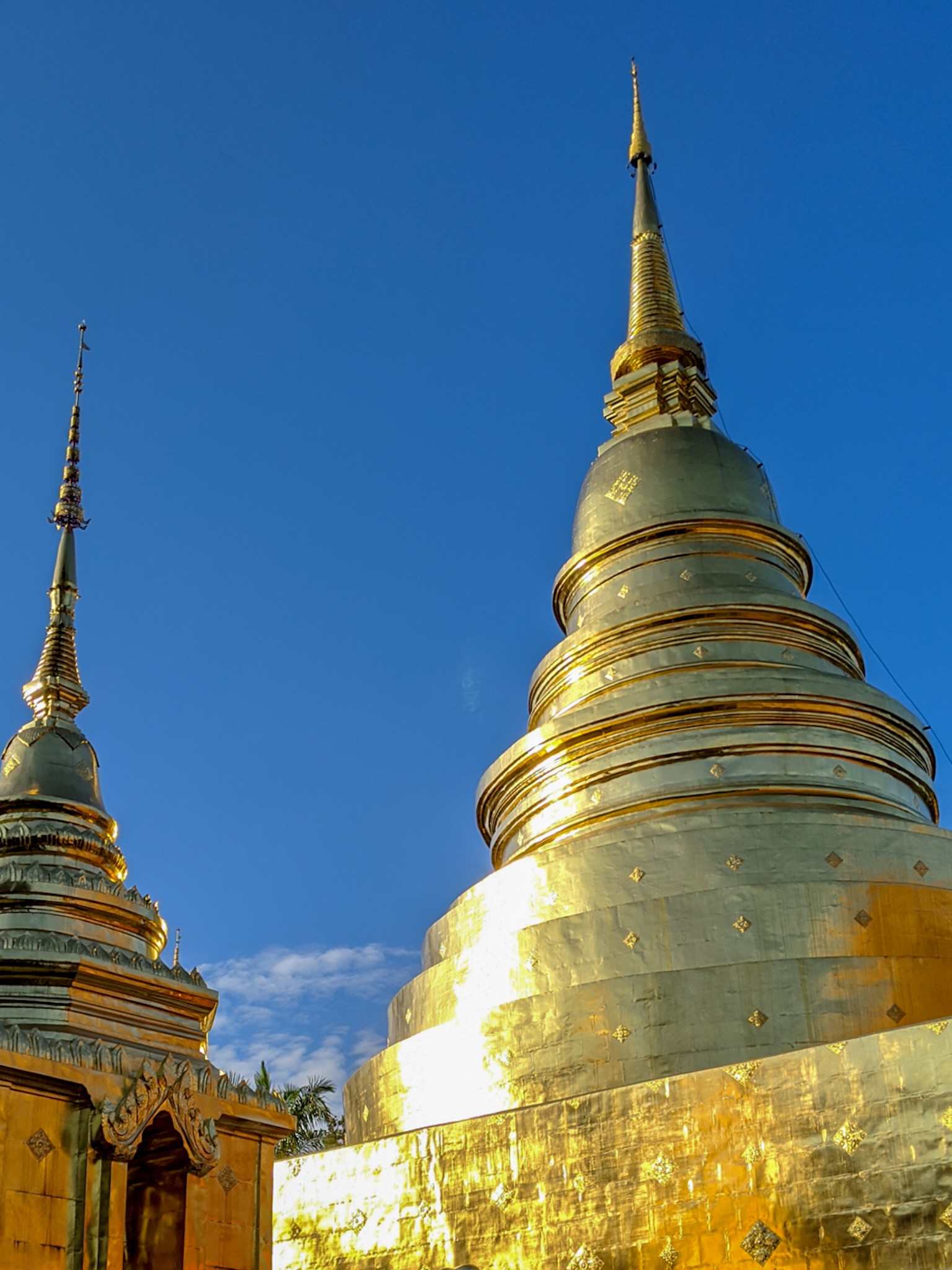
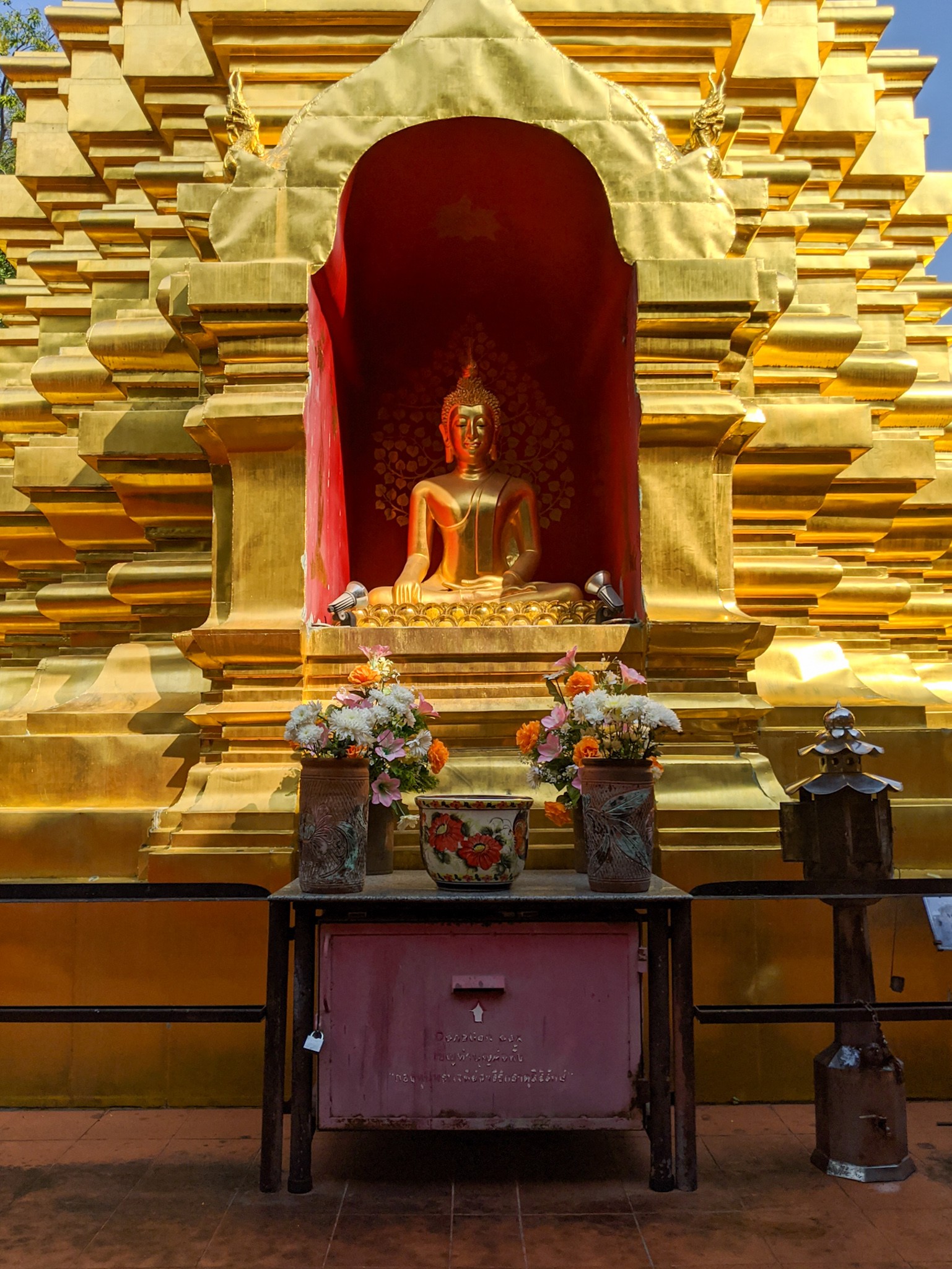
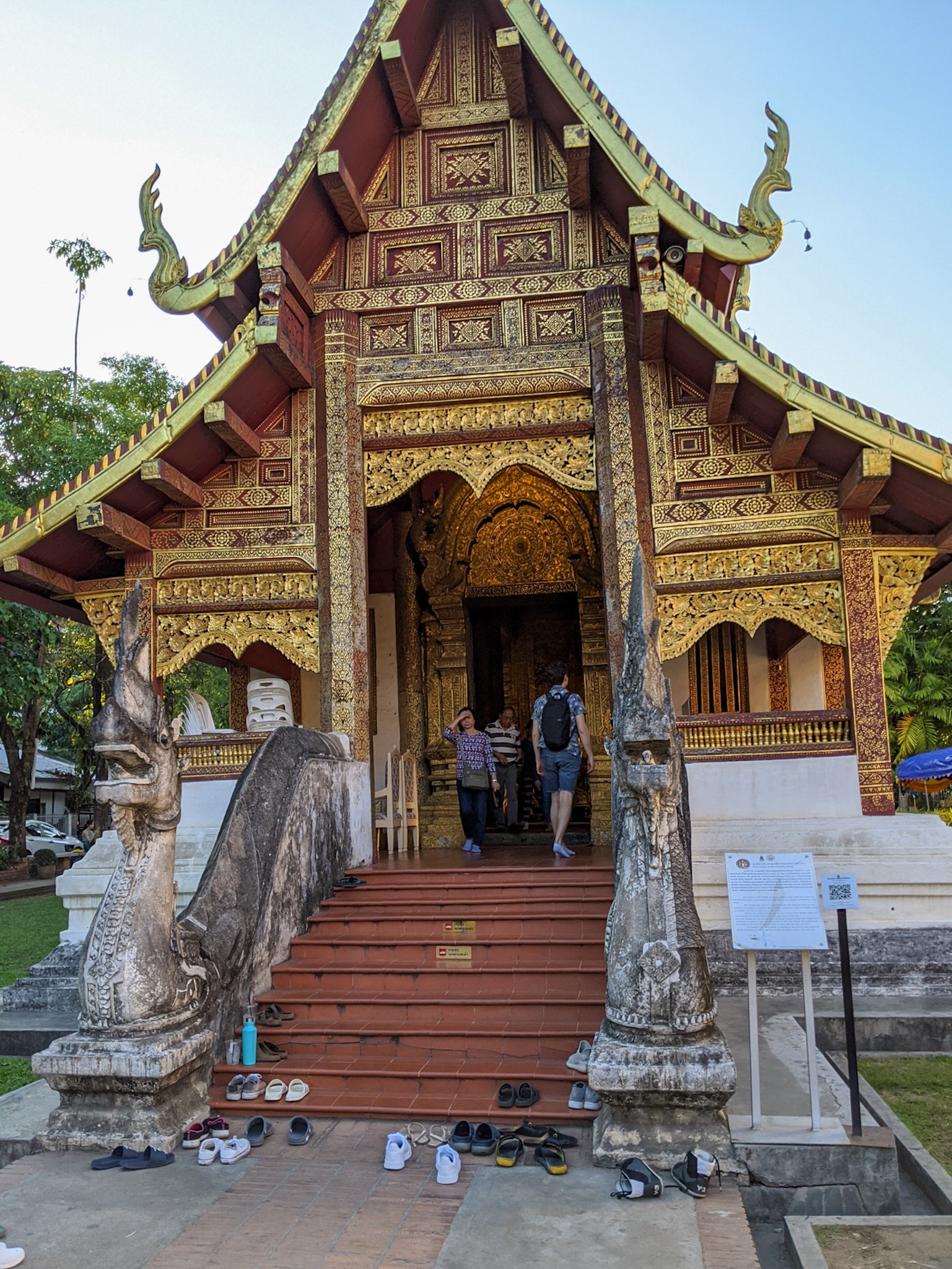
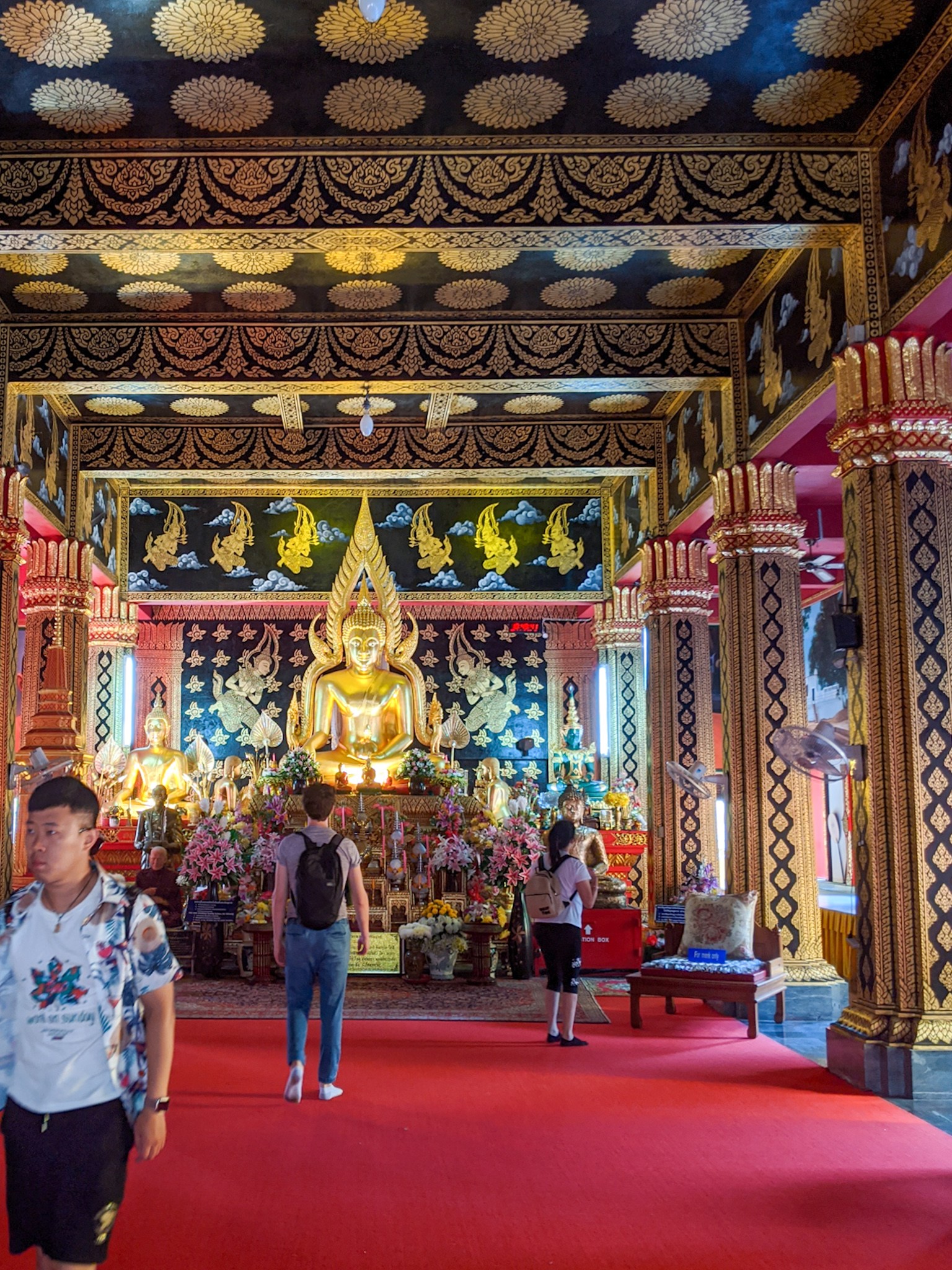
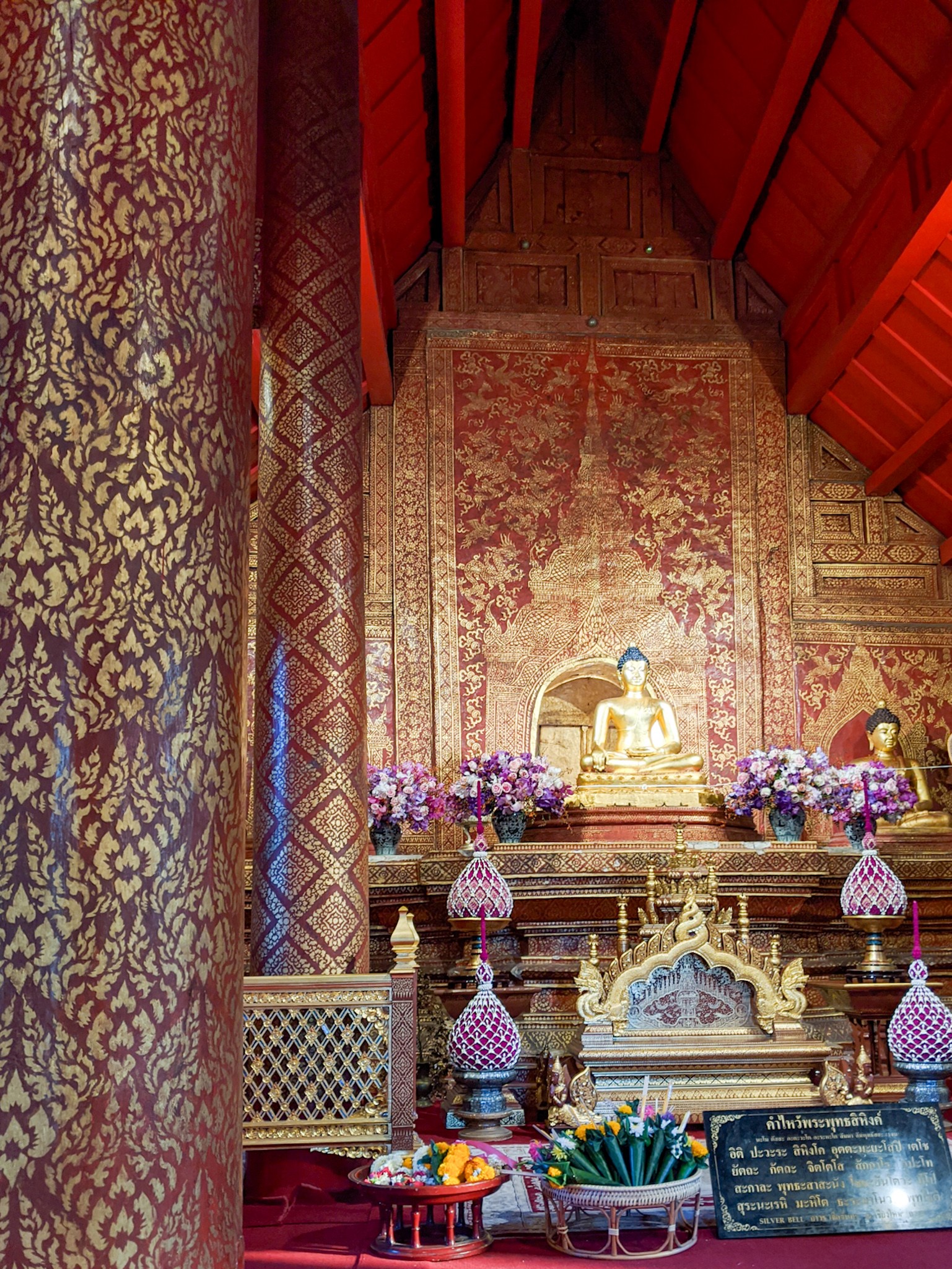
Wat is the Thai word for temple, and Wat Phra Singh is probably the most famous temple in Chiang Mai proper. It was been granted “royal temple of the first grade” status by a former king, which is basically like the 3-Michelin stars of Thai temple designations. It’s actually more of a temple complex with one large building and several smaller structures surrounding. However, the main attraction, arguably, is the gigantic, entirely gold-leafed chedi and it’s three smaller siblings. Either that or the Phra Singh Buddha, which is enshrined in a structure with gorgeous, centuries-old, hand-painted murals lining all of its walls.
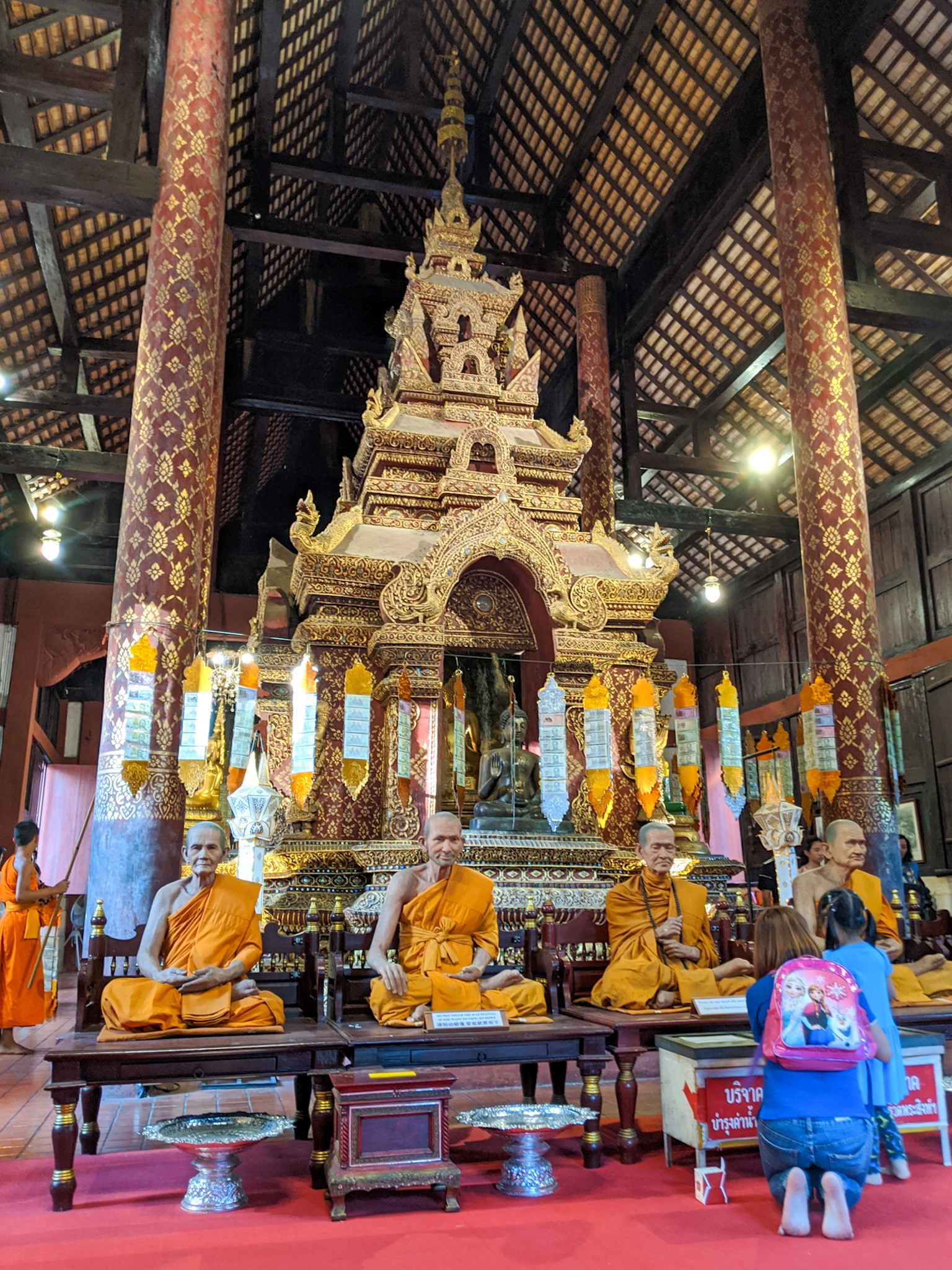
When Aaron and I came, we started by paying our respects to him. He is truly beautiful, even if shrouded in mystery (people are not really sure where the Phra Singh Buddha is from, what his significance is, or whether this statue is even really him; there are at least two other statues that claim to be the Phra Singh Buddha, and rumor has it this particular one’s head was stolen, but the temple hasn’t ‘fessed to it). We happened to arrive right as a service was starting, so even though we tried to do a quick meditation, I was a bit distracted by the loud-speaker. It became much more pleasant, though, when the monks began chanting. We visited an extremely large reclining Buddha in another structure and circled the enormous chedi while enjoying the monotonous Thai hum. Finally, we popped into the largest structure, where we were surprised to find four aged monks sitting side-by-side in a row, staring forward, placid and entirely still. Too still. “Are they going to blink or what?” I thought, as I approached. A sign told me not to touch them and that if I wanted to look at them, I would need to sit. And that’s when I realized they were wax, but not before pondering if they found it rude for people to stare while standing.
On the walk back to Awana House, we stumbled upon yet another temple. They are everywhere here. The only buildings more abundant than temples in Chiang Mai are coffee houses, and it’s pretty neck-and-neck. This one was empty, which was a relief after vying for space at the very crowded Phra Singh. We took a few minutes to meditate and enjoy the feel of the balmy late-afternoon air, then returned to our room to prepare for the evening’s events.
We had tickets to the Old Chiang Mai Cultural Center’s Traditional Khantoke Dinner Show, so we put on our nicer clothes and went to find a rot daang. Rot daang, or red trucks, are usually the cheapest way to get around in Chiang Mai. They are exactly what they sound like– red pick-up trucks– but the back has been converted to a covered seating area with a bench running along the length of the truck-bed on both sides. The front desk clerk told us to expect to pay about 50 baht, but haggling is common here, so I didn’t bat an eye when the first driver we approached quoted 100 baht. For a second, I forgot how haggling works and countered with 50 baht. The driver laughed and shook his head in a way that seemed to indicate he was pleasantly surprised that a white tourist was haggling with him, like I was a chicken that could do sums or something. “80 baht,” he said. “Erm, 50 baht?” I sputtered out, knowing I’d already messed up. This wiped the smile off his face. I had offended him. Whoops. Oh well. Move on to a different driver. But he was not to be deterred. He brought over another driver and asked him how much he would charge, which was, of course, 80 baht. I walked away embarrassed I’d failed at my first Thai haggle. Aaron was pleading with me to just pay the stupid 80 baht. But it was the principle of the thing! Our front desk clerk had said 50 baht! “You’re arguing over 99 cents, Anna,” Aaron reminded me, as another driver approached. Our last guy had been wrangling other drivers to tell them how crazy I was, and one tuk-tuk driver was prepared to go down to 70 baht. When I told him what our front desk clerk had said, he got upset. I was really botching this. Aaron looked at me, pleading, so I caved. On the way to the show, I googled what was a reasonable price: 100 baht. Sigh. My wounded pride. Not to mention these poor drivers who were just trying to make a reasonable wage. Lesson learned: google it first.
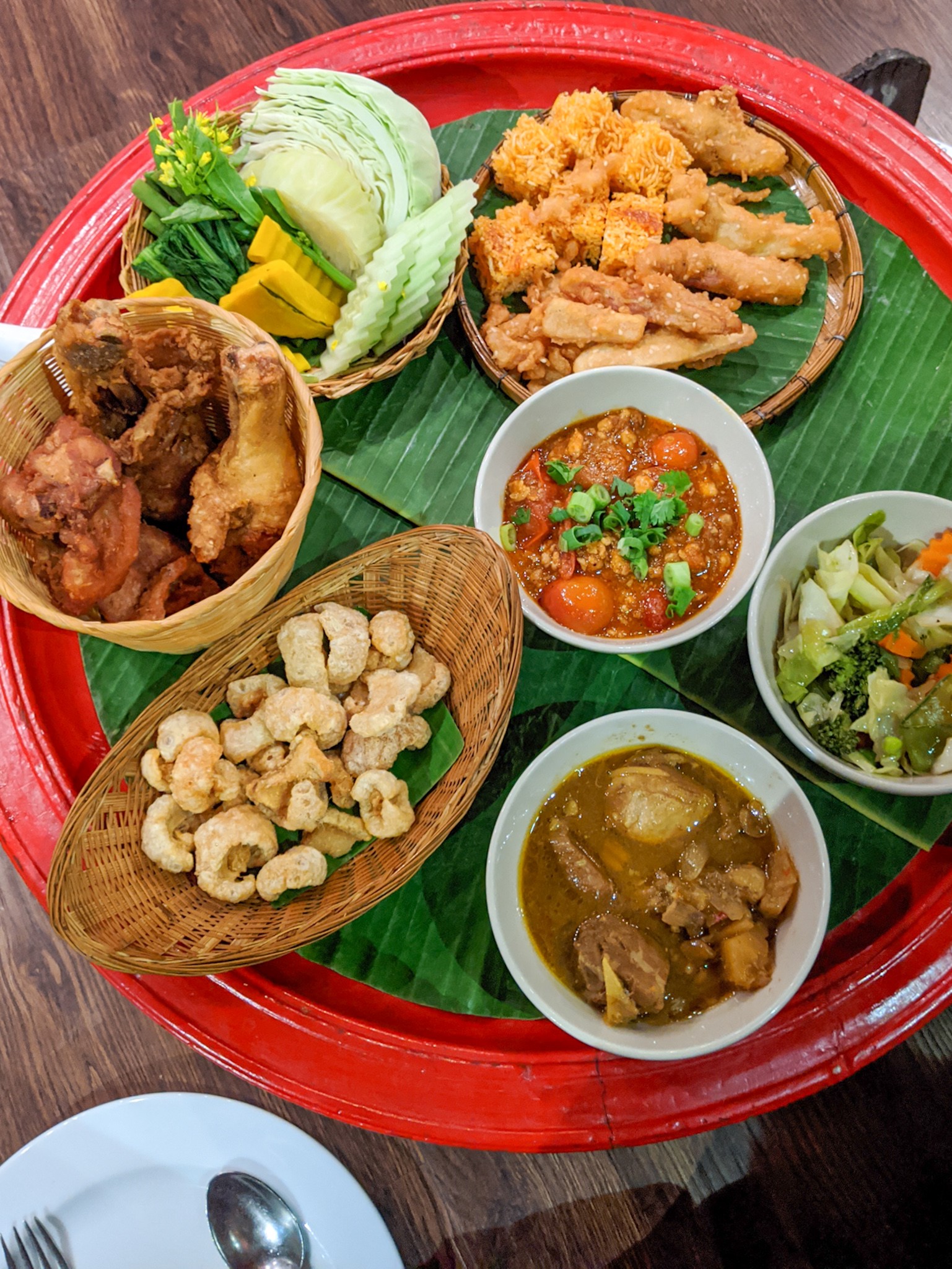
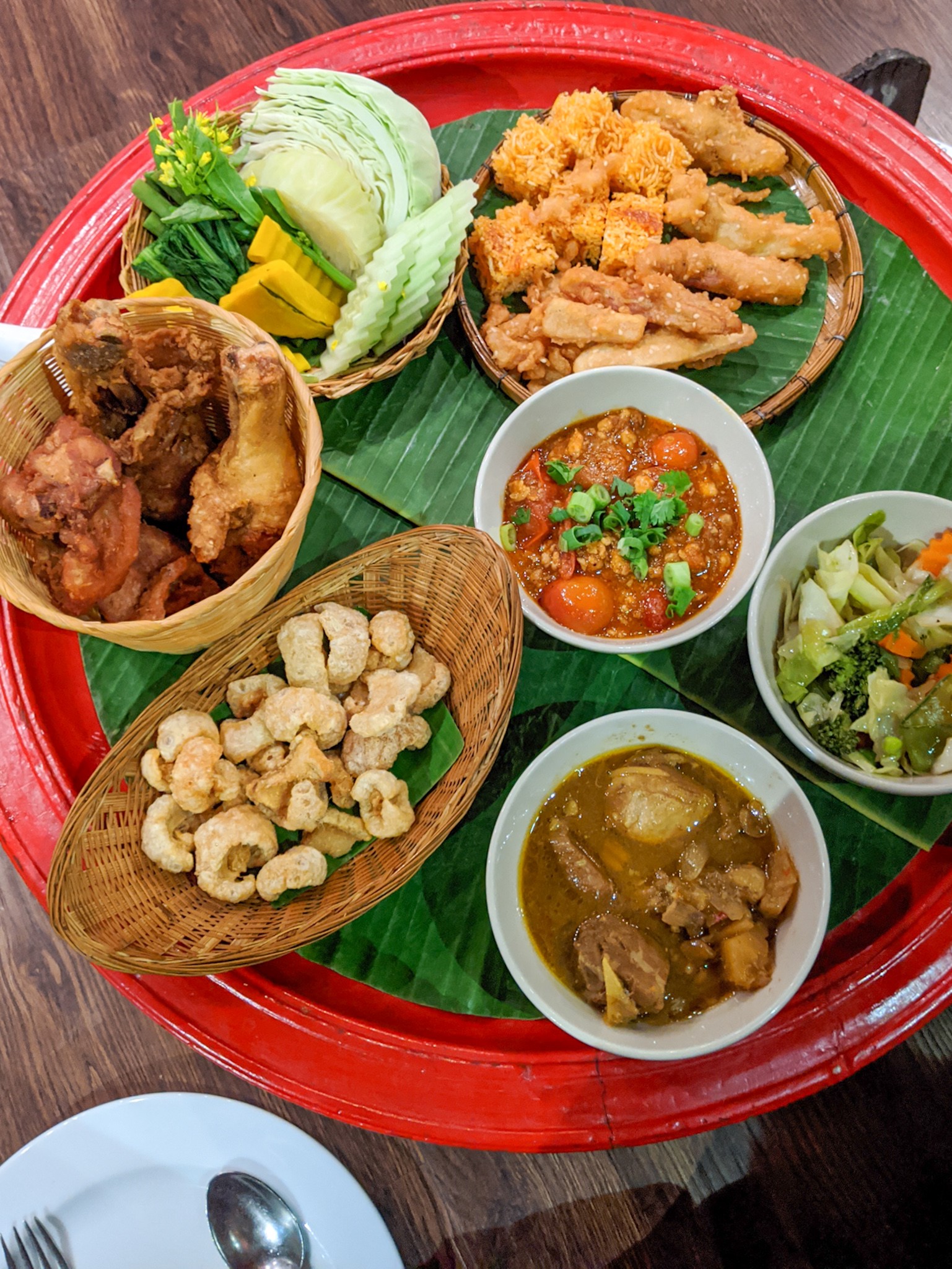
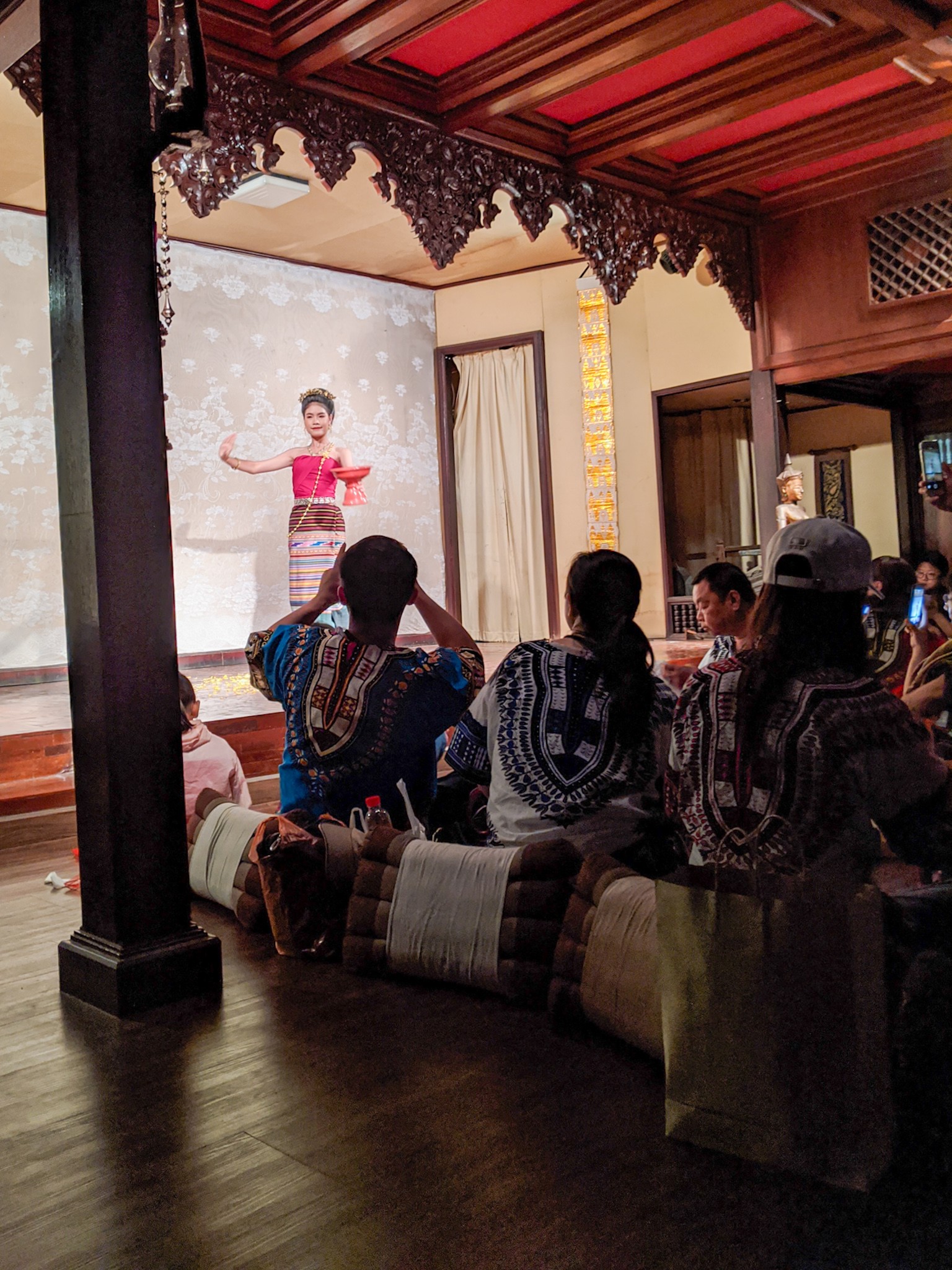
A somewhat tense tuk-tuk ride later, we reached the Cultural Center. We were greeted with a circle of dancers dressed in traditional Lanna garb, walking rhythmically to the sound of a banging drum. Lanna, by the way, is the name of the 13th-through-18th-century kingdom that spanned what is now northern Thailand, uniting several peoples under its banner. To call something Lanna, then, could refer to a lot of different time periods and peoples, but my understanding here isn’t very nuanced, so I won’t try to get too particular. We were led into a teak Lanna-styled room and given floor pillows to sit on. They then brought us a tray of Northern Thai specialties that I won’t even pretend to know the names for. Veggies boiled in a buttery broth, minced pork (I think– I don’t know: it was minced), beef curry, fried bananas, pork skin chips, and some sort of chewy, sweet, rice noodle cubes. Well, I could name one of the dishes, actually, because I’m pretty sure fried chicken is called fried chicken everywhere. After dinner, the show began. A so-beautiful-I-thought-about-shielding-Aaron’s-eyes young lady performed intricate hand movements to the music of traditional strings and cymbals. She would dance several times throughout the night. Her dancing was much like ballet–controlled, feminine, graceful–but if the emphasis were on the hands and arms, rather than the feet and legs. Even her blinking was deliberate and slow. The male performer made a striking contrast. He performed several militaristic dances, sweeping his swords in broad twirls and leaping wildly. They shared skill and grace, though, and both were extremely entertaining. At the end of the show, the performers came into the audience and chose onlookers to perform in the final dance. The female dancer walked straight to me and wai-ed (a common Thai gesture of greeting and respect where you press your hands together and bow your head). I wai-ed back, both terrified and flattered to be chosen. After I’d embarrassed myself thoroughly (Aaron has a video if you insist on mocking me), we paid what I now knew was a fair fare of 100 baht to return to our guesthouse and slept.
This morning, after another latte at Coffee Plus during which Billy the soi dog graced us with his presence, we stopped in Wat Phan Tao and another temple I didn’t get the name of, and ooh-ed and aah-ed over yet another couple of giant golden chedis. I think I might be getting a bit of chedi fatigue at this point. But Phan Tao also had a lovely wicker number that was a refreshing change.
After, we decided to make the journey to Sticky Falls, or Nam Tok Bua Tong if you’re a local. First, though, we would have to get some lunch in us, and we knew exactly where we wanted to do so. Khao soi is the local dish to try in Chiang Mai, and Khao Soi Lam Duan Fah Ham is the place to try it. The sesquipedalian-ly-named shop is in the northeast corner of Chiang Mai, an area known as the khao soi ghetto because of the abundance of khao soi hawkers. Lam Duan Fah Ham is, according to all the guidebooks, the best of them. Getting there was an adventure in itself, since (parents, please skip the rest of this sentence) Chiang Mai has very few stop lights, crosswalks, or even sidewalks, and everyone drives a bit crazy. But we managed to make it there in one piece. Or at least, we think we did. It didn’t have any signs in English, but Google Translate assured me the Thai on its sign read “Lam Duan Fah Ham.” This khao soi was my favorite dish I’ve had so far on this trip. Coconut milk, yellow curry spices, pickled mustard greens, lime, shallot, and rice noodles stewed together to form a salty, savory, sweet, sour, and very, very, VERY spicy soup. Did I mention it’s spicy? It’s very spicy. Aaron and I were both sweating and taking frequent breaks for water, but I couldn’t stay away long because it was so yummy. I finished Aaron’s for him because it was too spicy for his palate (more evidence that women have a higher pain tolerance), and we walked back to the main road to flag down a rot daang.
And that was day 2. Tomorrow, I’ll tell you all about the Sticky Falls we visited and may even explain what the Sticky Falls are.
 Hanoimoon
Another amazing adventure! You’re so brave to get up and dance!
LikeLike