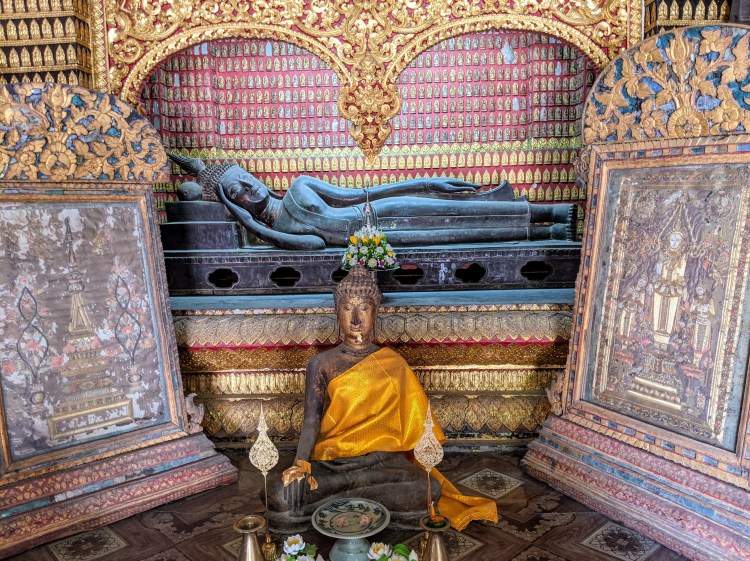
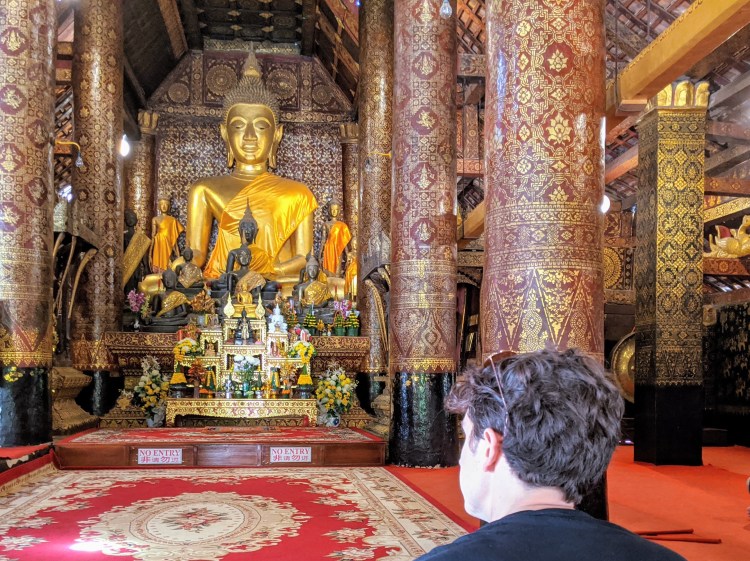
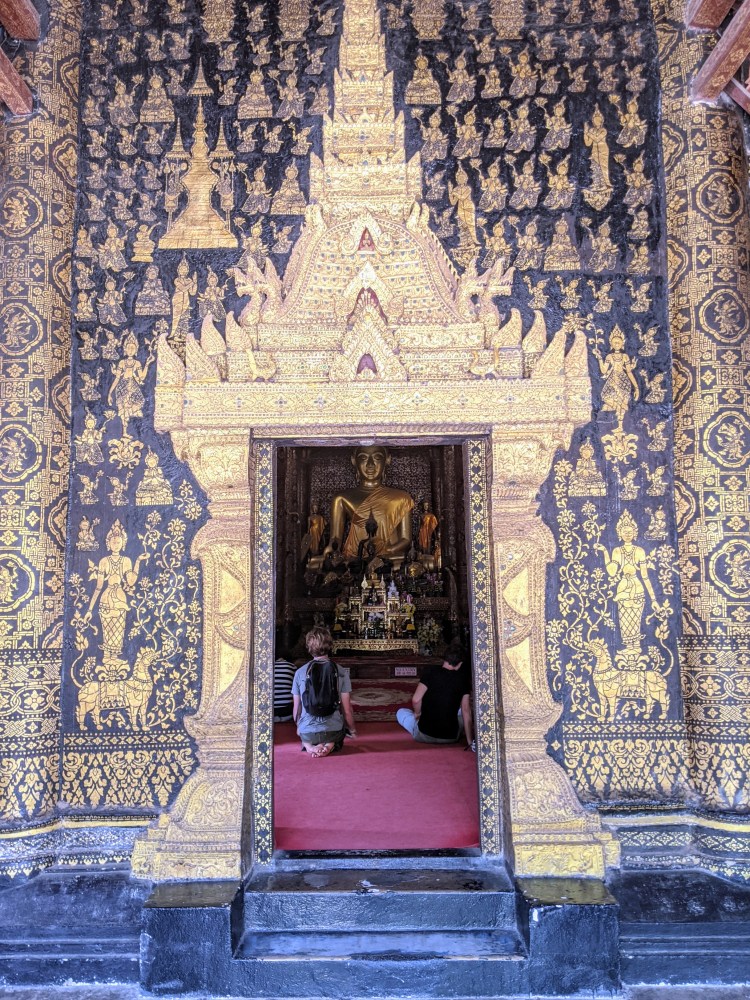
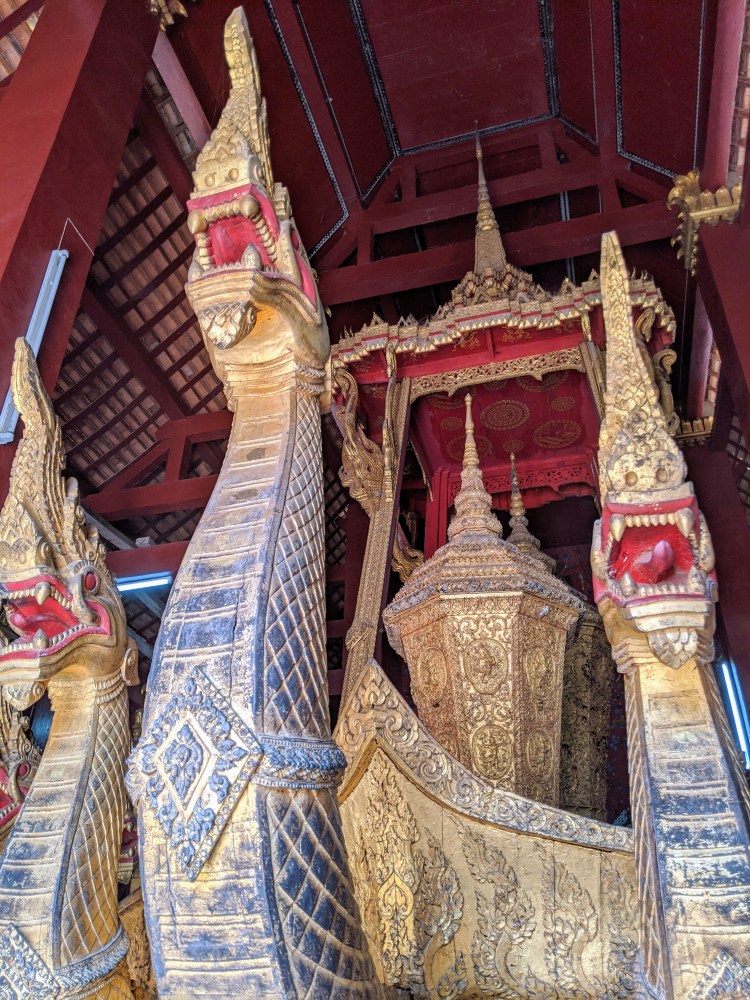
Wat Xieng Thong is a temple with a lot of historical significance for the Lao people. Prior to the establishment of the Lao People’s Democratic Republic (the current ruling body), it was a royal temple under the patronage of the king. It served as a place for Lao kings to be crowned, and still houses the funerary carriage and several royal urns. It also contains a rare Buddha in repose from the 16th century, when the temple was built. We saw all this and more during our visit. The wat (or vat, as they are sometimes called in Laos) was just as elaborately ornamented as the temples in Thailand, but there were quite a few differences to appreciate. Firstly, it was much darker than many of the temples we have visited; several of the buildings were covered in a black lacquer with ornate gold stenciling. Secondly, there wasn’t an excess of gold; instead, they used colored glass tiles to decorate their stupas (sidenote: I am still very unclear on when to call something a chedi vs. a stupa) and facades. The tiles refract light at slightly different angles, making everything they adorn appear to sparkle.
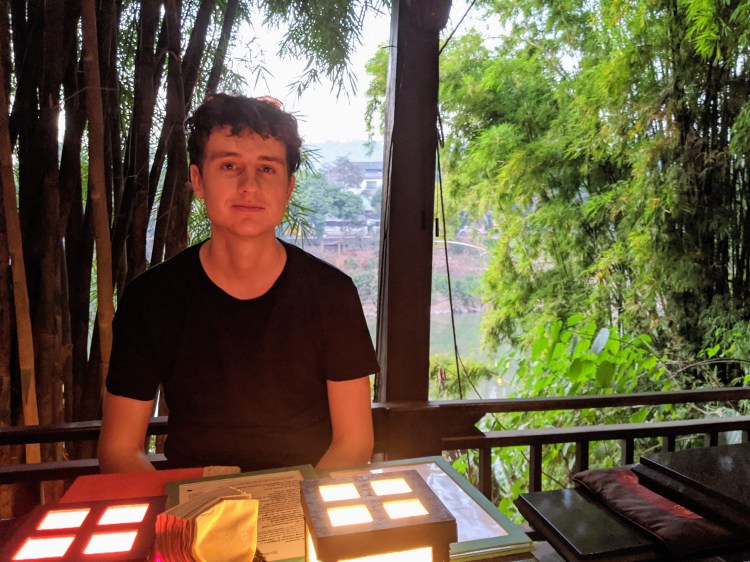
After Wat Xieng Thong, we relaxed at Fan Dee. We found a tucked-away covered deck overlooking the river and had a drink. I had Beerlao, which tastes like any of your standard not-water-but-not-quite-beer beers. Aaron had a piña colada made with Lao Lao rice whiskey, the cheapest liquor in the world. 75 American cents will get you .7 liters of the 90-proof stuff. You get what you pay for with this one.
For the evening’s events, we decided to grab a drink at Bio Bamboo, a restaurant recommended to us by the owner/barkeep of Icon Klub, then make our way over to Dyen Sabai for dinner. Those plans changed, however, when our tuk-tuk driver misunderstood and took us to Luang Prabang’s touristy bamboo bridge. English isn’t as pervasive here as it was in Chiang Mai, perhaps partly due to the fact that many tourists are French. Rather than correct him, we rolled with it. Dyen Sabai was directly on the other side of the bridge anyways. We passed the time with a drink and shared a tapas sampler at Paste. Paste was a little fussy for my taste, but the appetizers were some of the best food we’ve eaten. Luang Prabang’s food scene seems to be consistently beating out Chiang Mai’s. I wish I could tell you what we ate, but it was the sort of modernist fusion cuisine that read more like a novel than a menu. Something about quail eggs, maybe?
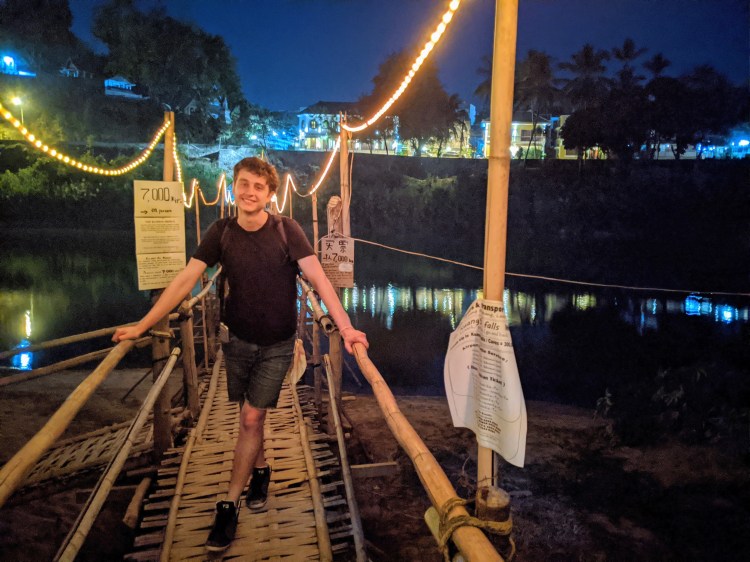
After a glass of wine, we walked across the tourist trap known as the bamboo bridge. It was, admittedly, fun, a little thrilling, and photogenic. Our restaurant was waiting on the other side.
Dyen Sabai had great atmosphere: roofed outdoor seating surrounded by dark wood and orange and red lanterns. We took advantage of their BOGO happy hour, first with pastis, then G & Ts. Ever since our arrival Laos, I had been meaning to find somewhere that served one of my favorite Lao dishes. I first discovered it at Thip Khao, in DC. It’s a kind of dried beef or pork, with sesame and some sort of sweet glaze. Dyen Sabai had the pork version of it, and while it was not as good as Thip Khao’s, it was still chewy, sweet, salty, and delectable. Aaron and I shared some tofu red curry and sticky rice (the superior rice; always go with sticky rice) while we discussed the differences between Luang Prabang and Chiang Mai: the food is better in LP, the people are more friendly in CM. I blame the French influence.
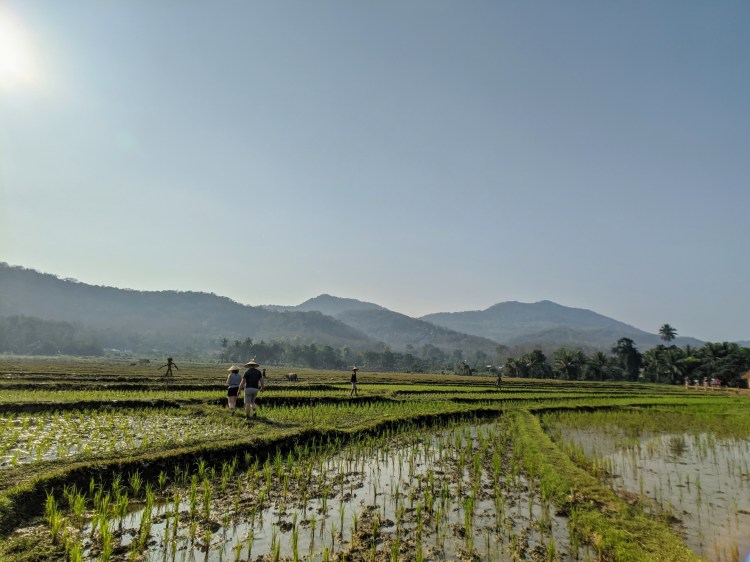
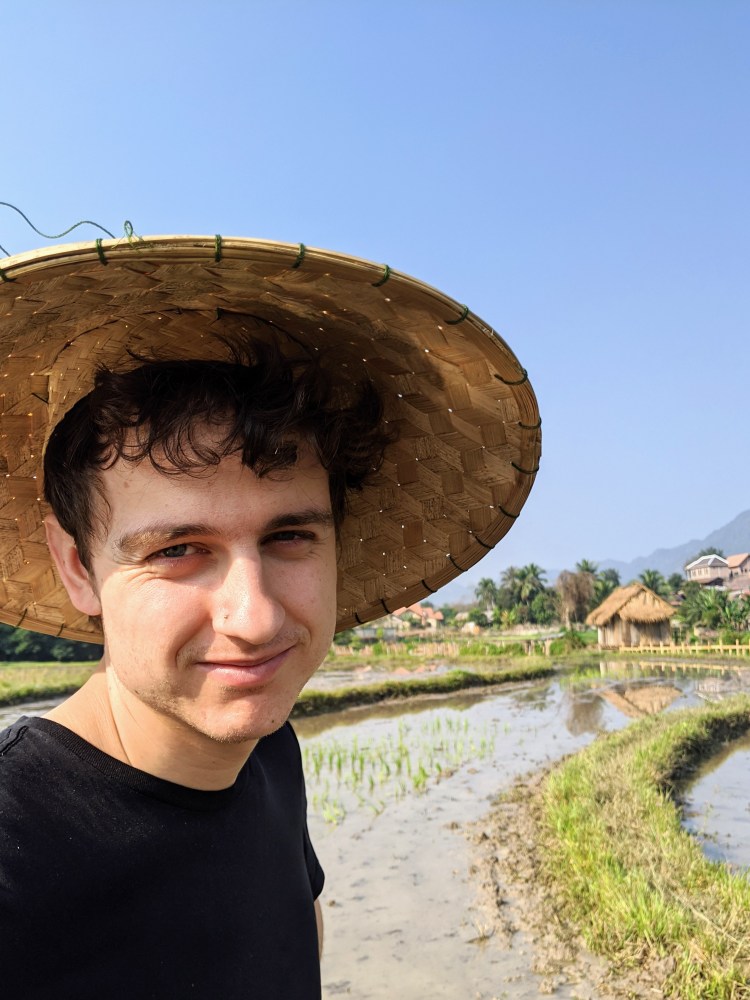
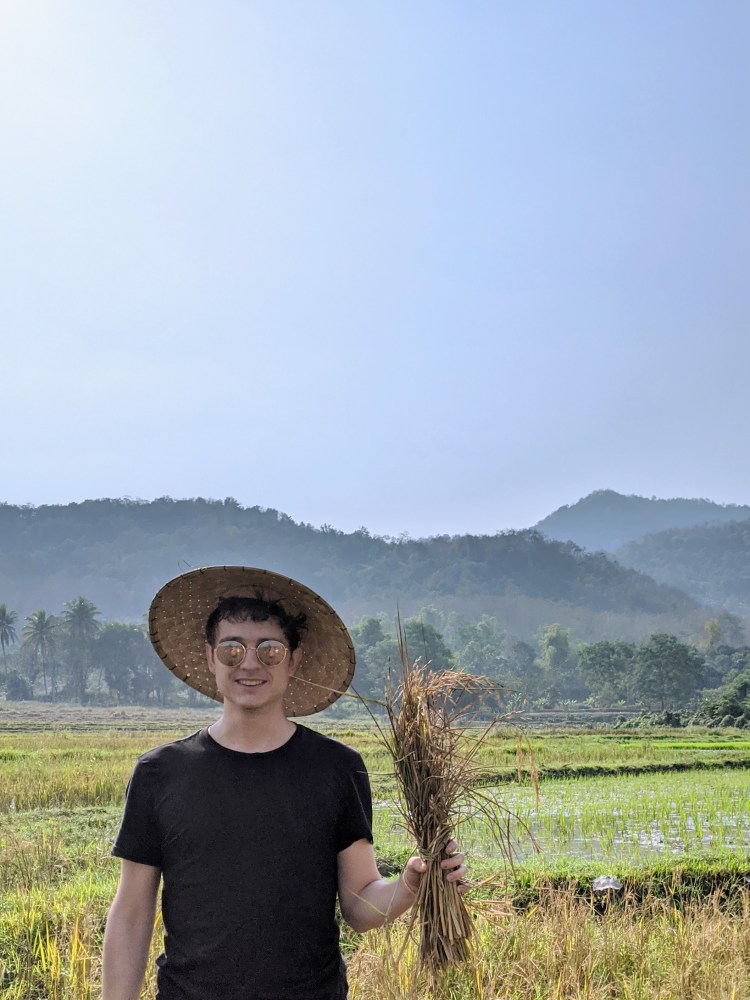
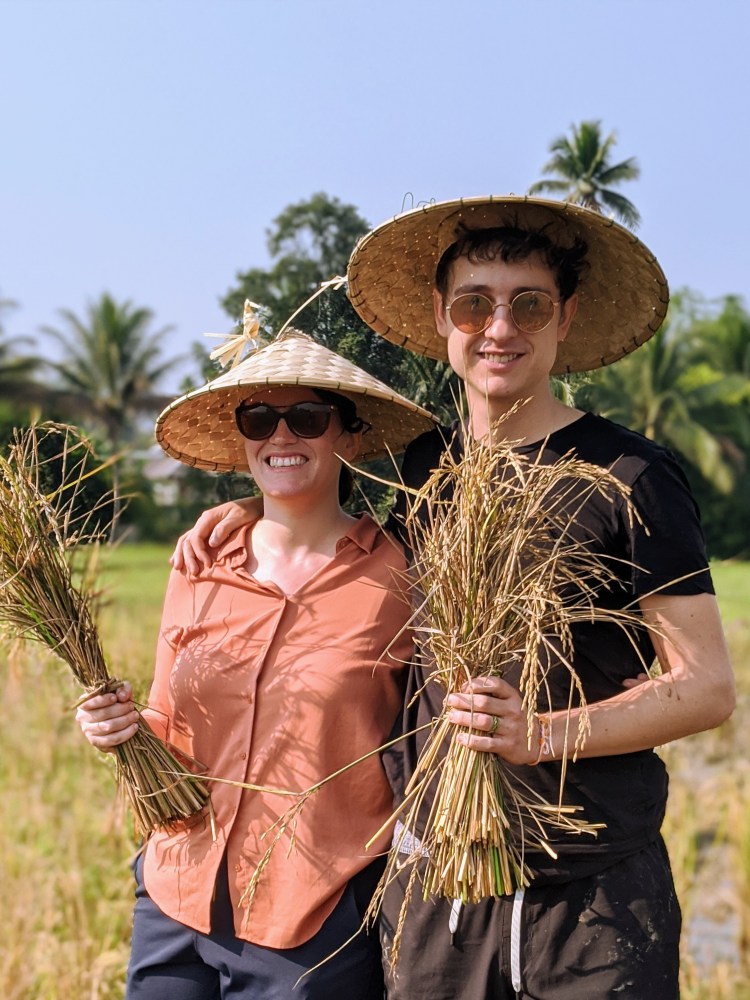
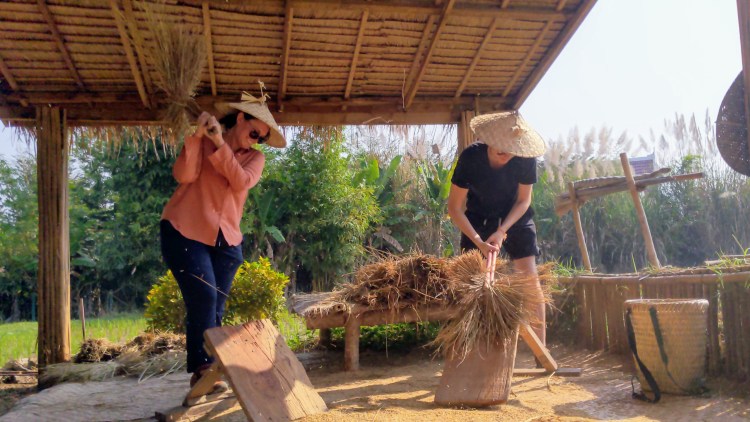
This morning, we woke early to catch our pre-arranged tuk-tuk to Living Land Rice Farm. Not early enough, however, because we had to give up on the omelettes we’d already paid for when our driver showed up. We arrived at the farm without incident, and were greeted by Din, our farm guide, a young, Lao dude with a sense of humor and a tour guide’s geniality. We were to be rice farmers for a day. He handed us some conical bamboo hats and gave us a spiel about the farm. It’s co-owned by 7 families, and includes farms for rice (obviously), sugar cane, pineapple, herbs, and vegetables. After introductions, we were taken to meet the bamboo weavers and given instructions on how to make a bamboo star. I made the best one, if I do say so myself. I have a bright future in bamboo handicrafts. Perhaps I, myself, am the bamboo star.
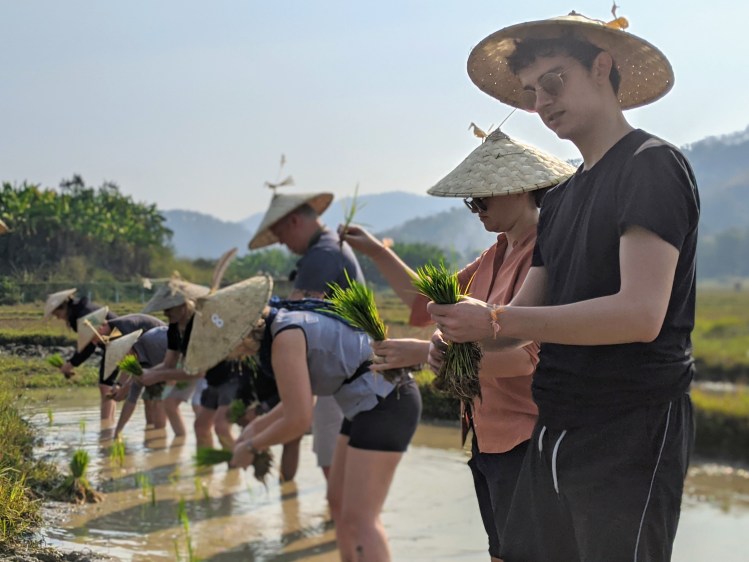
Din showed us how to place an egg in some water, pour salt until it floats, and then place rice grain from the last harvest in it to determine which to plant. The grains that float have air in them, while the grains that sink are good for planting. “Normally, it takes four months to grow and harvest rice, but today, we will do it in three hours. Magic rice,” Din told us.
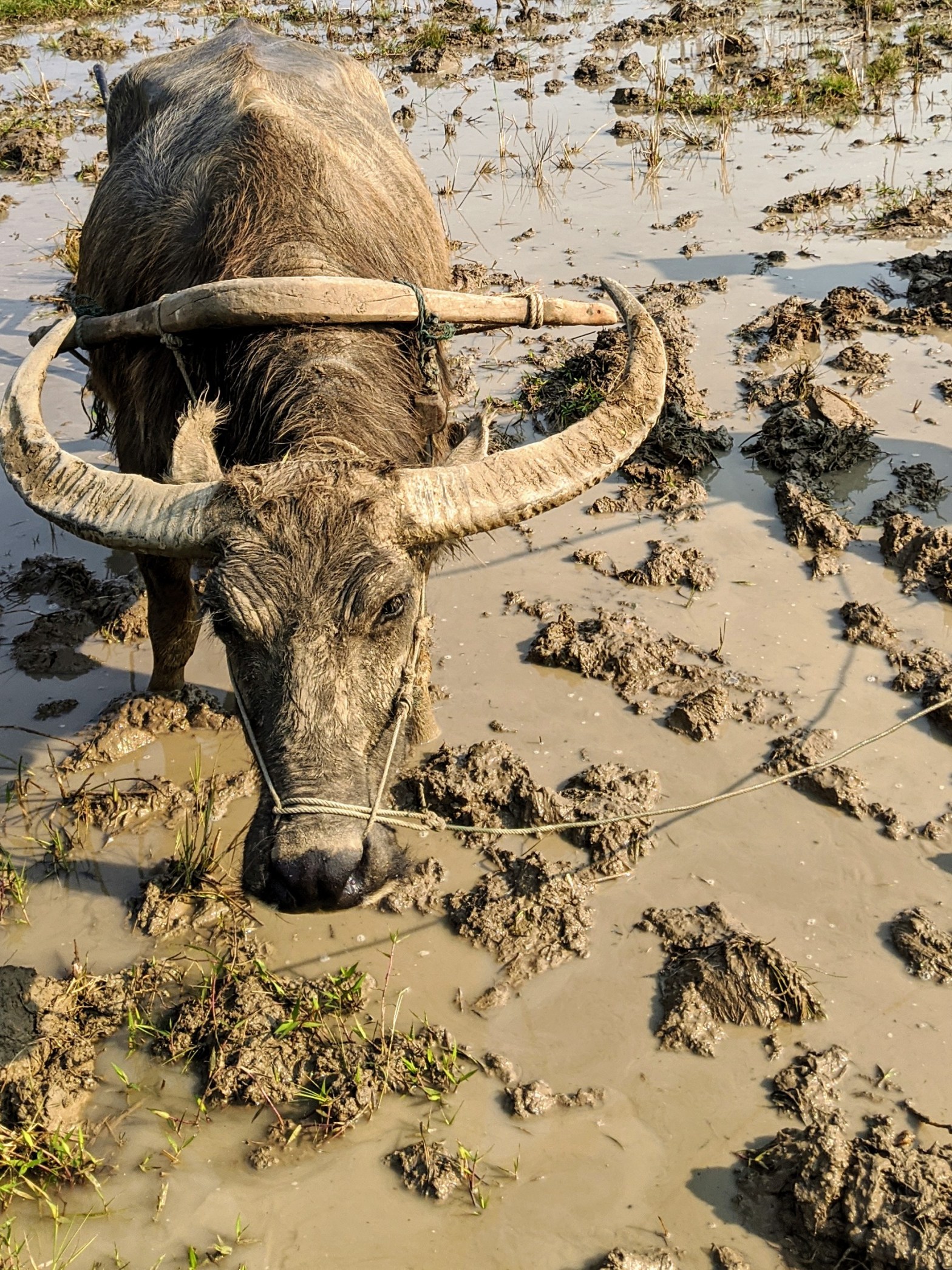
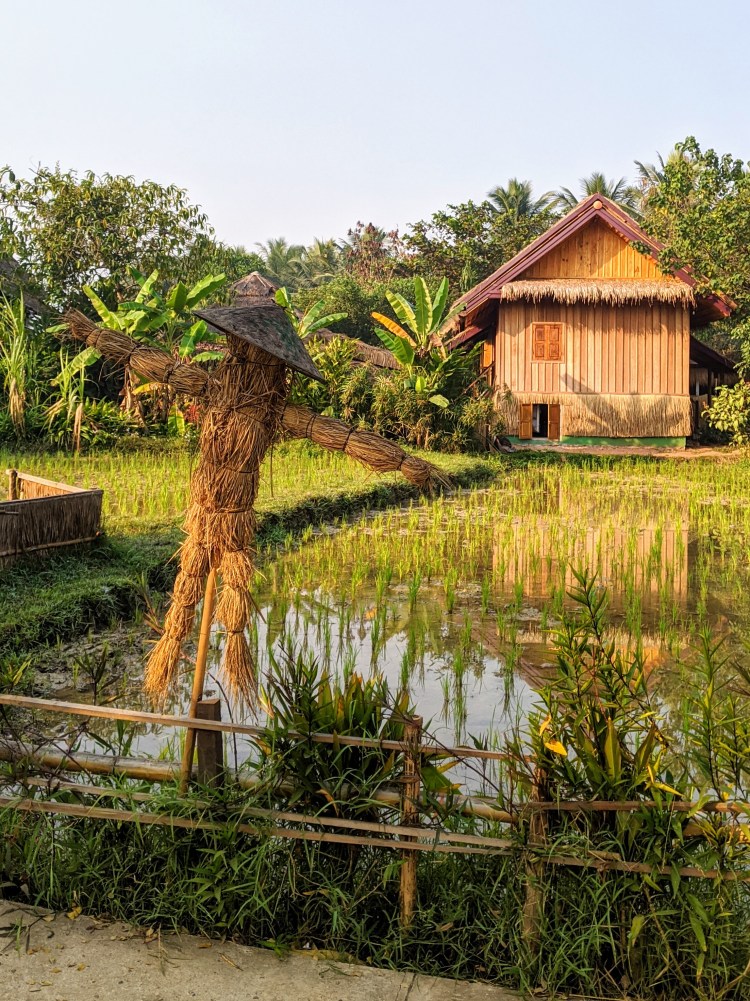
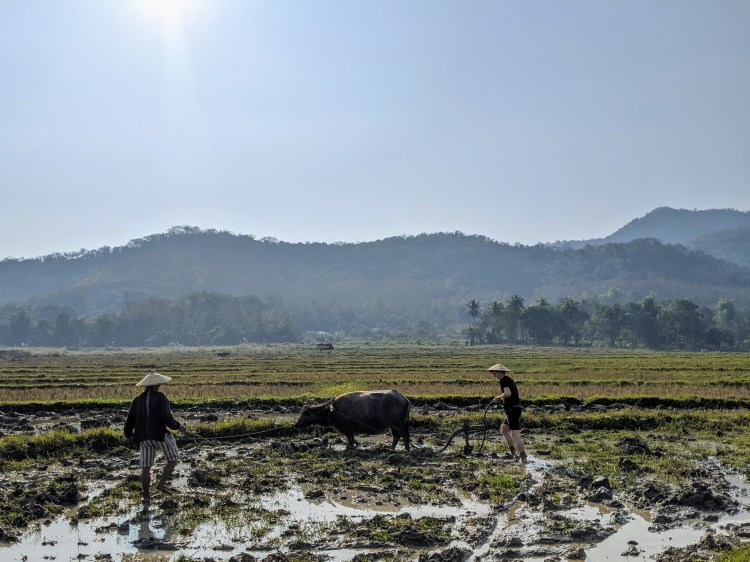
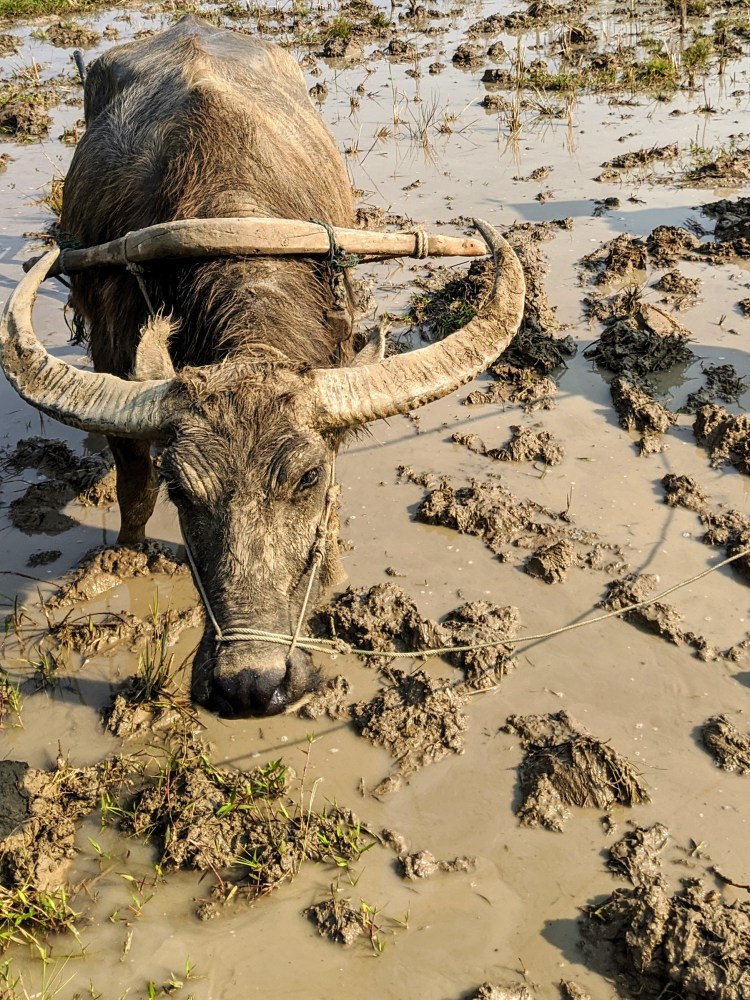
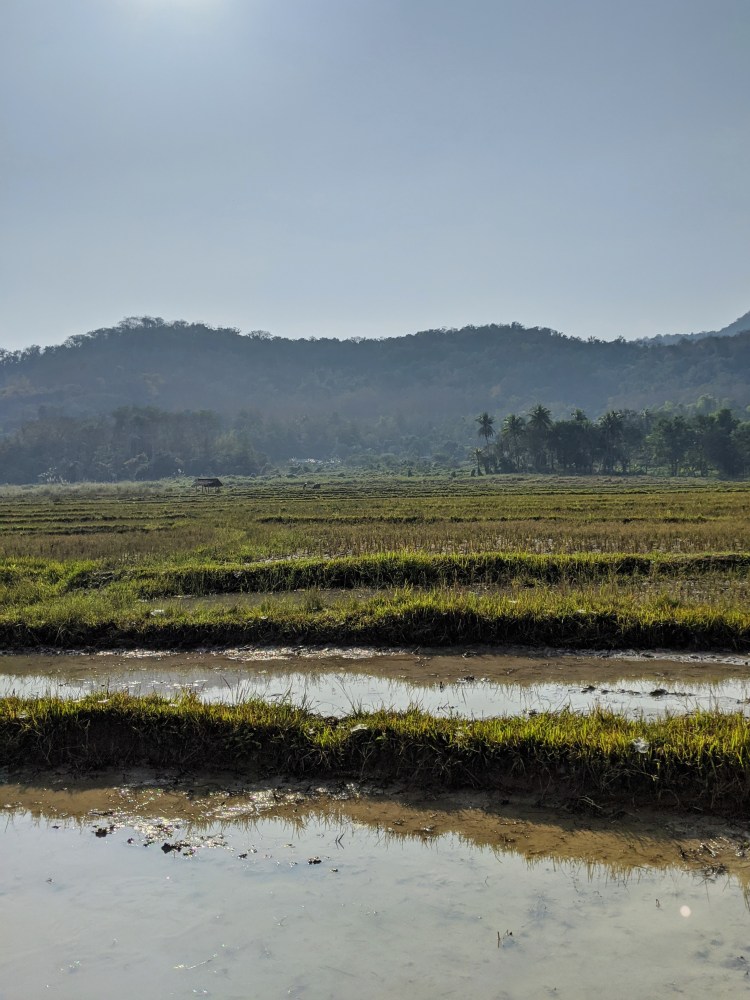
It was time to get dirty. We took off our shoes, and slogged into the nursery paddie, where Din taught us the proper technique for planting rice. Then, he showed us how to plow the leftovers from last year’s harvest using Susan, the beleaguered and adorable water buffalo. I volunteered Aaron as tribute and giggled as he struggled to set the pace with this giant beast. We planted, harvested, separated, husked, and ground the rice. All of this we did in the golden-lit surrounds of this large, open rice farm, actual farmers in the distance silhouetted against the deep emerald mountains. We were rewarded for our labor with fresh sugar cane juice and rice treats of every kind. Aaron and I were particularly greedy with ours, because of the skipped breakfast.
For lunch, we finally made our way to Bio Bamboo. It’s a bit out of the way, even further from the main tourist area than our ecolodge. It’s also aptly named; everything was bamboo: furniture, yes, but also plates, serving mats, bowls, glasses, and tableware. Food was served in cooked bamboo, and cooked bamboo was served as food. We tried the recommended traditional Lao dishes, which I’m sure would have been magnificent if Aaron and I could have handled any more adventurousness in our food. As it was, we ate around most of it and wished we’d ordered vegetarian. The banana blossoms were about the only thing we could stomach.
We returned to Fan Dee to rest up before our hike of Phu Si Hill, but that’s for tomorrow.
 Hanoimoon
You guys are rocking those bamboo hats. You ARE a bamboo star! 😂 It’s fascinating to read about your experiences and impressions.
LikeLike