During our travels, we’ve witnessed a number of upsetting scenes featuring cruelty towards animals (skip the rest of this paragraph, if you’re sensitive to animal cruelty). We’ve seen Couscous, our favorite Laotian dog, beaten until he whimpered for chewing at his casted, broken leg. We saw a monkey indefinitely tied to a tree in a backyard on a 5 foot chain, a hellish fate for such a social animal. We’ve seen chickens in tiny cages at a bustling market, literally piled atop each other. Fish in a bucket of water, deep enough to keep most of them alive, but shallow enough to keep all of them almost dead. And scores and scores of malnourished, mangy street dogs–as friendly as if they were homed, even at the brink of death. Sometimes, we’ve even been brought to tears by the things we’ve seen.
Last night, we came upon a pug sitting under a street vendor’s table. When we asked her owner for permission to engage, she gave us a confused nod–a confusion which we initially attributed to language barrier. But her eyebrows only furrowed deeper as we bent over to pet her pet. As soon as we touched the dog, it went absolutely buckwild. It was like our dogs when we get home from an especially long workday. As wads and wads of hair peeled off with each stroke, it became clear that this simple show of affection wasn’t a regular part of its life. This dog was hearty, hale, and starved for attention. As our tour guide to Trang An told us, dogs just aren’t pets in Vietnam (though that fact is changing). It may have been the reminder of our own much-missed pugstrosity Bob, or just the unbearable normalcy of the situation, but this one really tore us up.
This is not to say that Southeast Asia is more cruel to animals than the United States. Much to the contrary, in fact. Considering that 60% of mammals on Earth are livestock, and there are about three livestock animals per person, we can probably conclude that agricultural animals comprise the Lion’s share of living domesticated animals. And there can be little debate that animals in factory farms are subject to abysmal conditions of abuse and neglect. With the United States consuming more than twice the meat, per capita, of Vietnam and Malaysia, and more than four times that of Indonesia, Thailand, Cambodia, and Laos, it’s fairly certain that the United States carries out far more animal cruelty than Southeast Asia (Note: I hate to rely on so many extrapolations. Abroad and without my computer, it’s difficult to research much deeper than Wikipedia. I’m trying to limit myself to self-evident assumptions).
Still, the witnessing of cruelty and neglect in the open has been eating at both of our brains, and I imagine that we aren’t the only ones. While the abuse may be less widespread, it is certainly more visible. This may harm both non-human and human animals alike.
What’s often left out of the debate about animal cruelty is the effect it has on its witnesses. Research has shown that witnessing animal cruelty has a profoundly negative effect on children. Children, particularly in difficult situations, confide in pets and see them as family members. When they witness the abuse of those same animals, they are often forced to harden themselves to the very creatures they consider family. Others may just be haunted by memories. “I remember my mother selling my dog to the neighbour for dog meat. I saw him drowned and cried for him to be saved. I’m still haunted. I love dogs and will never eat dog meat.” said Ngoc Linh, a young Vietnamese woman.
Perhaps even worse than the effects on witnesses is the effect on perpetrators. When I see videos of factory workers excessively prodding cattle, or fur traders skinning live animals, my first response is self-righteous anger. But upon consideration, it’s hard to stay angry, given both my own culpability and the basic fact that nearly every one of us would do the same given the same conditions. Farm workers are people like you and me. They have families they love, friendships they cherish, and often pets they love and care for.
Yet each day, they are compelled by supervisors and economic necessity to be villains in the lives of thousands of animals. This sort of dehumanization has deep and lasting effects on perpetrators and their communities. After controlling for many demographic factors, US counties with slaughterhouses suffer violent crime arrests at four times the national rate.
Having worked in science and witnessed (and perpetrated) things that I would consider necessary evils, I’m familiar with this pattern. What kept me up at night early in my studies was cold and routine by the end. While I wouldn’t consider myself to be traumatized, I lost a certain amount of empathy that I’m not sure I’ll ever recover.
I wonder how the harm we’ve seen in our short stay in Southeast Asia affects both its witnesses and its perpetrators. How do children feel watching their parents beat their beloved pets? How does the normalness of a man walking down a crowded market with terrified parakeets chained to a post affect the locals who know him by name? What’s the human cost of witnessing all of that suffering?
The intuition that originally inspired me to write this post was this: if mistreatment of animals is visible, people will be inspired to action. But the anecdotal evidence doesn’t seem to support my hypothesis. The United States has manifold, if insufficient, animal protection laws. Vietnam enacted its very first enforceable animal welfare legislation in 2018, despite having far more visible animal cruelty. This was a milestone achievement, but also suggests a historical lack of activism and action concerning animal rights. It’s hard to identify the causality in this case; it may be that a lack of activism and legislation allows a greater visibility of cruelty, but it may be that desensitization to cruelty slows action.
Recalling my previous post about morals, culture, and self-determination, I’ve also been thinking a lot about our moral responsibilities as outsiders and witnesses. Anna and I have a running joke since we’ve been here: “It’s our job as tourists to leave a legacy in this country.” A Hanoi scooterist flying through a crowded market (which doesn’t faze locals a bit)? It’s definitely my job to stand my ground and teach him what sidewalks are for. But it’s no laugh when the Hanoi scooterist is a teenager beating little Couscous, earnestly believing that this is an effective and humane way to train him.
Anna earned her PhD in Animal Behavior. She is a professional animal trainer. She can say with near certainty that using punishment to teach a dog is both less effective than reinforcement and has significant side effects (beyond the obvious suffering physical punishment causes in the immediate). Our saying something would, in theory, be beneficial to both Couscous and his owners. From a utilitarian perspective, it seems a very straightforward moral dilemma. An animal is suffering, has no way to advocate for itself, and we are observers with the ability to intervene to the benefit of both parties. The worst case scenario is that someone gets their feelings hurt.
But in these situations, both of us have consistently failed to speak up. In part, that’s just bystander effect: people tend not to speak up in the face of injustice provided there are others around to witness it. Surely someone else will say something, right?
But there’s an additional layer of complexity. If I were a tourist in Cambridge and witnessed a middle class family mistreating an animal, I doubt many would oppose my saying something. But there’s a long history of white people forcing the hands of other cultures on the basis of alleged moral superiority–the proverbial white man’s burden. In response, many on the left, ourselves included, have developed a strong aversion to white folks intervening in the lives of people of color. It’s a completely understandable response to a long history of brutality and self-righteousness. But it seems that, at times, it may discourage individuals from taking action in what seems a morally straightforward situation. If I equate a conversation with peers to imperialism, I may choose inaction at the expense of the very people I’m trying to respect.
However, there’s one other layer, and that’s a simple fact about people: everyone believes their cause to be worthwhile and morally obvious. Evangelical Christians truly believed that missionary work in Africa was saving souls from eternal damnation, even though their work justified atrocious regimes that maimed and murdered countless indigenous people. I’m writing from a country that my own country ravaged in the name of “democracy.”
Scientists are still bickering over whether what animals experience as pain can be called suffering, so can we really assume the minimization of pain towards animals to be a universal moral good? Maybe I’m an ignorant colonialist–and I don’t mean that sarcastically–but I believe that minimizing harm to animals would have far-reaching benefits. Even if animals don’t experience true suffering, the human cost is too great to ignore.
 Hanoimoon
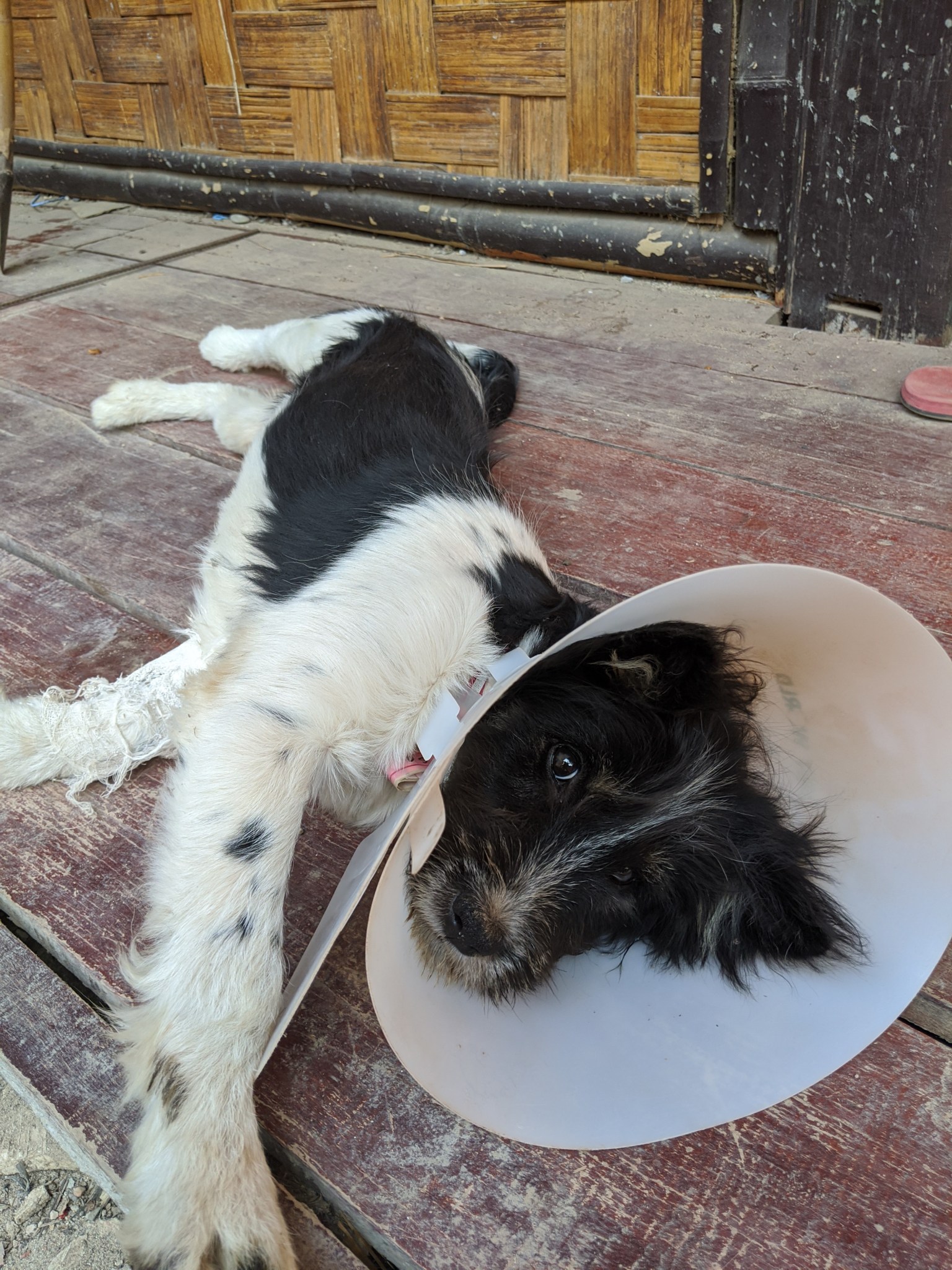
This is so hard to read about. I can only imagine how hard it was for you and Anna to witness and be unable to intervene. I fell in love with your pictures of Couscous in prior posts, and my heart breaks to hear about his suffering.
LikeLike