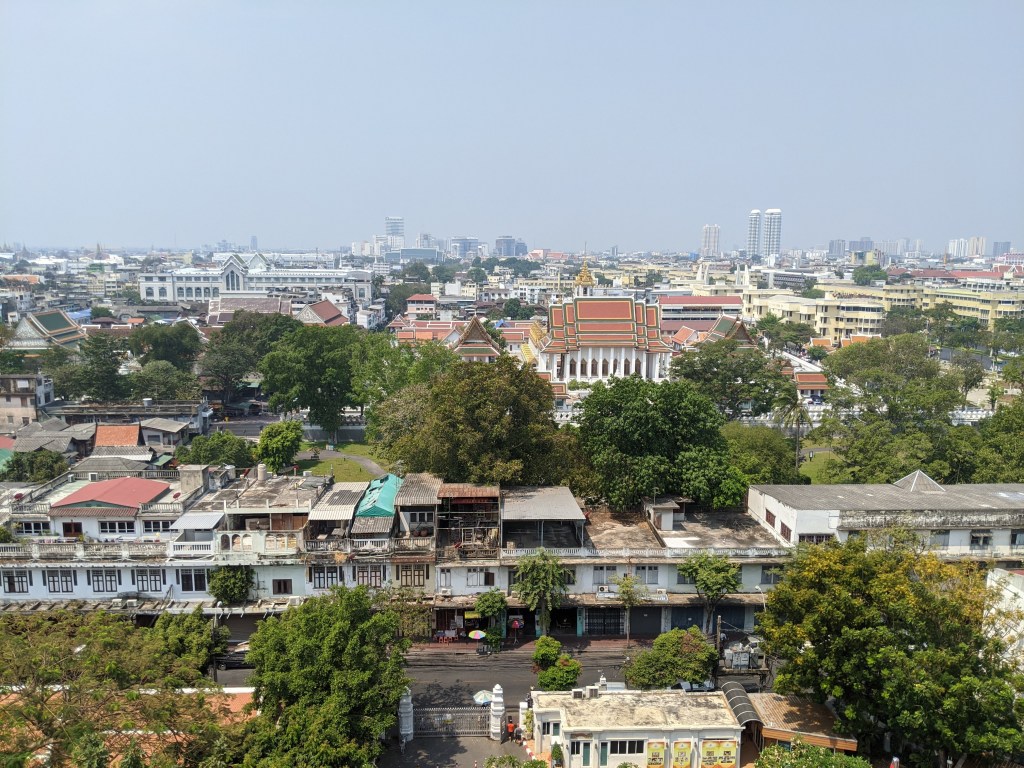
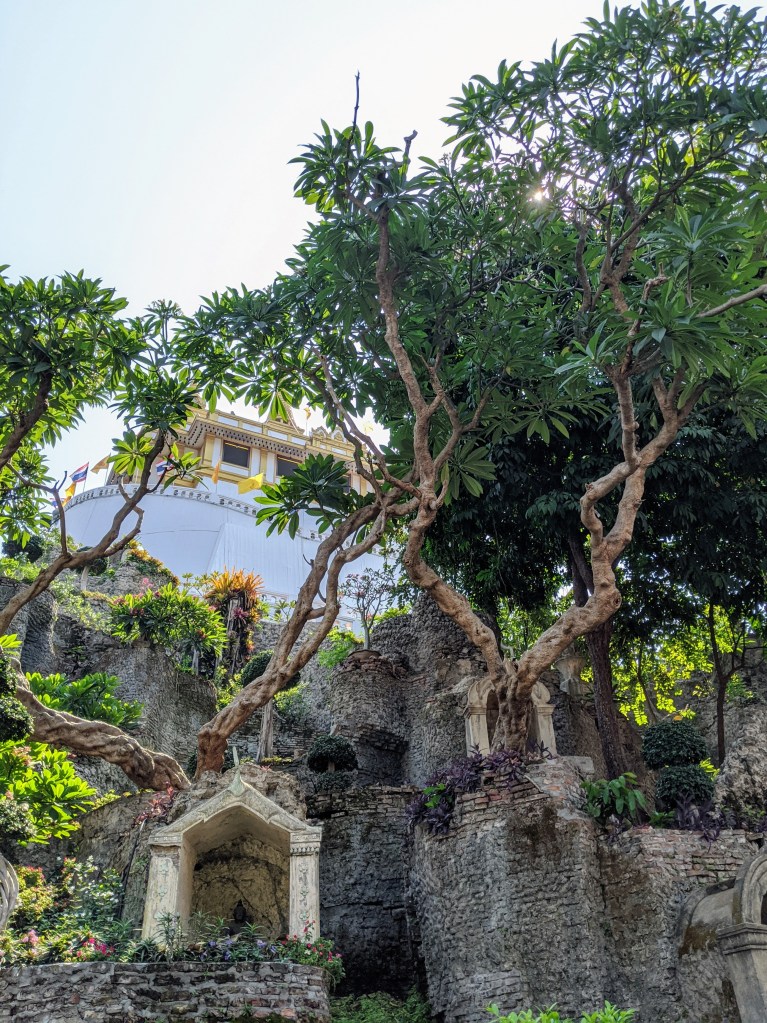
Enough with all these malls. It was time to get serious and visit some of Bangkok’s famous temples. Not too far from our hostel, upon a steep artificial hill, lies Wat Saket. First built during Thailand’s Ayutthaya period (1350-1767), it was later renovated and renamed by King Rama I when Bangkok became Thailand’s capital. Wat Saket is often called “The Temple of the Golden Mount,” because of its steep, man-made hill and the giant, golden chedi at the apex. We began our visit circling the base of the hill, which is surrounded by grotto-like shrines. From there, it’s not too far of a climb to the top, but we decided to stop at the coffee shop just before the peak. We hadn’t had our caffeine yet. Aaron and I whiled away a good chunk of time here, just chatting about some self-improvement projects we’d like to take on in the new year, one of which was meditating more. There’s no time like the present, so after a respectful circling of the chedi, we settled onto a bench and began a meditation session.
This time, instead of metta or mindfulness of breath, I did what I call “inside/outside” meditation. It’s a form of mindfulness that I like to use in areas that are distractingly noisy. If you wish, you may try it as follows: first, find a comfortable position and set a timer for your desired amount of time (if this is your absolute first time, I’d recommend 2-5 minutes). Close your eyes. Take a deep breath in and exhale, then allow yourself to become aware of your body’s position. Relax your shoulders. Straighten your spine; I once had a meditation teacher tell me “your spine should be a balanced stack of golden coins”–I’m still not entirely sure what this meant, but I think of it often when I’m straightening my spine. Next, become aware of your contacts with the chair and/or ground. Feel where your feet meet the ground, where your thighs touch the seat. Now, slowly, open your awareness to the outside world. Feel the air on your skin. Hear the birds or traffic or A/C or whatever your current soundscape is. Since your eyes are closed, I would mostly stick with sound. Once you have more practice, you may try open eye meditation and do this same exercise with visual input–it works particularly well outside on a rainy or windy day, or when looking at a river or waterfall. But for now, let’s use sound. Even in very quiet places, there are constant, subtle changes in sound. Your job now is to tune into those. However, resist the urge to label them. Your first response will be “oh, that’s a wind chime, and oh, that’s a car honking far away, and oh, that’s a mourning dove.” It is ok that this is what your mind does. This is what minds do. But, do your best to spend less time labelling and more time being curious. Yes, it might be a windchime, but what does it sound like? Can you hear each individual chime tinkling? Where is it located? Can you hear how the sound changes from second to second, moment to moment? Try your best to listen openly, curiously, calmly, without labelling or judging or having a conversation in your mind. Answer these questions not with words, but with experience. Experience the sounds. And as you experience them, try to notice how your experience isn’t actually parsed. What does it mean, ultimately, to say that your experience is of a windchime to your right? “Windchime” and “to the right” are ideas, not experiences. Your soundscape is whole. Even the parsing of sounds from other senses is an illusion. Sound is just one aspect of a singular conscious experience. Notice that the feeling of the air on your skin is as much part of your conscious experience as the windchimes are. Ok, it’s about to get a bit weirder. Notice that your internal experience is also part of this singular consciousness. That the way the air feels on your skin is part of the same consciousness that’s feeling bored with this meditation, that’s having worded thoughts about how you’ve got other shit to do. Your thoughts, your feelings, what you think of as you is not different, experientially, from what you think of as windchimes. Words are just our clumsy way of butchering experience. They are also the aspect of our experience we tend to identify with the most. But the words in our heads are no more “us” than the sound of the windchimes. Does that make sense? No? Well, that’s because you have to actually experience what I’m saying to believe it. It’s not intuitive. You’re not going to reason your way there. If you spent a lot of time reading about neuroscience, you’d get close, but this way is a lot faster and a lot more real, in my opinion. Even if you don’t feel like going all the way down this path because it sounds like a crazy acid trip, getting to a point where you can be mindful of sound is also a form of meditation.
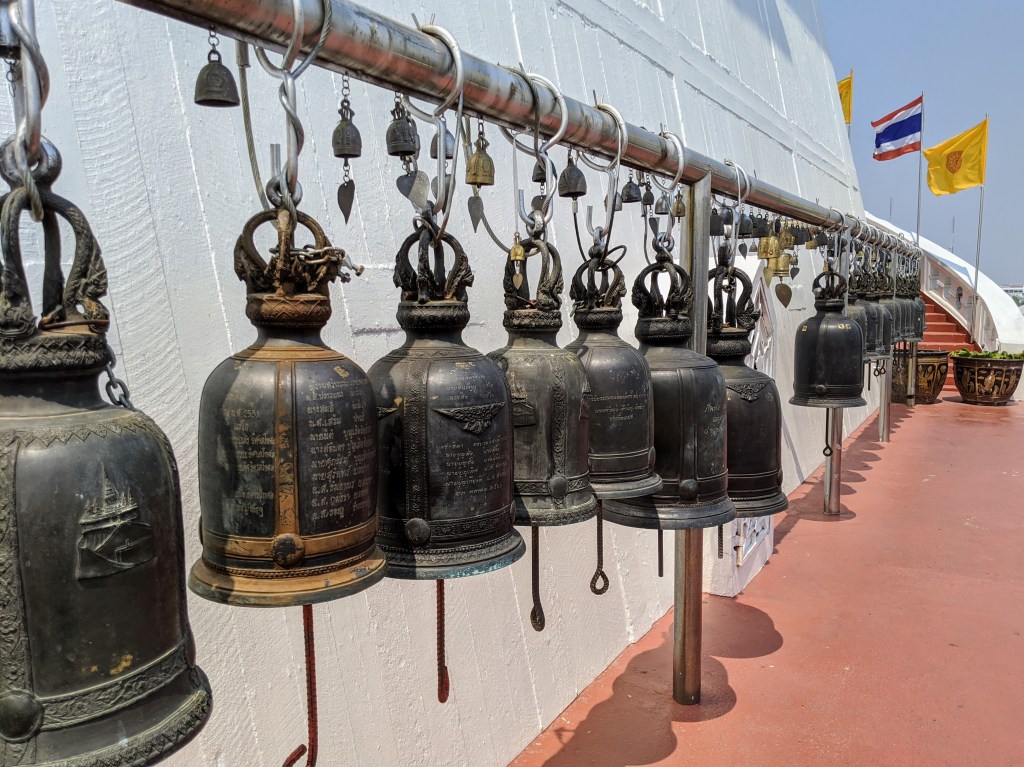
I did inside/outside meditation on The Golden Mount, with windchimes behind me, traffic below, birds nearby, and the occasional low chatter of visitors walking past. Also, every now and then, one of these visitors would bang an enormous gong a few feet from my head. That sound was a little hard not to label as “terrifying” and “extremely annoying” and I can’t say I succeeded in not doing so. But overall, it was a very fulfilling meditation, and I was happy to be back at my practice.
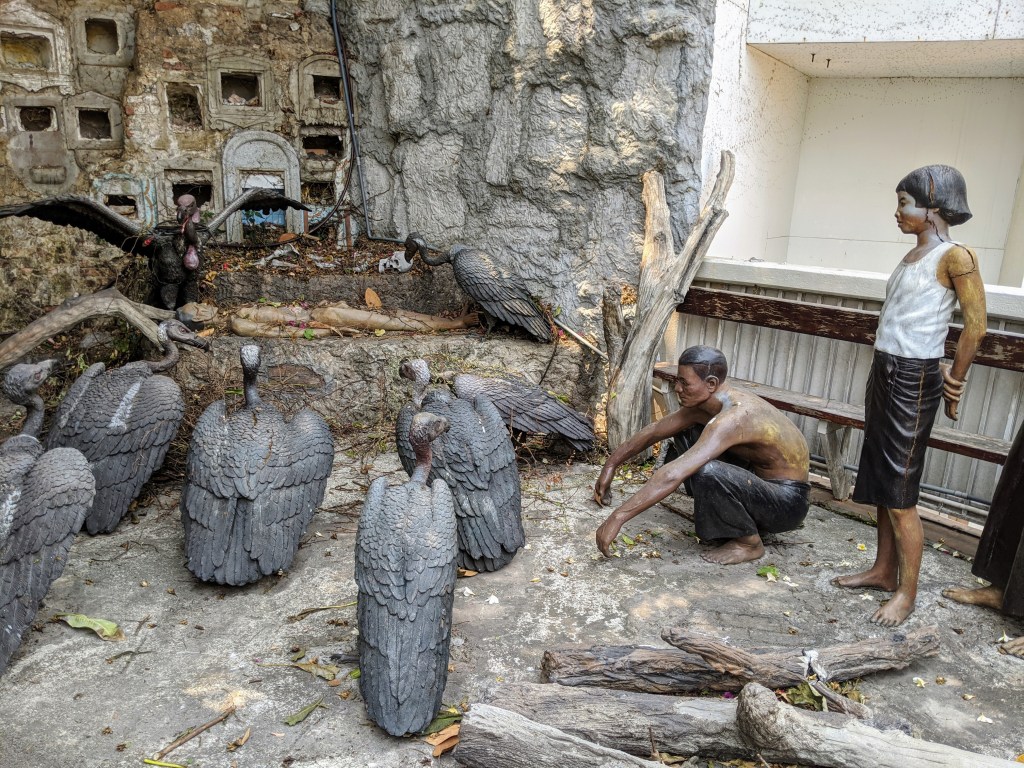
After our descent, in which we briefly stopped to learn about how this temple used to have so many piles of bodies taken by cholera that a colony of vultures took up residence there, we walked to lunch at Krua Apsorn. It’s not a beautiful restaurant, it’s also not a particularly cheap restaurant, but it was both authentic and delicious. We shared a crab omelette and some crab in yellow curry, both of which had big, sweet chunks of jumbo-lump cooked perfectly. Apparently, this place is even popular with Thai royalty, despite its fluorescent lighting and linoleum flooring, and it’s known for the two crab dishes we ordered.
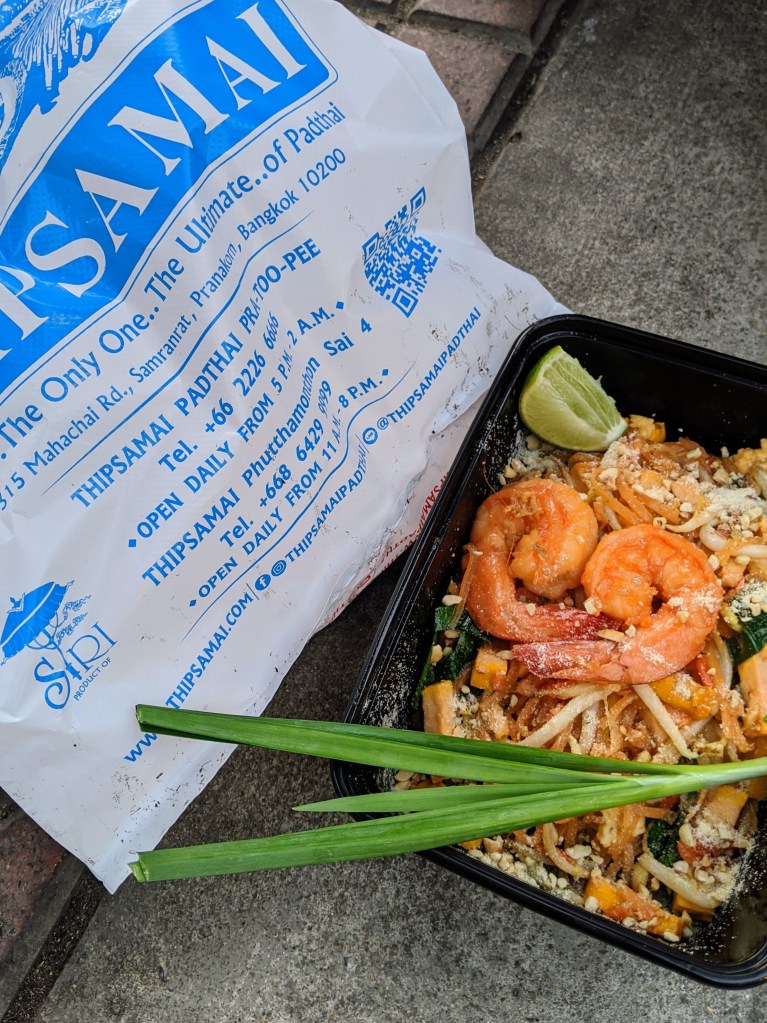
We hid from the heat of the afternoon in our hostel, and then, briefly, in a coffeehouse. For dinner, we had what’s considered the definitive and original pad Thai at Thipsamai, which is only a couple of blocks from our hostel. It was good. Shrug. Pad Thai is good.
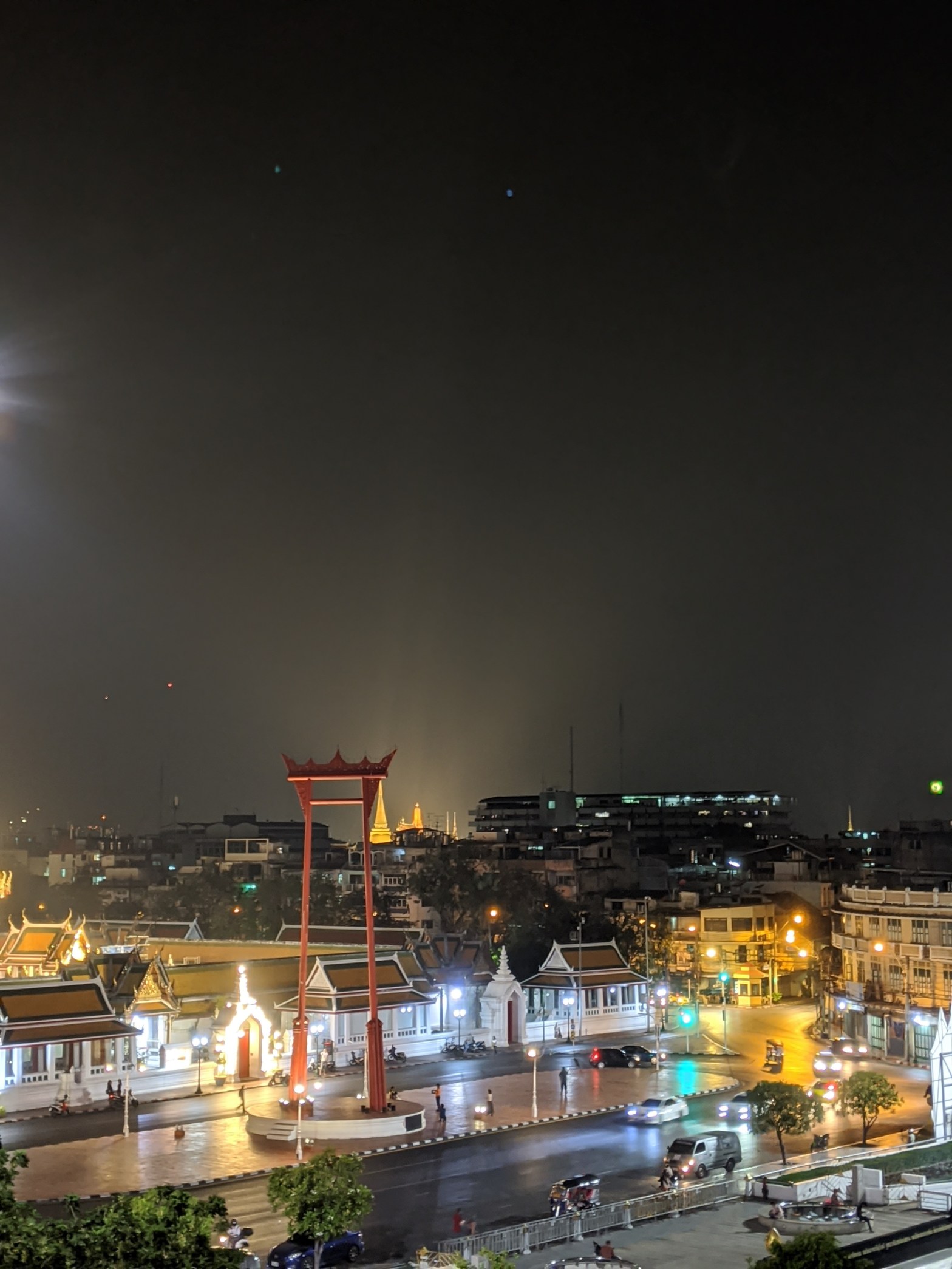
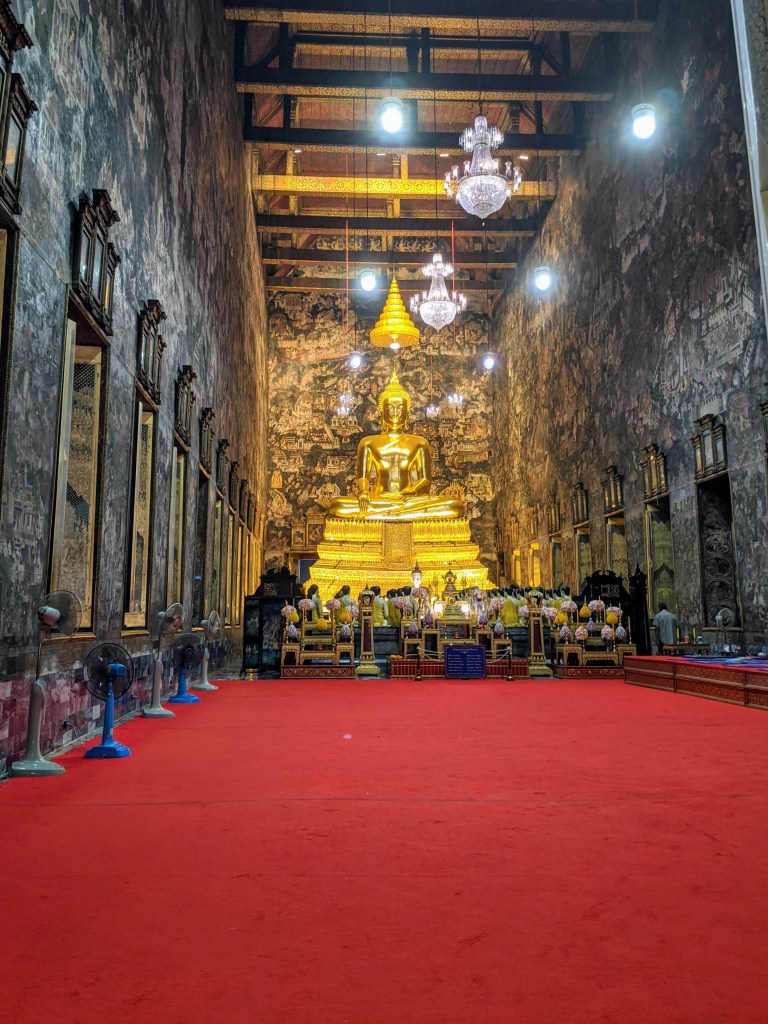
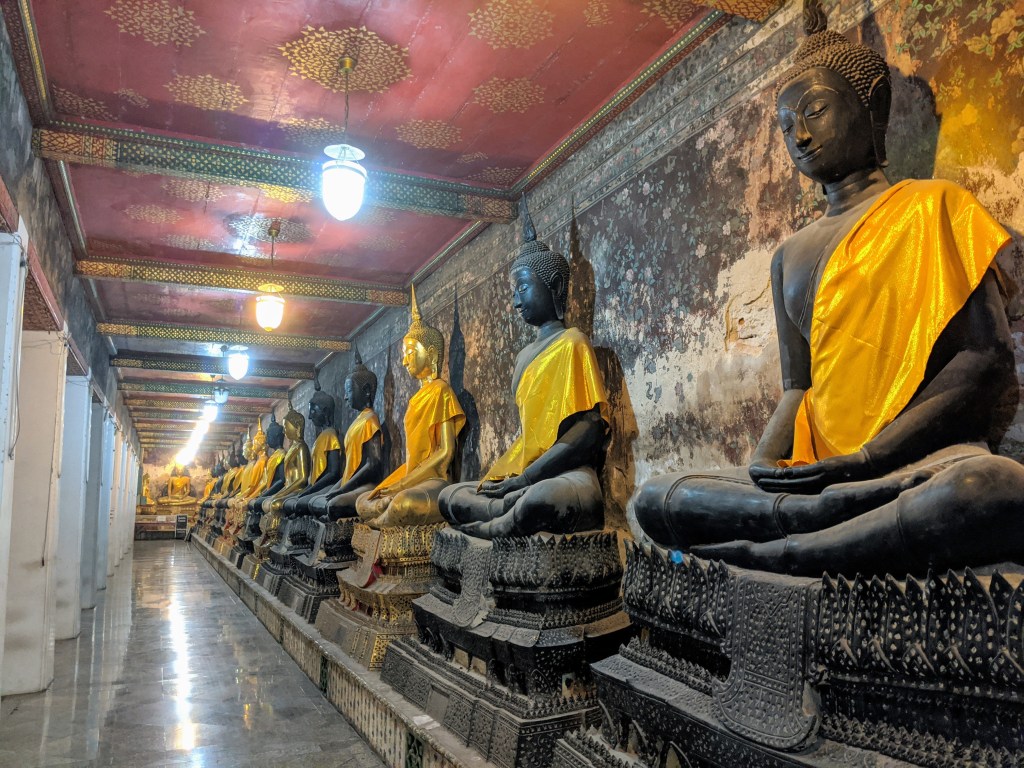
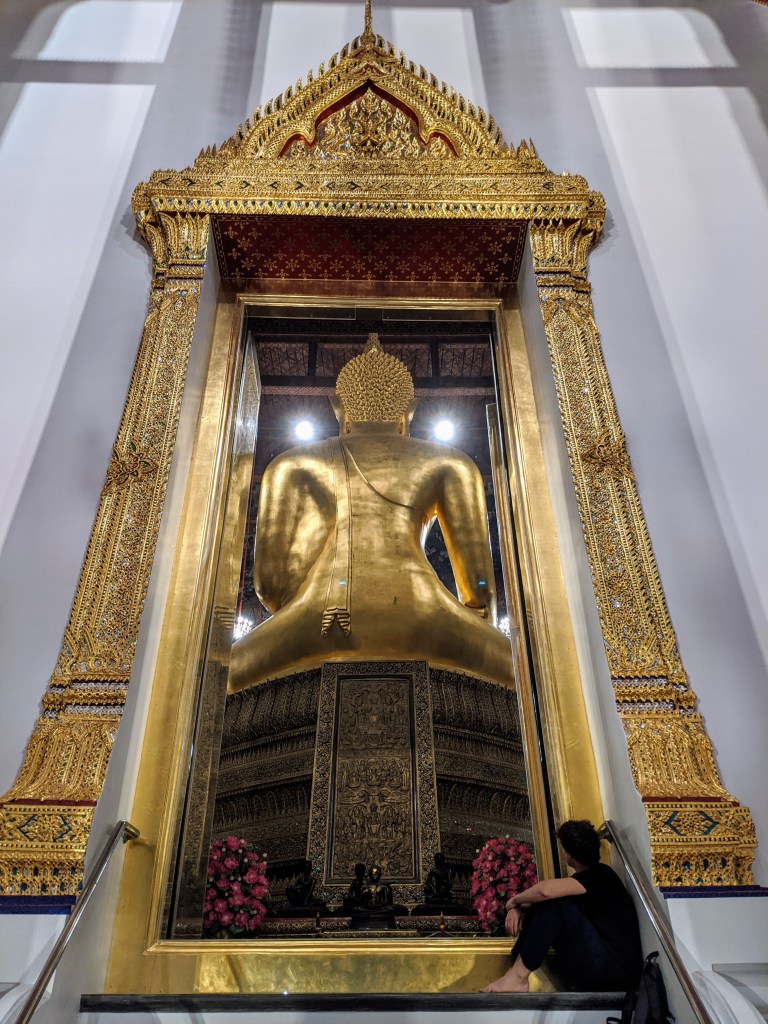
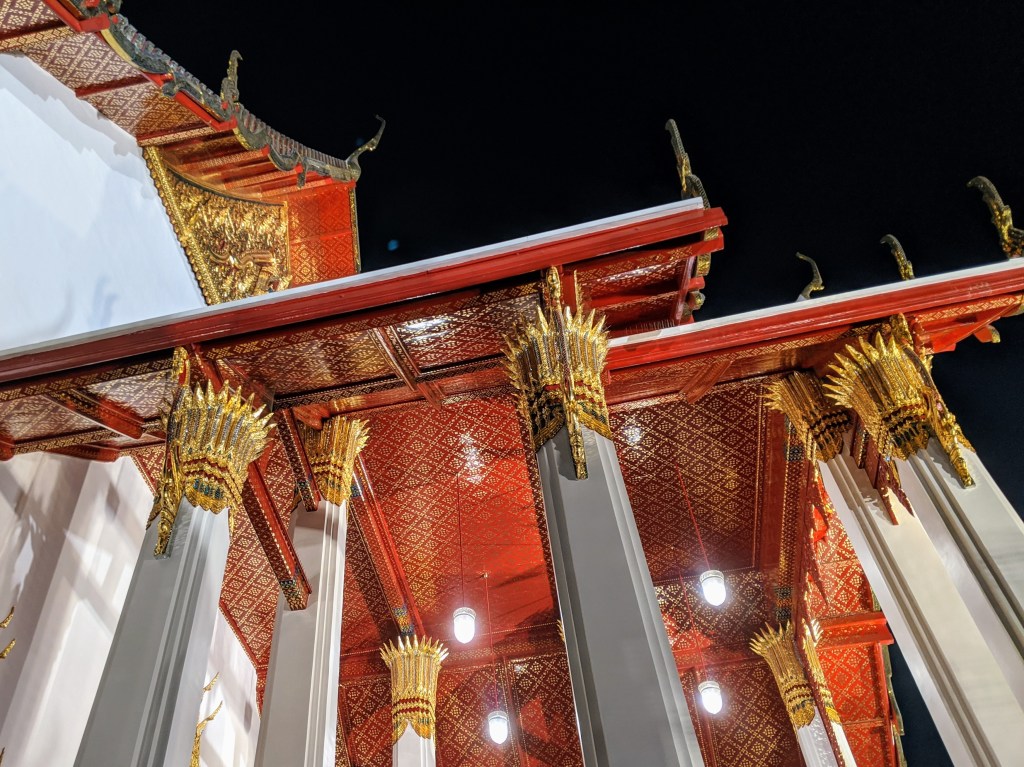
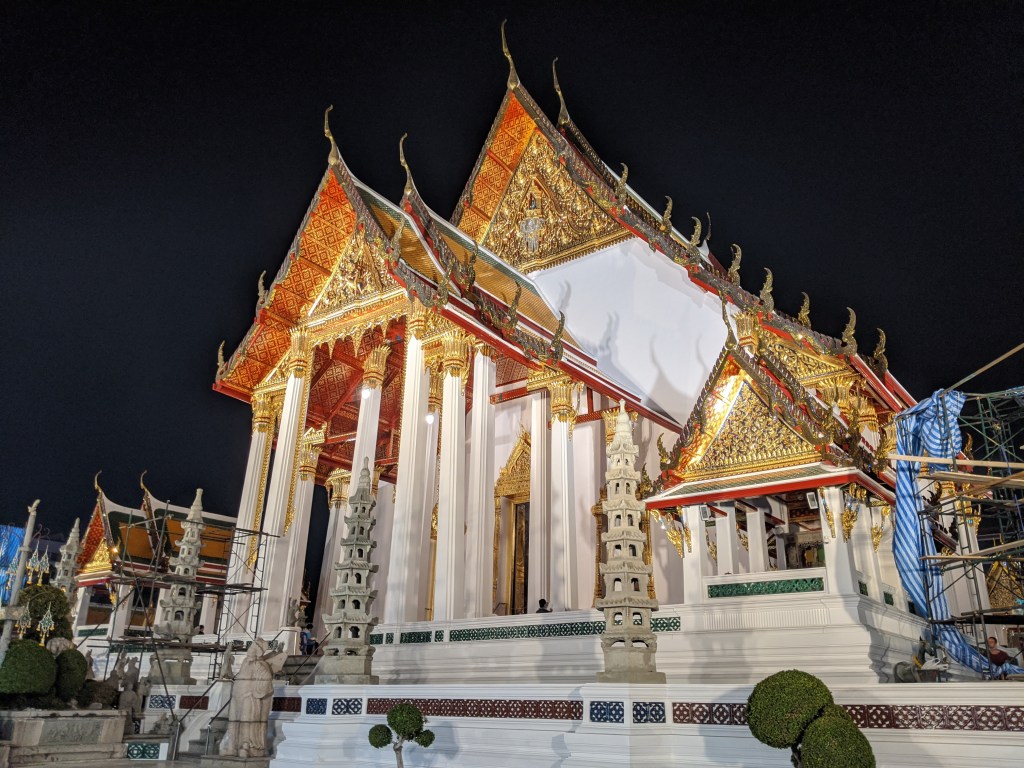
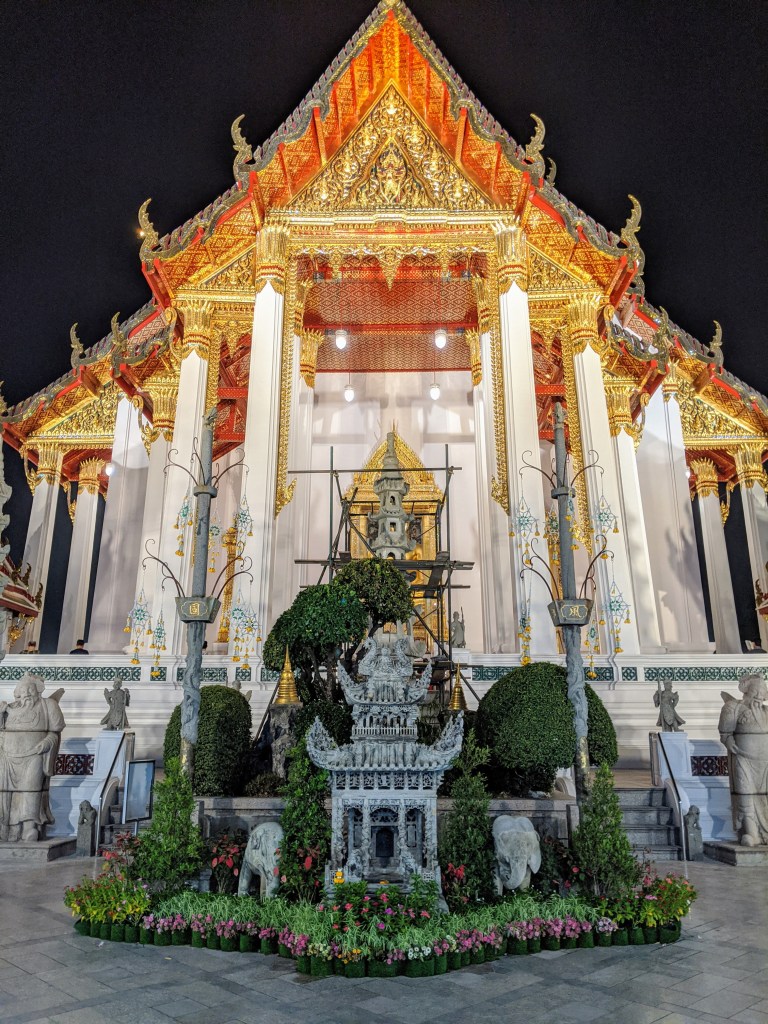
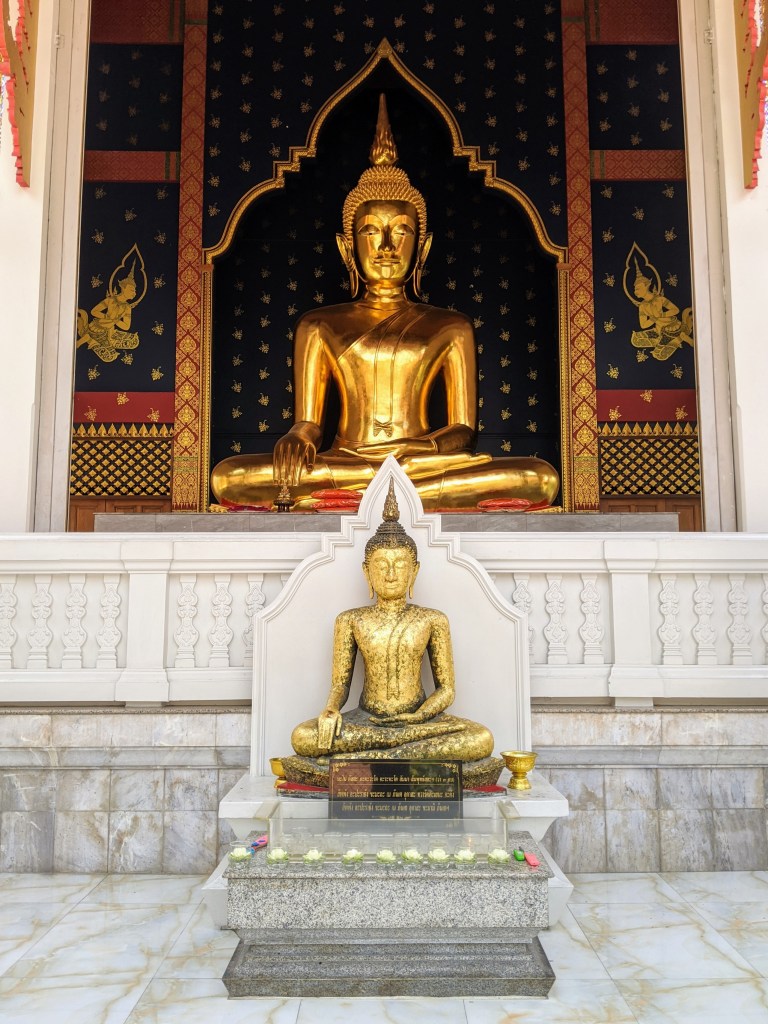
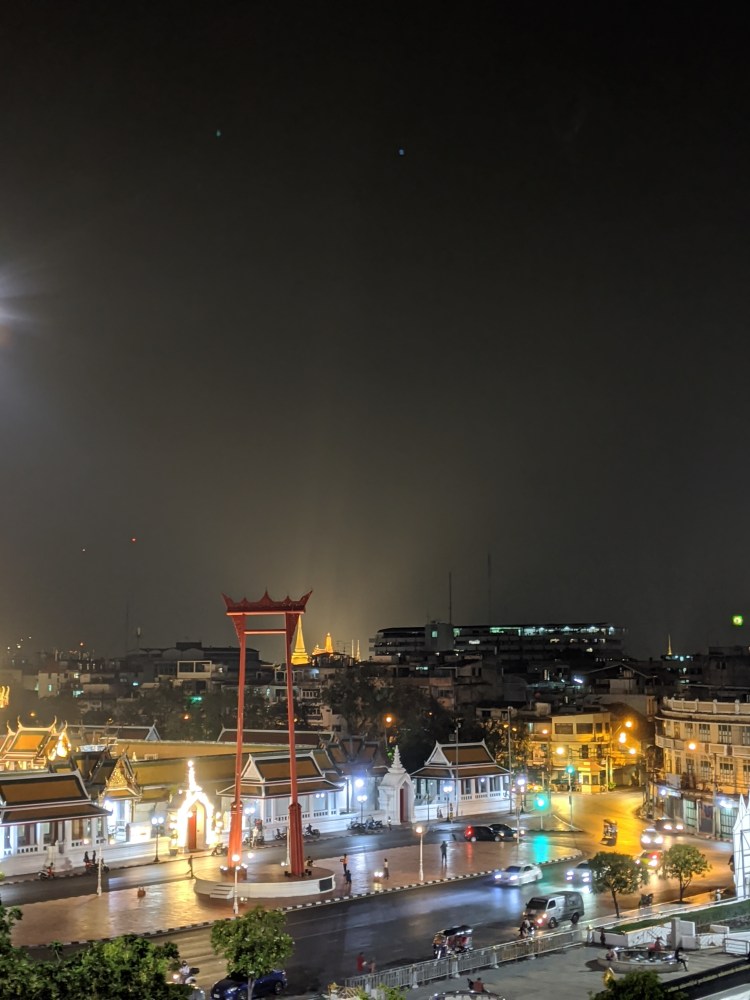
After dinner, we made our way to Wat Suthat Thepwararam. It’s open later than most of the other temples, so we decided to visit at night to see it all lit up (and also because it wouldn’t feel like it was 105 degrees while we checked it out). Outside the temple sits the Giant Swing. The monumentally tall, red archway was originally built as part of a Brahmin ceremony, but is now an iconic landmark of Bangkok. We walked through Wat Suthat’s gates, and realized we were entering the complex mid-service. I’m not sure if the chanting was in Pali or Thai, but it was rhythmic and beautiful. We approached cautiously, trying not to disturb the service. Inside, I could make out a large group of seated figures, surrounding a large, golden Buddha statue. The walls were elaborately muraled with scenes from the Buddha’s life. We walked around the outside of the temple, then sat on the steps in the back to meditate on the chanting. Listening to this crowd, devoting themselves in unison to Buddhist principles, communing together over this shared belief, I started crying. I became aware of the impermanence of it all. First, because I would probably never be in Thailand again, listening to this chanting at this gorgeous temple, but also, because this service would end. And these people would go home and live their lives and they too, would eventually end. This temple would eventually crumble. The sun would eventually die. No note of this chant would last. No part of this brief communion was forever. I was deeply sad, yes, but also deeply grateful to be there, in that brief moment, with these people, in this place. Everything was as it was, everything was as it had to be, and all was right. I don’t know how long I sat there with tears streaming down my face, but, eventually, a man approached us. He warmly told us “you can go inside,” as he entered the temple. I don’t know if he noticed I was crying, or was just being friendly. I think Aaron and I both appreciated that small act of welcoming. We weren’t sure if we could go inside, or if it was ok to enter during the service, but now we had been invited in. Aaron settled in and meditated, and I did for a bit, as well, but soon I got up. I wanted to explore the temple grounds with the sound of the chanting around me. I had them all to myself (well, except for the ten temple cats I kept running into). I walked them mindfully, aware of the feel of my feet on the stones of the garden. Through a door, I found the ubosot, or ordination hall. It was empty, save for a temple worker changing the arrangement on the shrine. I stood and watched him for a bit, before realizing the chanting had ended.
After, Aaron met me for a drink at a rooftop bar nearby, where we could still see the temple, and we debriefed about our respective religious experiences. Some days are more Buddhist than others.
 Hanoimoon