Hoi An: Day 3

We returned to Phin Coffee for our morning cup. The events of the day before had proven that when you find a good thing, you stick with it–novelty be damned. 

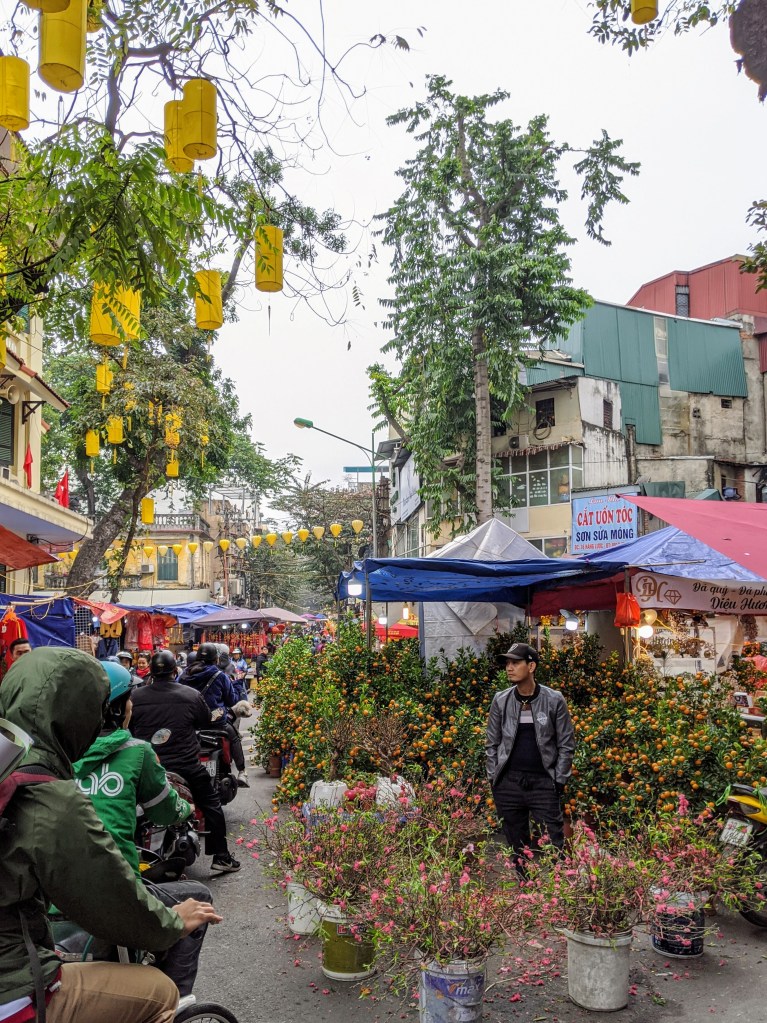
Everything we want to try or do is closed for the Lunar New Year celebrations. If y’all thought we took Christmas seriously, you ain’t seen nothin’. People here take a full week and a half off work for Tết. But it’s not just people; businesses will close for two, even three, weeks sometimes. We will walk halfway across town for a restaurant, only to be greeted by a sign saying that it won’t be open again until mid-February. Even doctors’ offices close their doors for a couple of weeks. So it wasn’t surprising when our planned lunch spot had a sign saying it was closed for Tết. Fortunately, the place next door, What Else? Cafe, was taking this opportunity to poach some business.

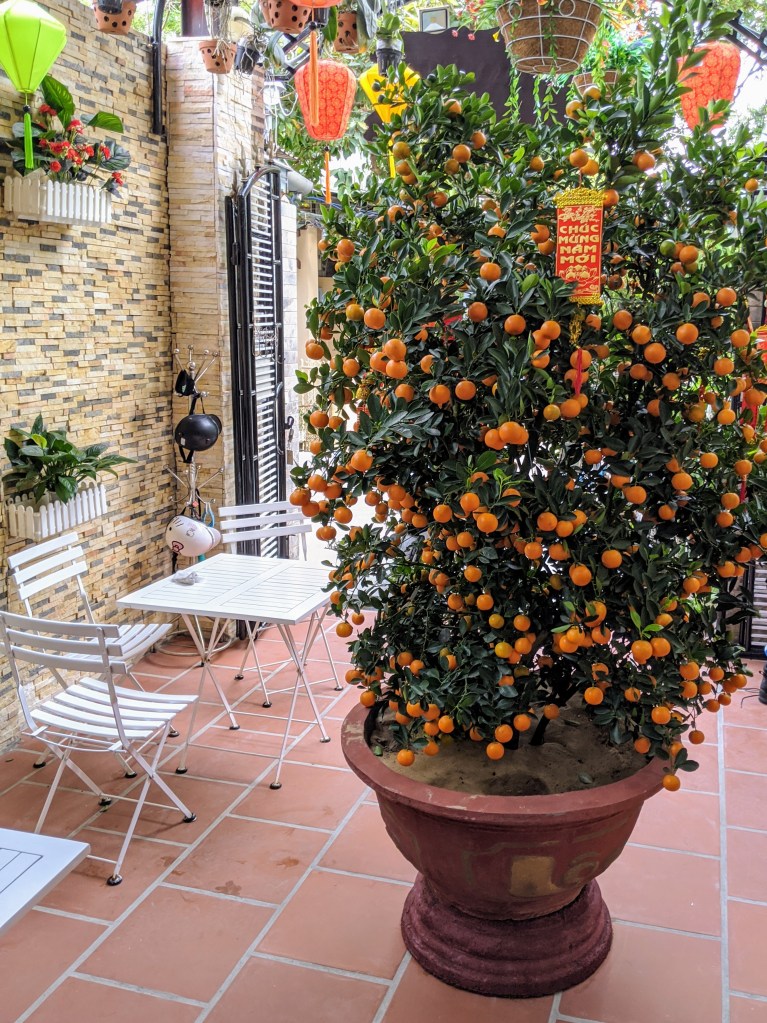
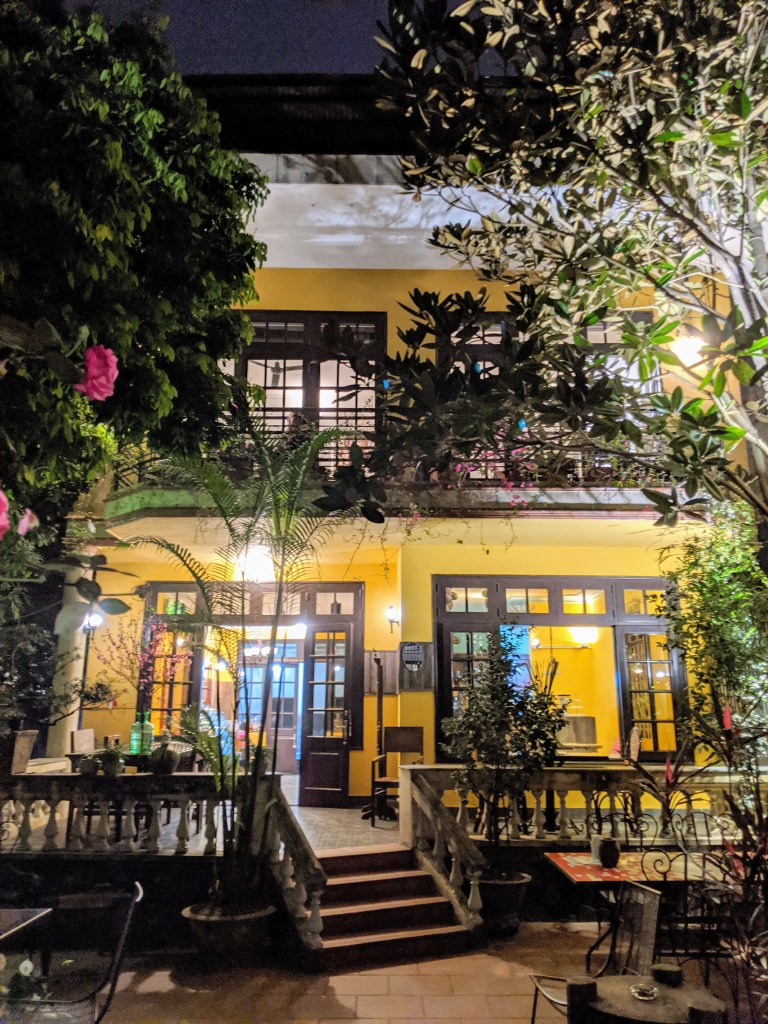
The small restaurant had a cute, florid courtyard, and Hoi An was keeping it’s perfect record of balmy temps, so we sat outside. After the pizza and creamy Indian food from yesterday, I was craving something light. My green mango salad with grilled shrimp was what I needed. It had big chunks of not-green mango as well. I couldn’t help but wonder if that was because some ignorant westerners complained that there wasn’t any mango, not recognizing it’s shaved, green form. Aaron finally got to try some banh xeo, which he’d been talking about ever since he read a short description in our guide book. Per our guide: banh xeo is “crispy savoury pancakes rolled with herbs in fresh rice paper.” Another perfect record Hoi An was keeping was “most edible food.” We had yet to have a meal here that we didn’t like, this one included. 

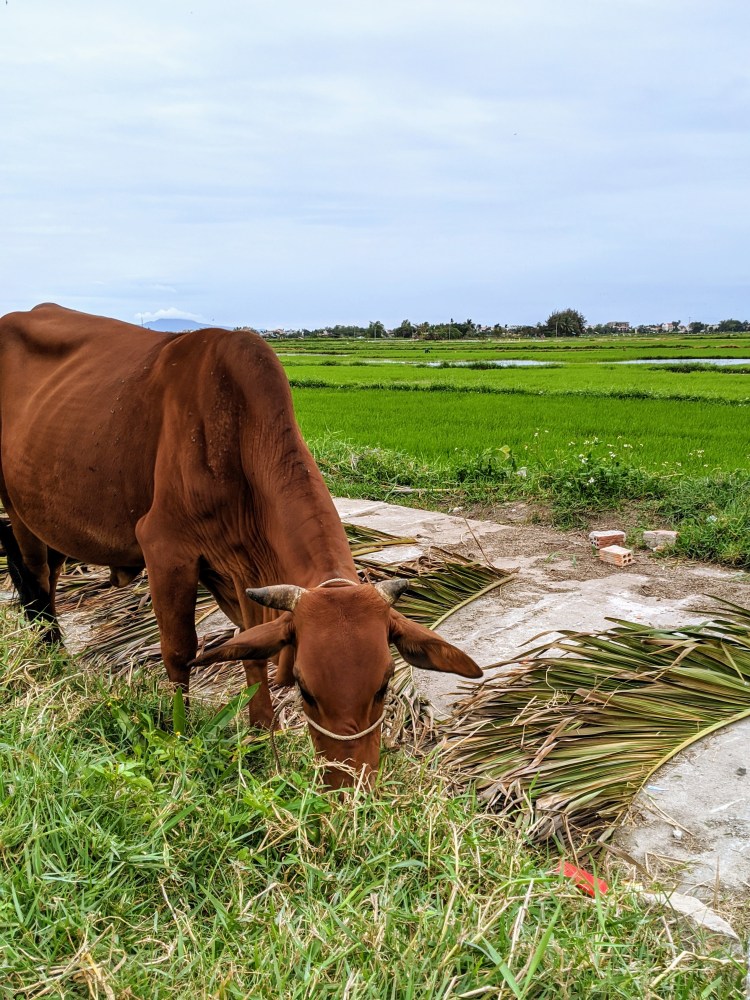
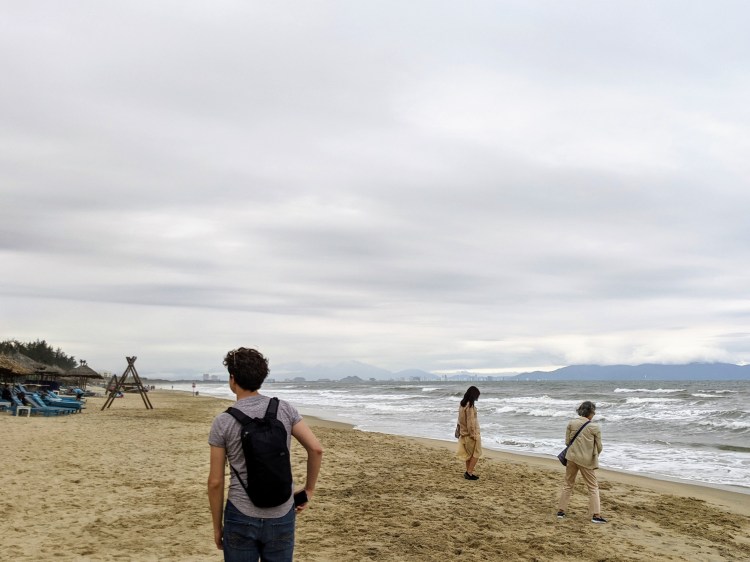
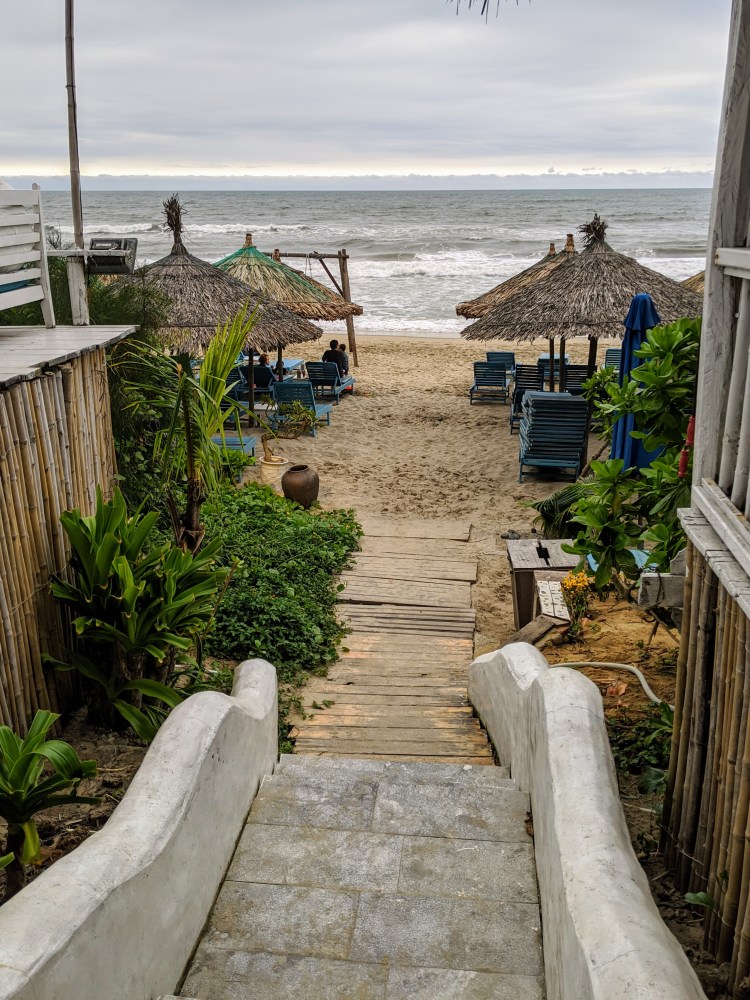
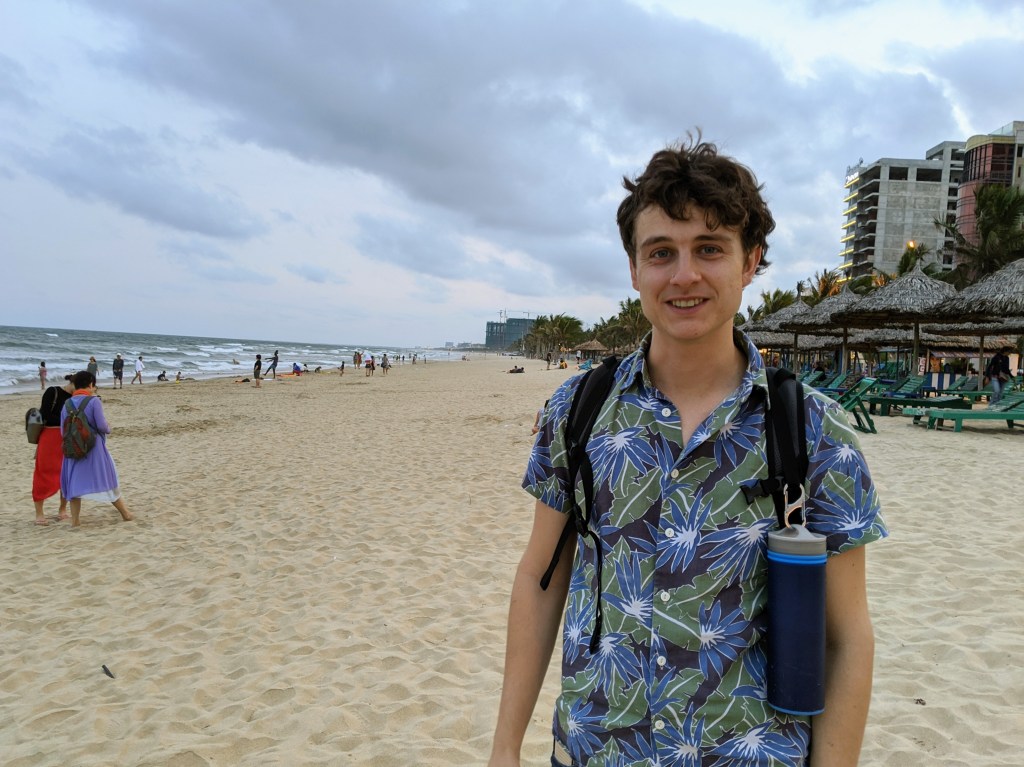
The closest beach to Hoi An is only a few kilometers away, at An Bang. Our long, scenic walk there took us through rice paddies and buffalo fields. The beach itself was not impressive, but I’ve been spoiled by growing up in a state on the Gulf. The sand was a dirty brown color, and the water was gray-ish. It was also threatening to rain now. Restaurants along the shore were putting away their beach chairs. We decided to try our luck on the upstairs deck of the Deckhouse. It was windy and a bit chilly up there, but we got to enjoy our mojitos and piña coladas with an unimpeded view of the ocean. 

Dinner was a bit difficult. We had already tried most of the places that weren’t closed for the Lunar New Year. We spent at least an hour chasing potentially open restaurants, only to give up and go to the first place with people in it. Good Morning Vietnam was, incomprehensibly, an Italian restaurant. It was–as you may have predicted from the name and cuisine combo–not very good. But, any port in a storm. The food was food. The wine was wine. 

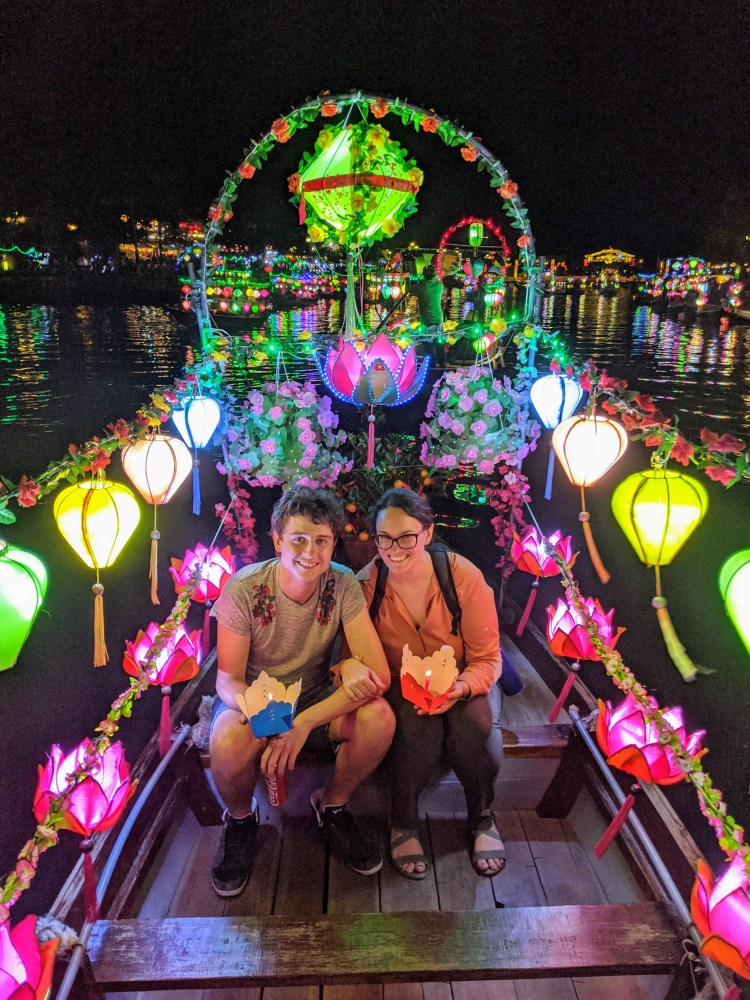
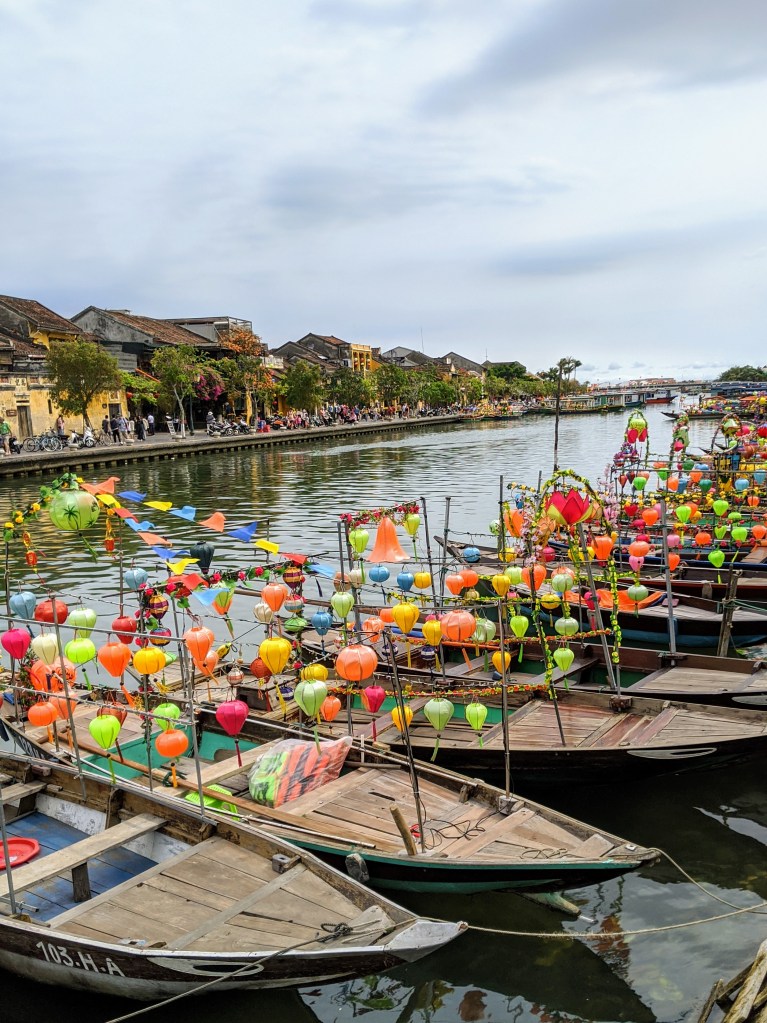
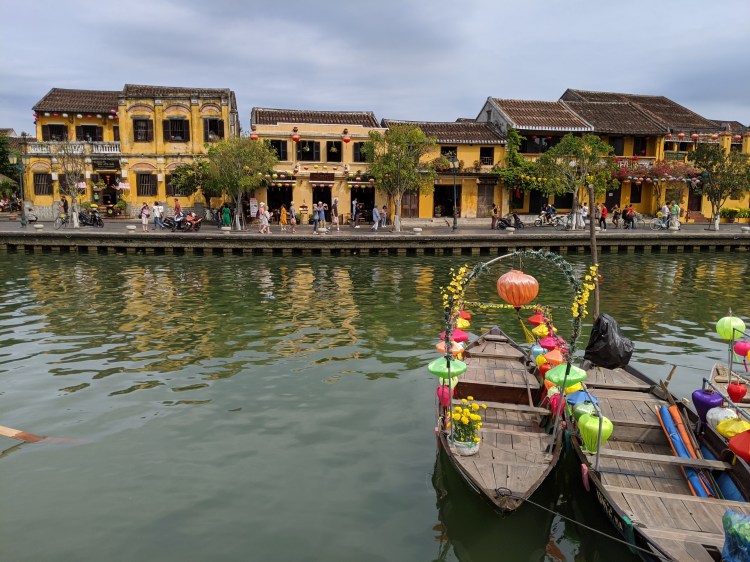
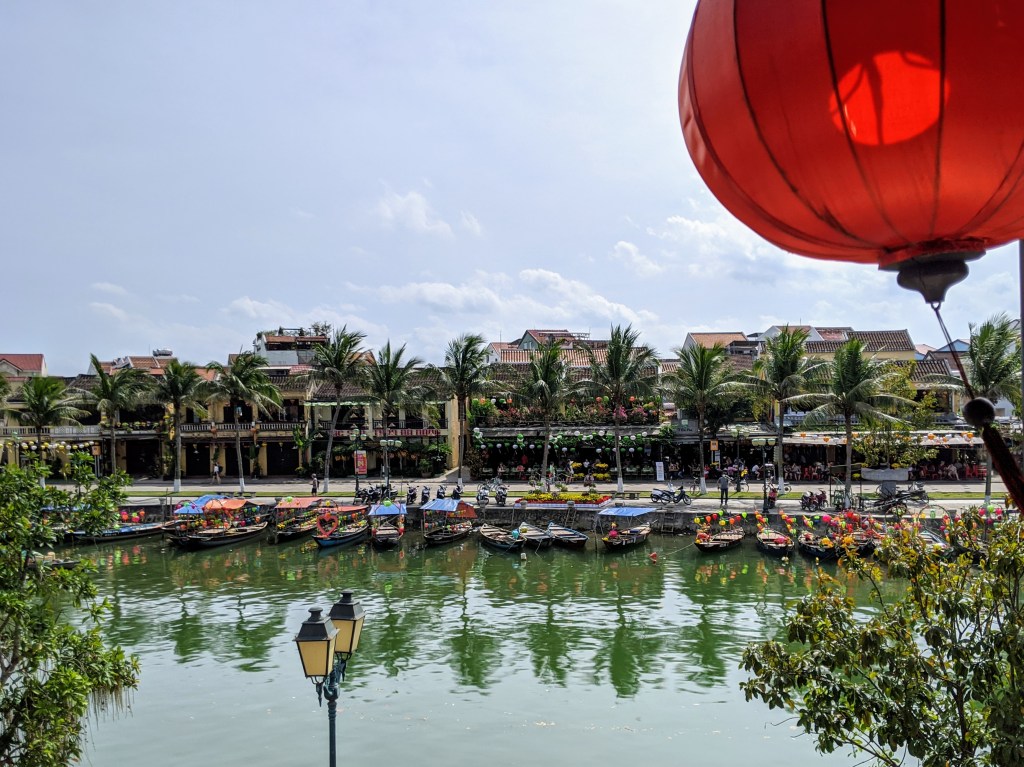
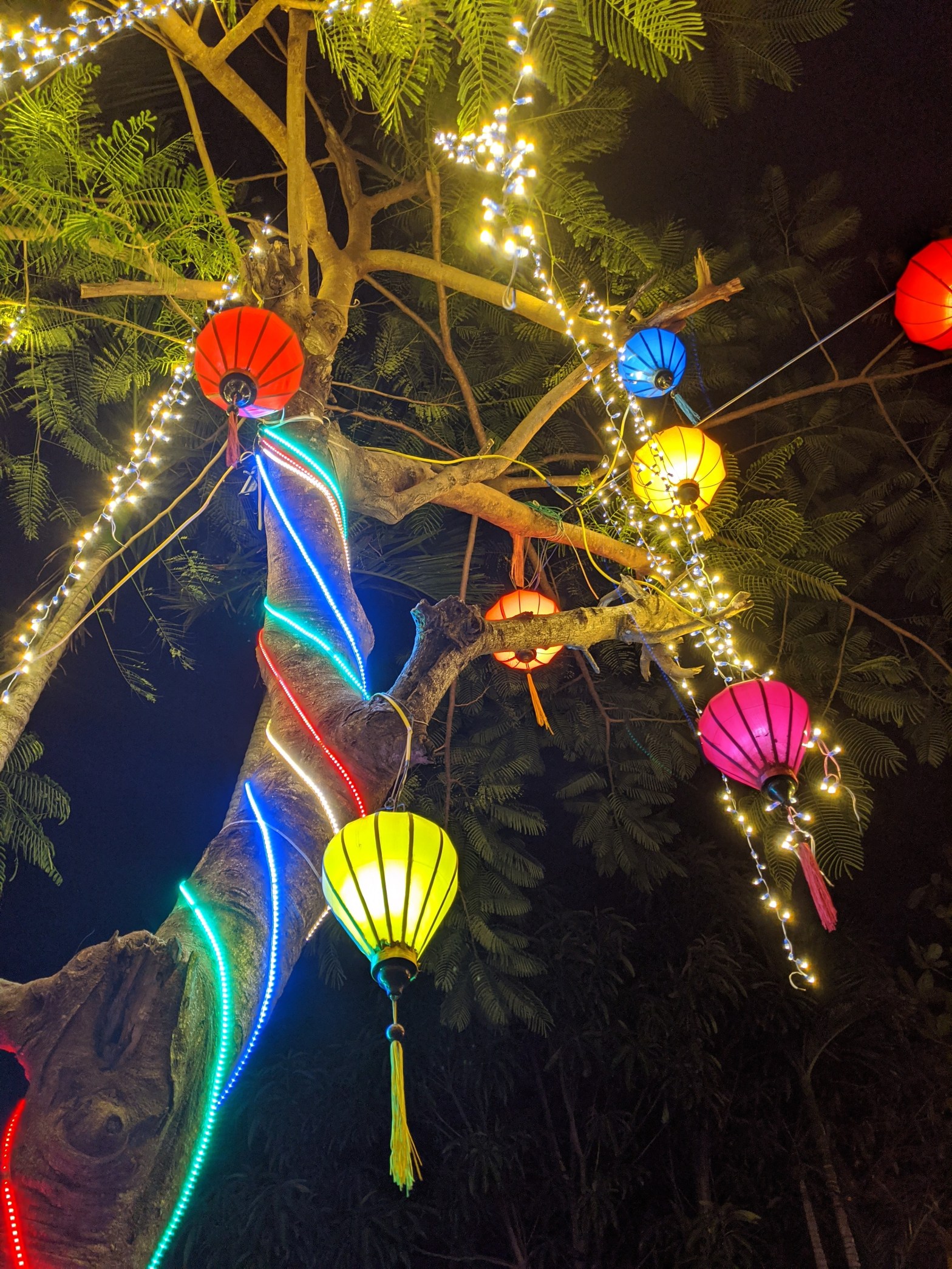
On our walk back to the guesthouse, we were waylaid by a woman trying to get us on to one of the many lanterned rowboats that cruise the river at night. Usually, our policy is not to buy anything from the aggressive sellers, but we negotiated a price with her. She led us to our boat, festooned with glowing blossoms and multi-colored lights. It wasn’t the twenty-minute ride our hawker promised, and the rower asked for twice the amount we’d negotiated, but it was a lovely little tourist trap while it lasted. 

We crossed the river for one last nightcap after our ride, and listened to the competing live bands at the restaurants along the banks.

Hoi An: Day 2

Sometimes, my desire for novelty trumps all else. It is an all-too-frequent problem of mine that I will end up somewhere disappointing, just because I wanted to try something new. Phin Coffee was good. It was actually kind of perfect. But we’d been there, done that, so I suggested we try Coffee 11, on the other side of the river. When we got there, the door was just a crack open, so we peeked inside. The lights were off, but the owner took our orders. You could tell from the coffees that her heart wasn’t in it, though. It was like she wanted to be closed for Tết, but still wanted to make a bit of money. We sipped our lackluster coffee drinks on a bench looking out at the river and wrote. 

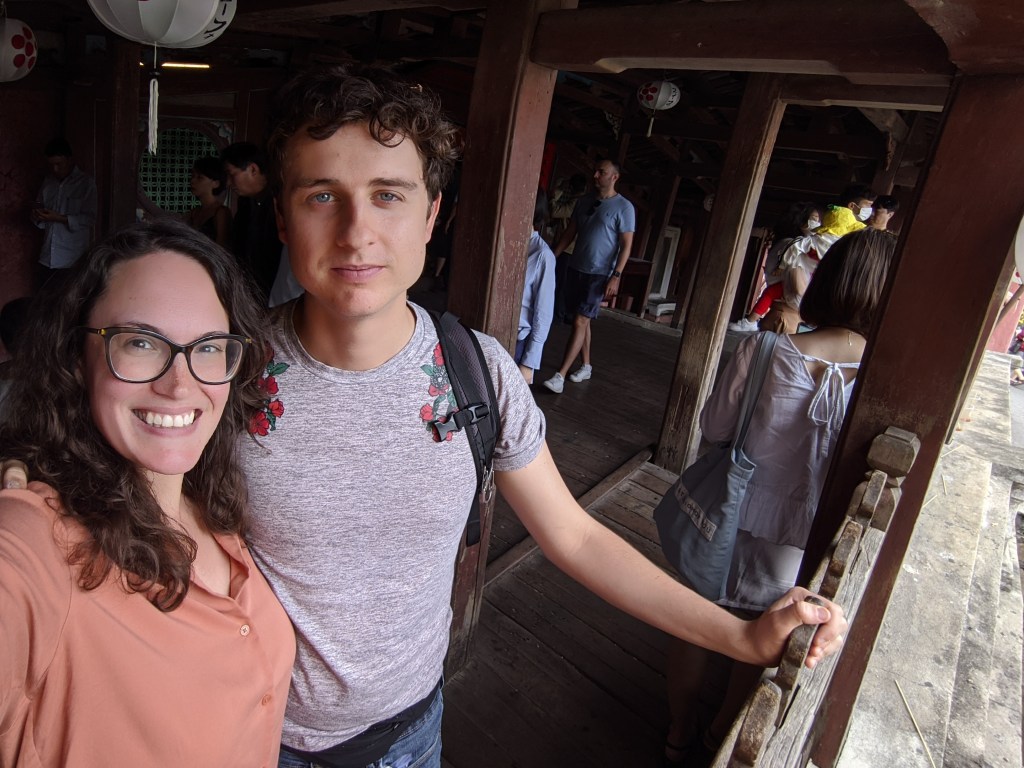
When we got hungry, we strolled along the river’s western bank to the Anantara Resort’s restaurant, Artspace. Indoors, it had a number of art pieces and photographs from local artists, but we chose to sit on its patio and enjoy the clement weather. We stayed here for maybe 4 hours, slowly working our way through a wagyu burger, a half-pepperoni/half-carbonara pizza and a few cold, craft beers. We talked about our families, our friends, our failures, and our future together. We basked in the sun and the fortunate circumstances that allowed us to come to this instant of our lives. I was happy. Aaron was happy. It was the stuff that honeymoons are made of. 

After lunch, we realized our debit card was missing. This was the second card we have lost since coming here. Aaron and I are a lot of things, but attentive is not one of them. We would both lose our minds if they weren’t in our skulls (and, in fact, we frequently manage to lose them despite this). So, we panicked a bit–we split up, checked our tracks, called everywhere we went. No dice. 

On top of the loss of our main way of withdrawing cash, we were also contending with a finger infection. Aaron had a particularly nasty and painful paronychia that would not be ignored. Couple this with the usual tummy issues and the fact that he was in charge of the credit cards, and he was a pretty miserable guy. I picked up some Indian takeout and we finished our re-watch binge of Rick and Morty. We stayed in, figured out what to do about our card, and decided to start over fresh with life the next day. 

Halong Bay: Highlights Reel

Author’s note: we are skipping “Best Meals” and “Blooper Reel,” because there were none. We were only there for two days.

Best Experiences: Anna

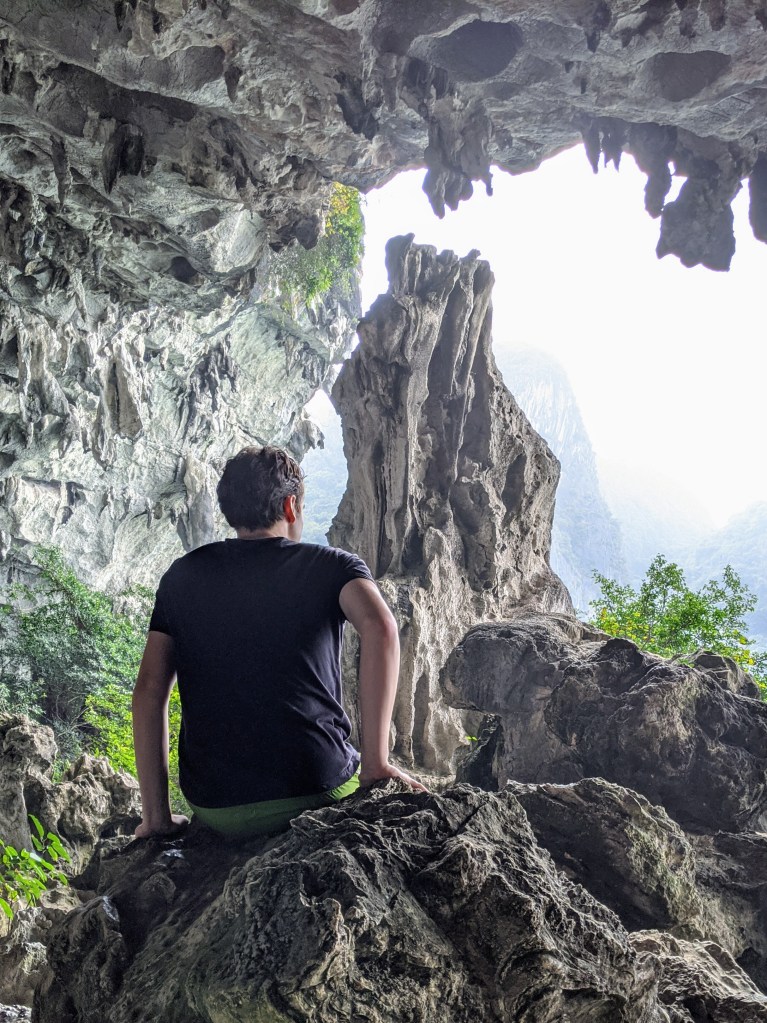
  1. Not dying while scrambling up and down the treacherous rocks on Cat Ba Island. It was both scary and very fun!
  2. Happy houring with our fellow international passengers. I’m going to miss those guys.
  3. Kayaking to another quiet, secluded cove surrounded by colossal karsts. It loses a tiny bit of the awe the second time, but not much.

Best Experiences: Aaron

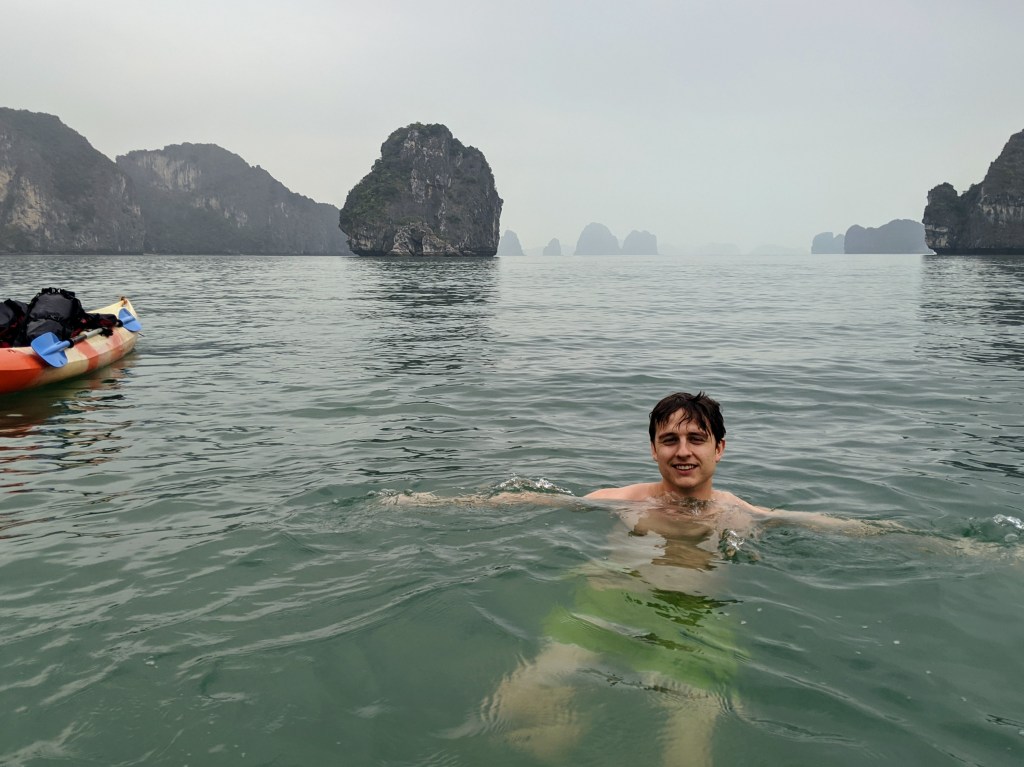
  1. Swimming from the kayak in cold, cold Halong Bay.
  2. Making friends with our Australian, Ecuadorean, German, Swiss, and Taiwanese comrades. Sharing stories and bonding over drinks on the deck.
  3. Cycling through the Cat Ba countryside, surrounded by towering karsts (which hardly deserve mention by this point).

Hoi An: Day 1

I am going to skim past a couple days here because I’m sure you don’t want to read about us waiting in the airport for six hours for our delayed flight, or the two times (two!) we ate Burger King, cause we’re disgusting. Suffice it to say, we disembarked our Halong Bay cruise after breakfast the next morning, rode back to Hanoi, spent one night in Hanoi, then spent a whole day in the airport waiting for our flight to Danang. We landed in Danang, taxied to our guesthouse in Hoi An, and immediately went to sleep. It’s not a gripping tale.

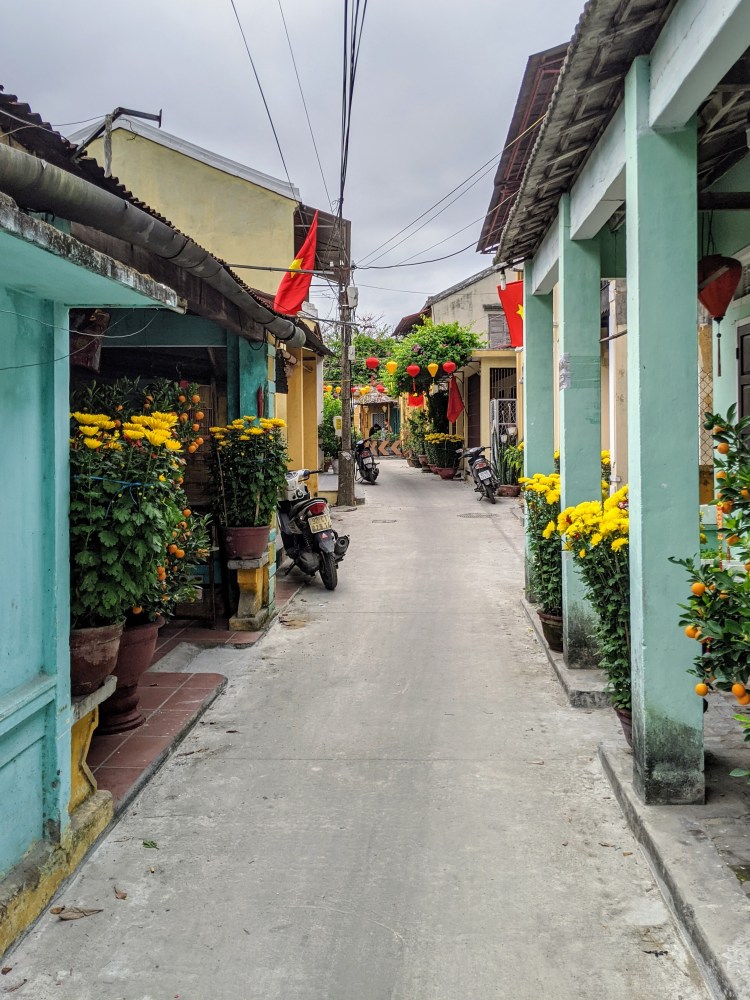
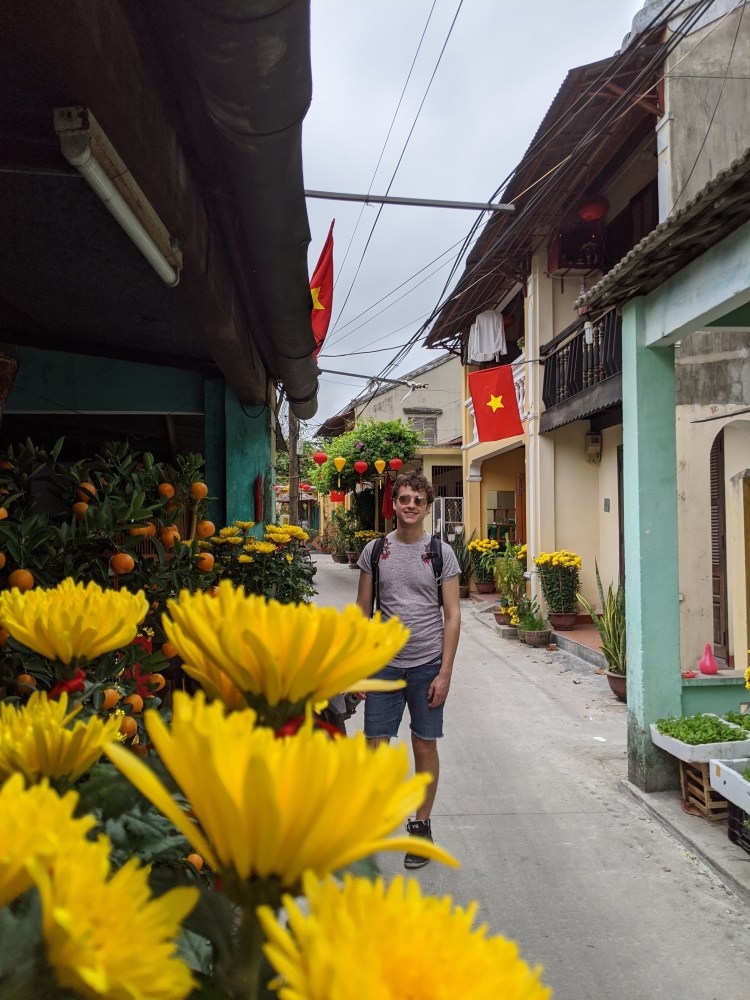
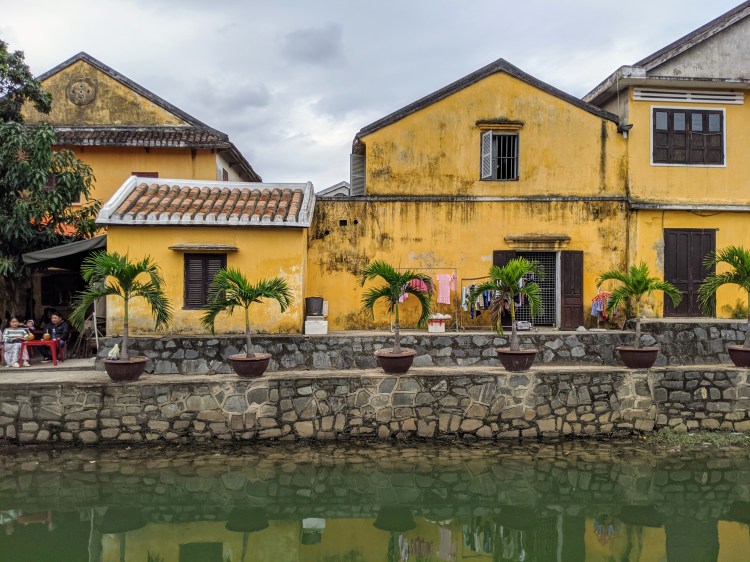
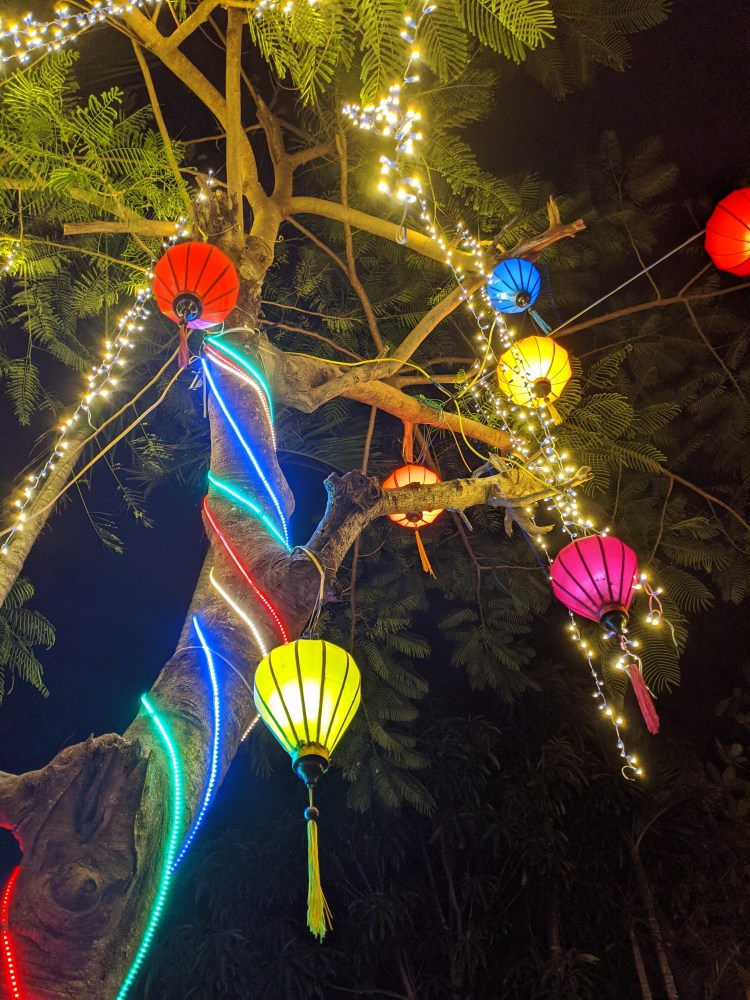
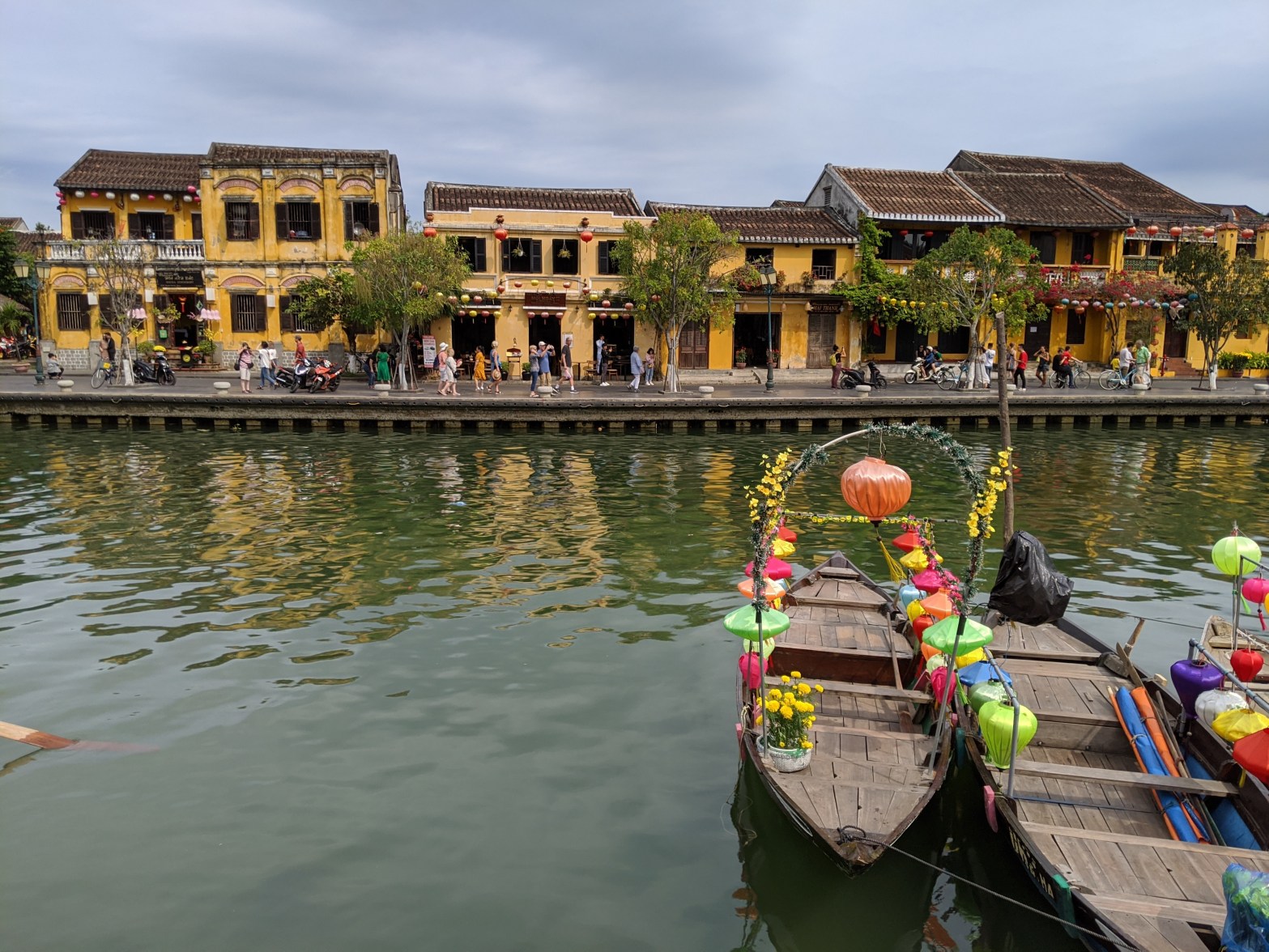
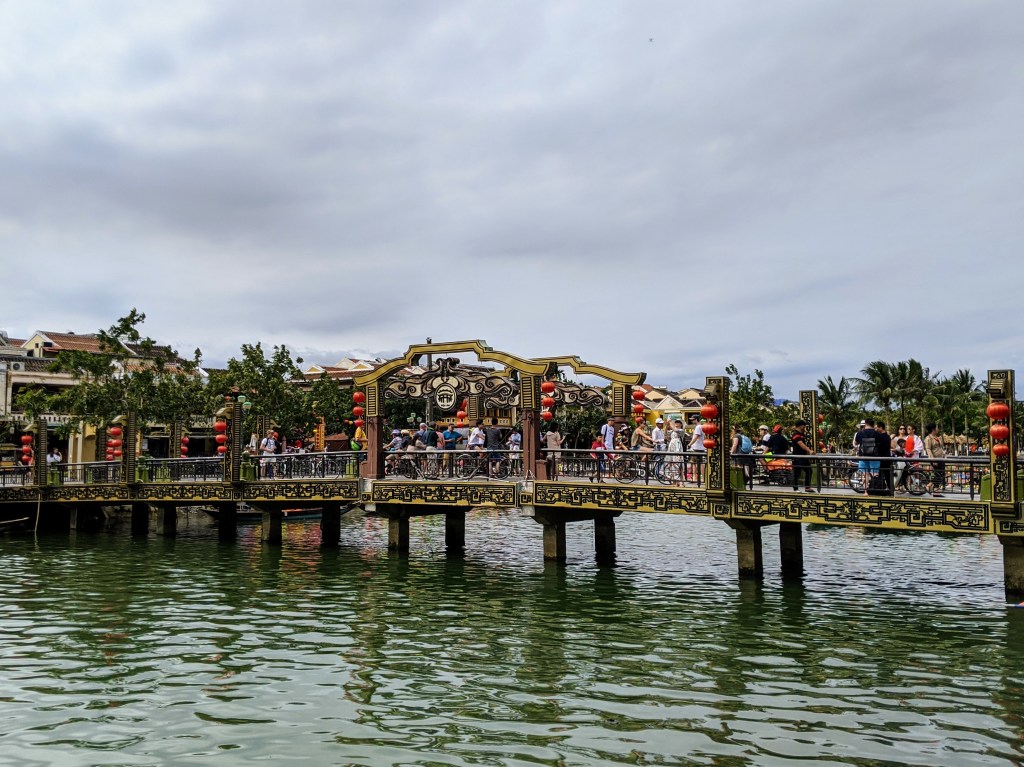
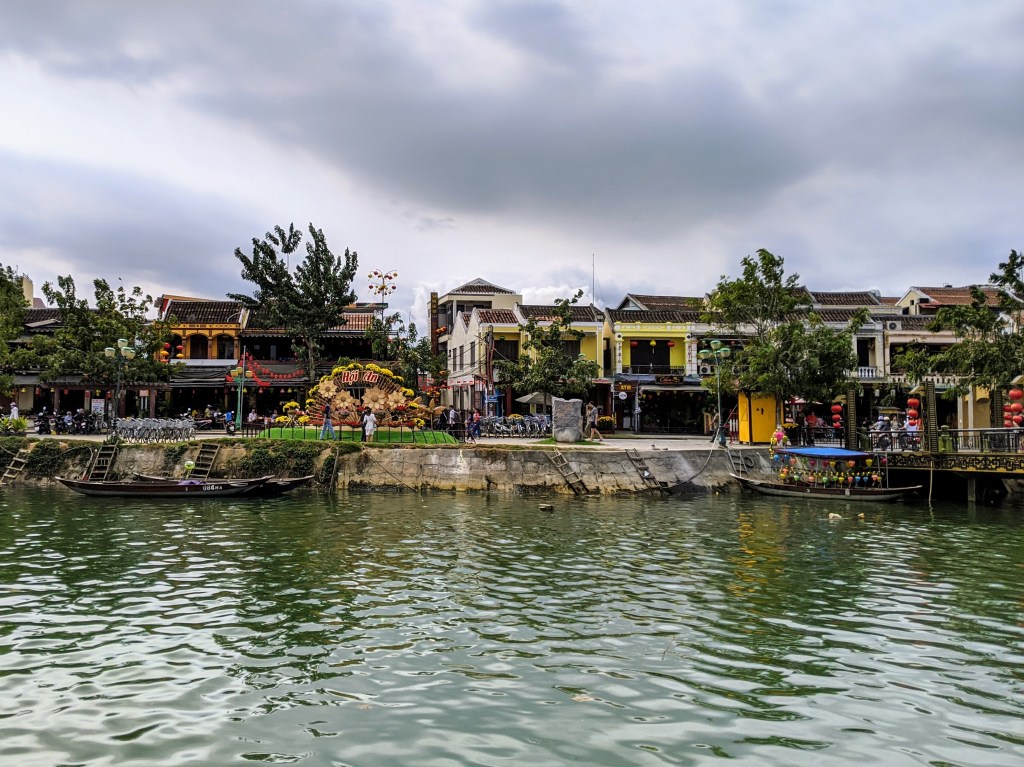
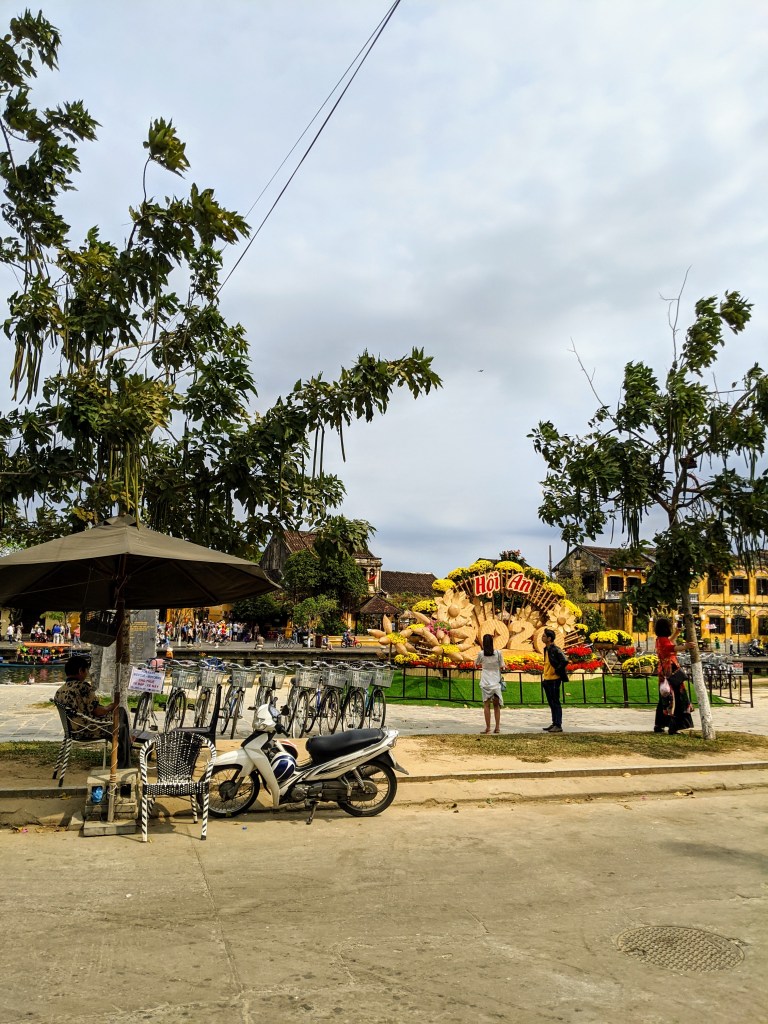
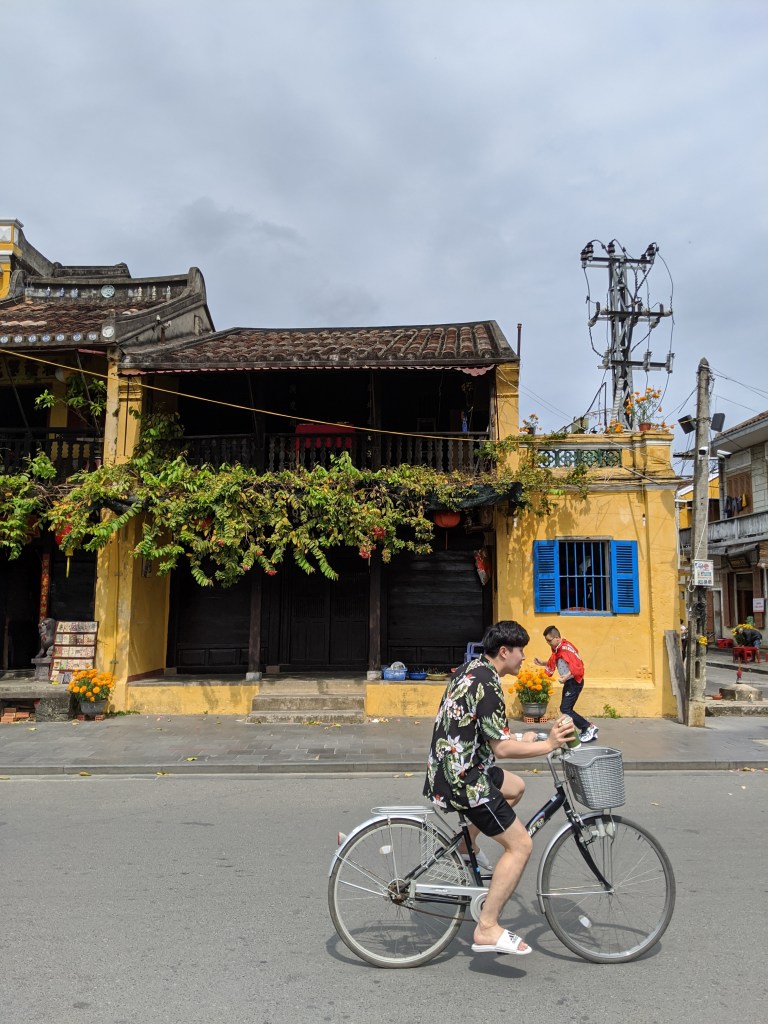
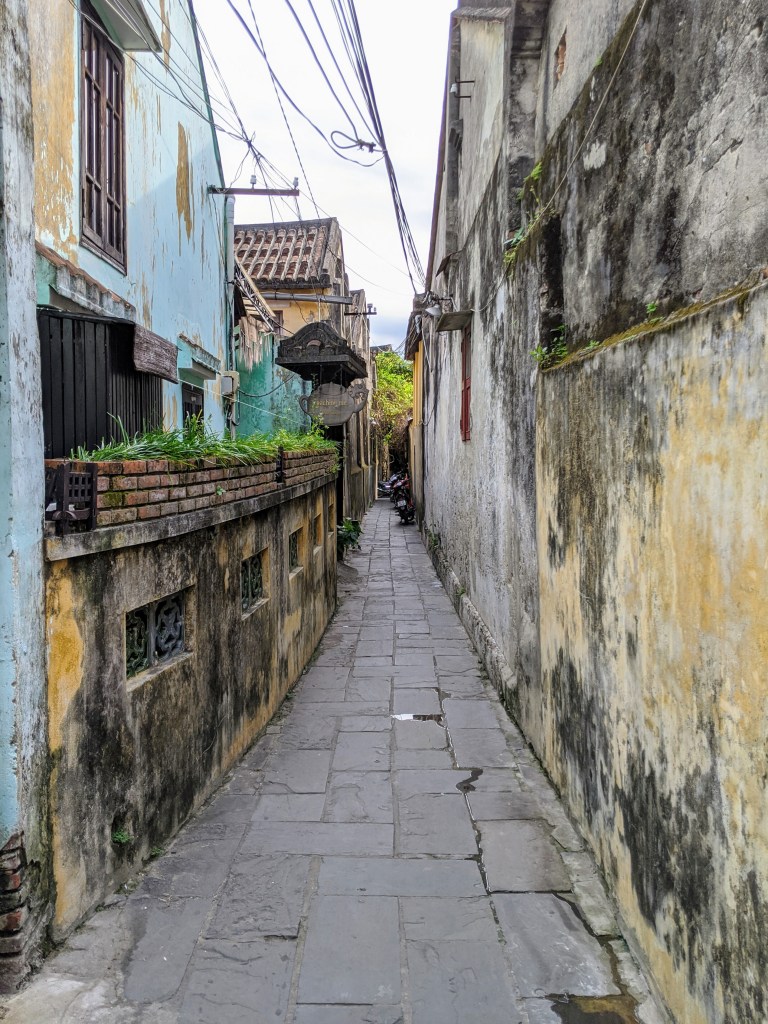
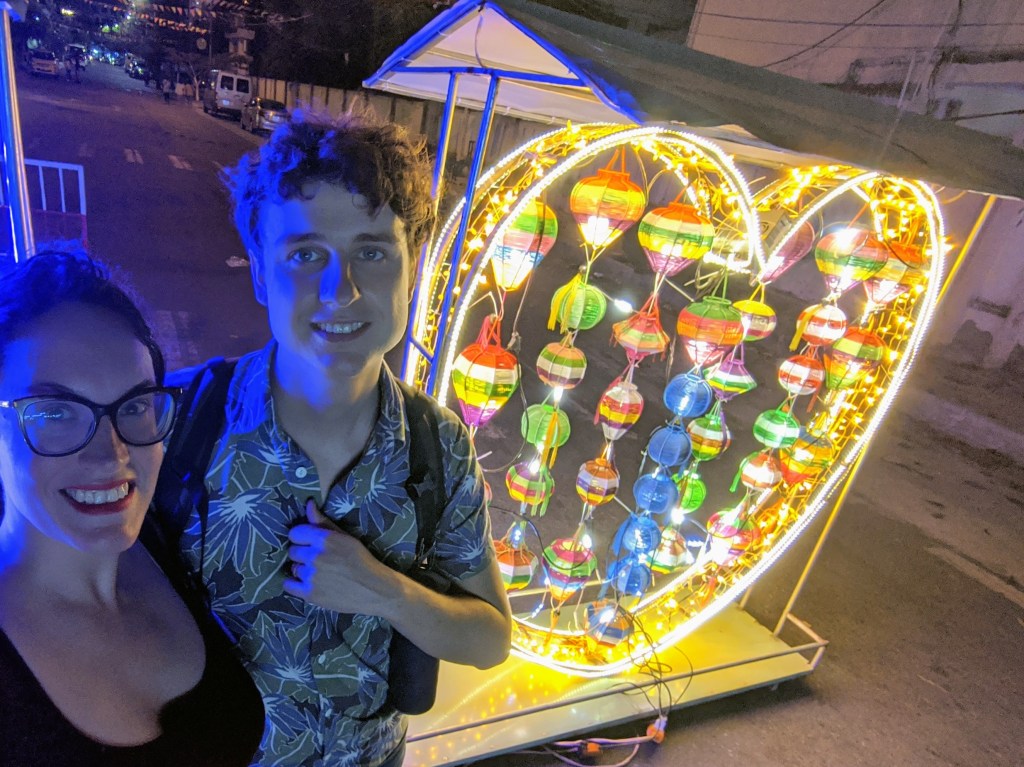
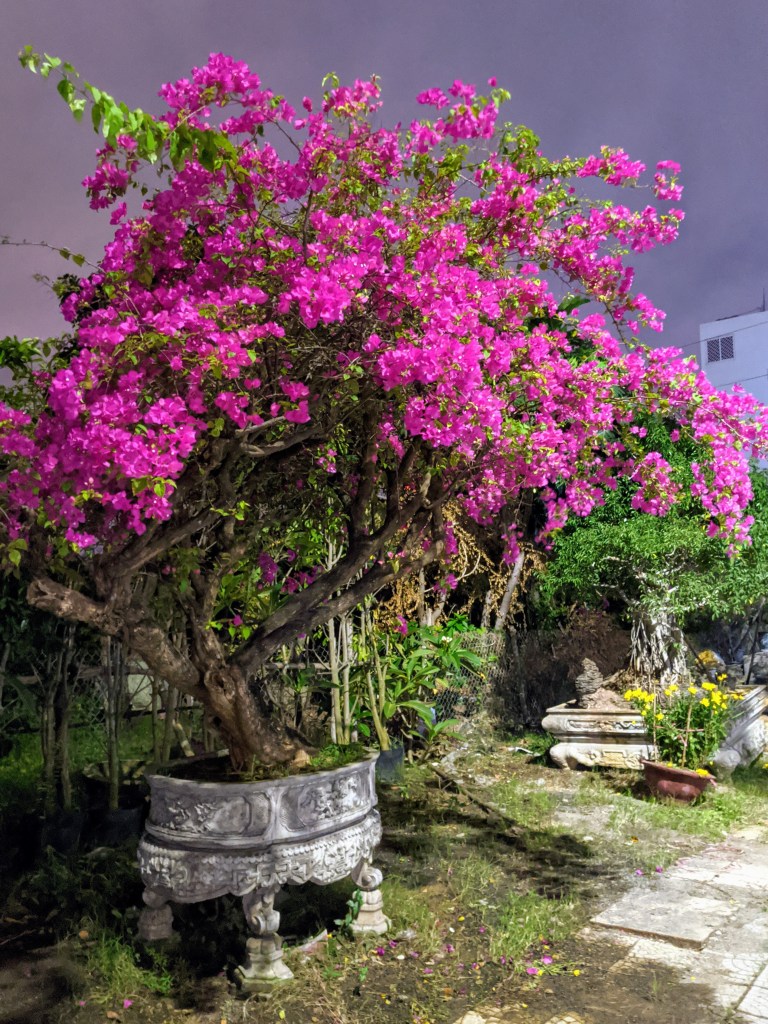
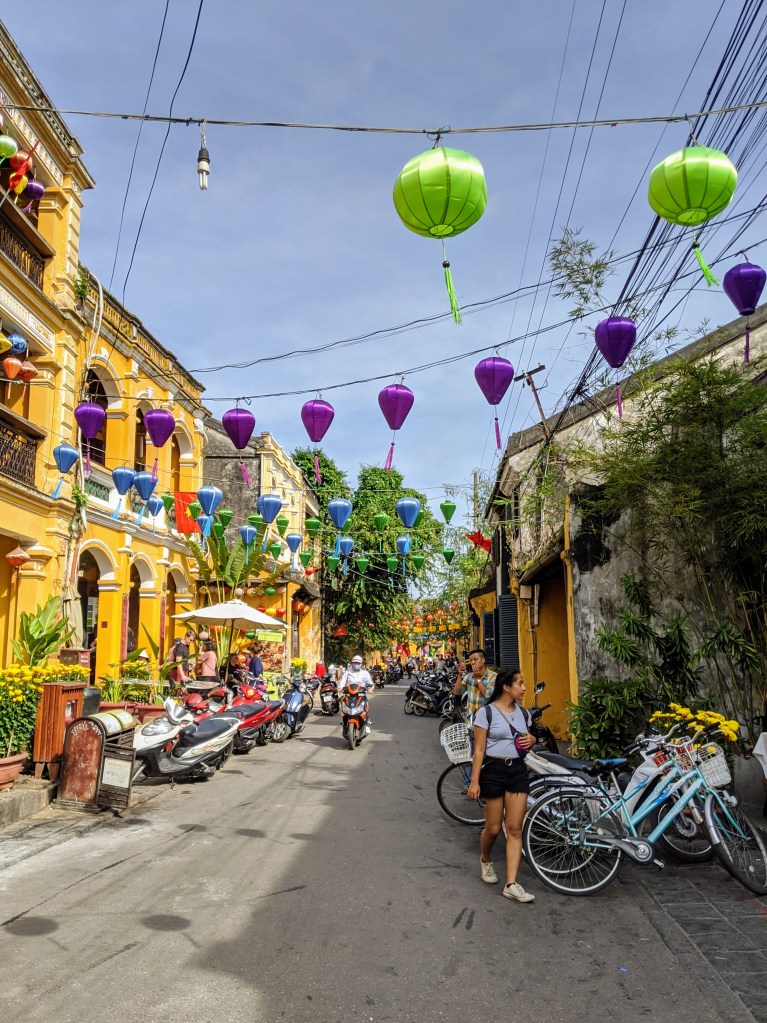
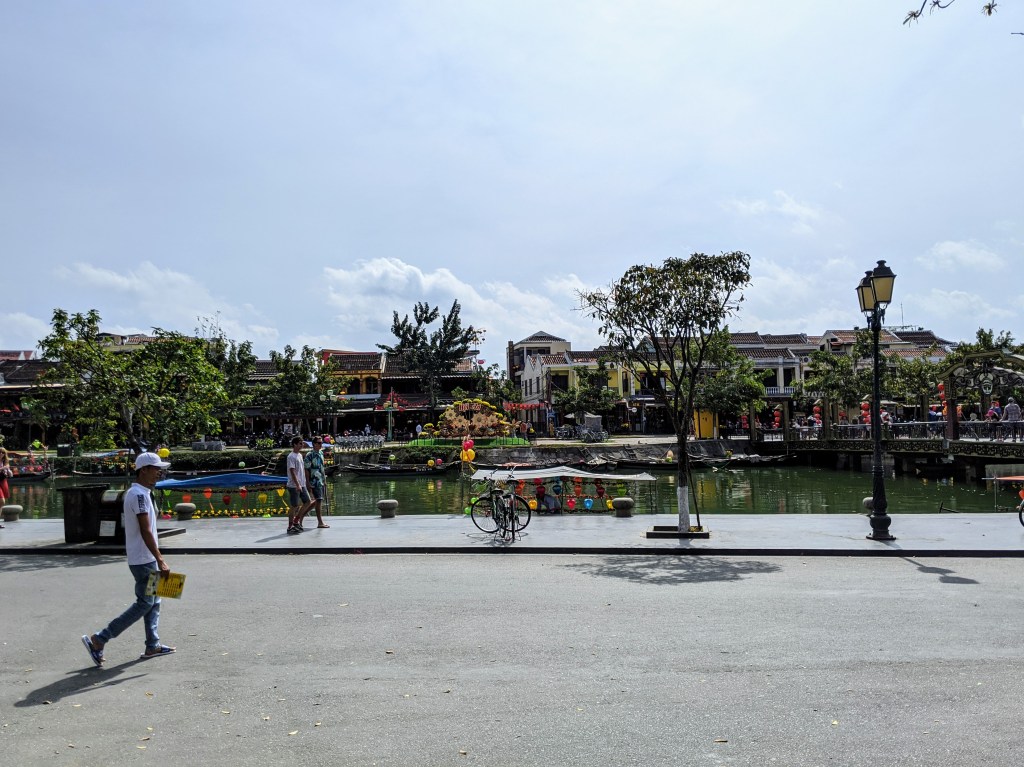
The biggest problem with Hoi An is knowing when to put your camera down. I have never been in a city so photogenic (and I’ve been to almost all the major players in Italy, France, and Switzerland). Sunny stucco and dark teak trim enrobes every French-Colonial building. Nothing is higher than two stories. Bright-pink hollyhock greets you around every bend, in the narrow alleys that lead to the slow, graceful river. And everywhere above, a rainbow of paper lanterns. At night, this city looks like a lit-up kaleidoscope–it’s magical. I think you could probably just point your camera in a random direction and shoot, and you’d end up with something frameable. This is the city that greeted us when we first left Nu Ni Homestay. 

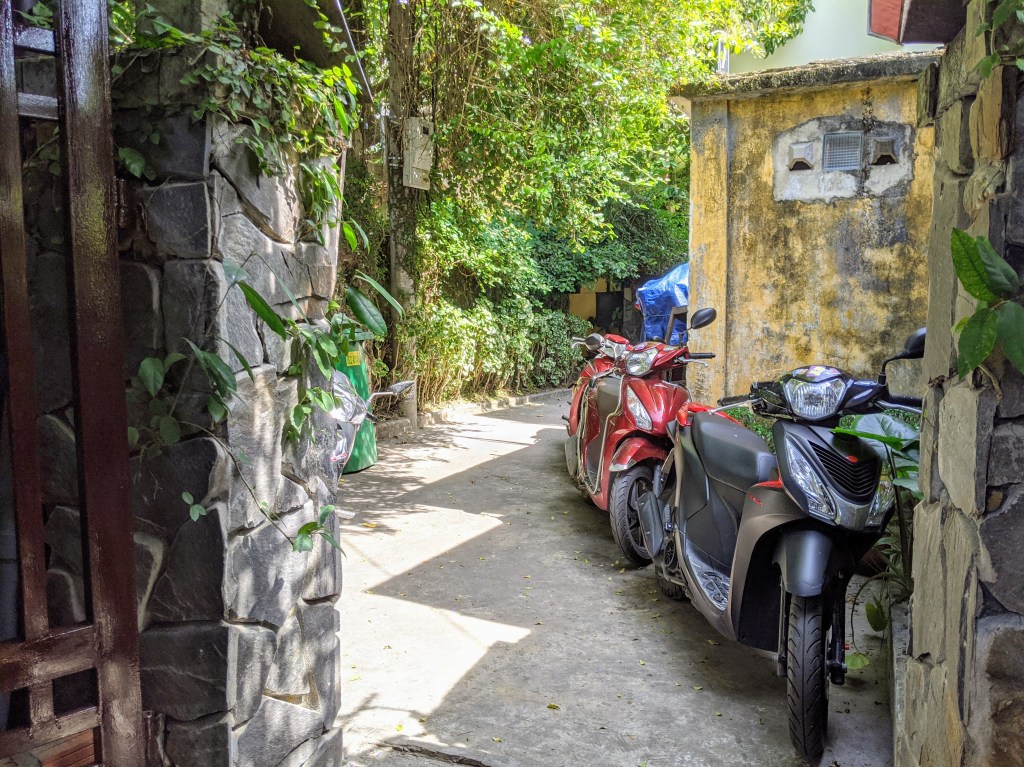
The air was balmy. We made our way through Hoi An’s enticing lanes to a spot at the end of one of its many alleys. Phin Coffee is hidden from the main thoroughfare. That doesn’t stop people from finding their way to it’s secret garden courtyard to get their caffeine fix. This is likely because the coffee is so good and the courtyard so botanical. Aaron and I smeared mustard on an excellent egg croissant and sipped iced coconut coffees while we plotted what to do with our first day in Hoi An.

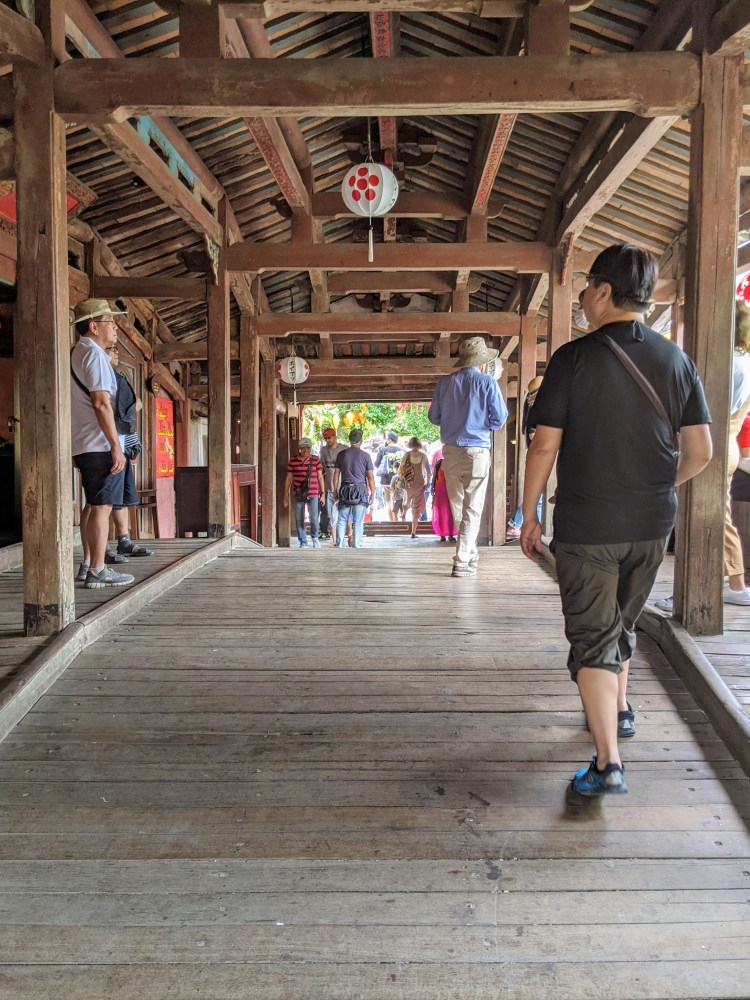
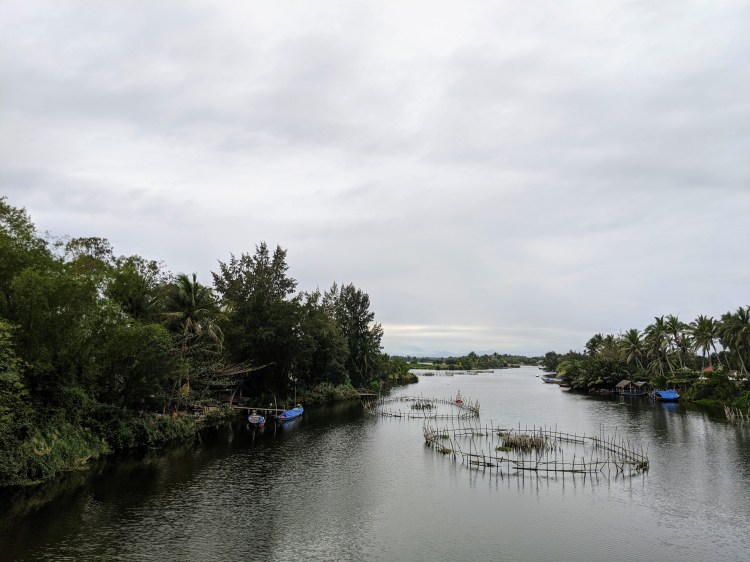
We decided we’d do nothing in particular. We window-shopped her tailoring shops and craft stores, meandered over her bridge and alongside her river. We breathed in the incense wafting from the shops and houses. How could a place be so entirely and effortlessly enchanting? If Hoi An were a person, she’d be that girl you want to hate because she’s always gorgeous without trying, but you can’t because she’s also kind and genuine and just generally lovely to be around. 

We wound up, eventually, on the second-floor patio of Cargo Club, looking out over the Thu Bồn River. Our first real meal in Hoi An was superb. Tiny, fried wonton nachos held fresh tomato and crabmeat, a green papaya salad served as a bed for chewy, dried sesame beef, and steamed, dumpling-dough blossoms cradled shrimp paste and mushrooms. This last dish was called “white rose”; it’s a specialty of Hoi An. All of it was delicious, and entirely unchallenging in a way that Aaron and I really need right now. The only ding I would give them was for the cloying Hoi An Love cocktail, but, in all fairness, our server warned me it was sweet and I ignored her. 

Aaron and I parted ways after lunch. He needed some time to rest in our room, and I wasn’t ready to leave the Old Town. I popped into a couple of clothing shops to admire the handiwork, and eyed some pieces at Reaching Out Craft Shop, where the artisans are all differently-abled. I stumbled upon a coffee shop with good reviews, Mun Cafe. Upstairs, they had a balcony where you could watch the street below. I wrote and drank a chai tea until Aaron could join me again. By then, however, all of my devices, including the ever-convenient external battery we brought along, needed charging. Aaron confessed that he needed some more time in the room (or, rather, his stomach did), so we returned to the room to recharge our stuff and ourselves.

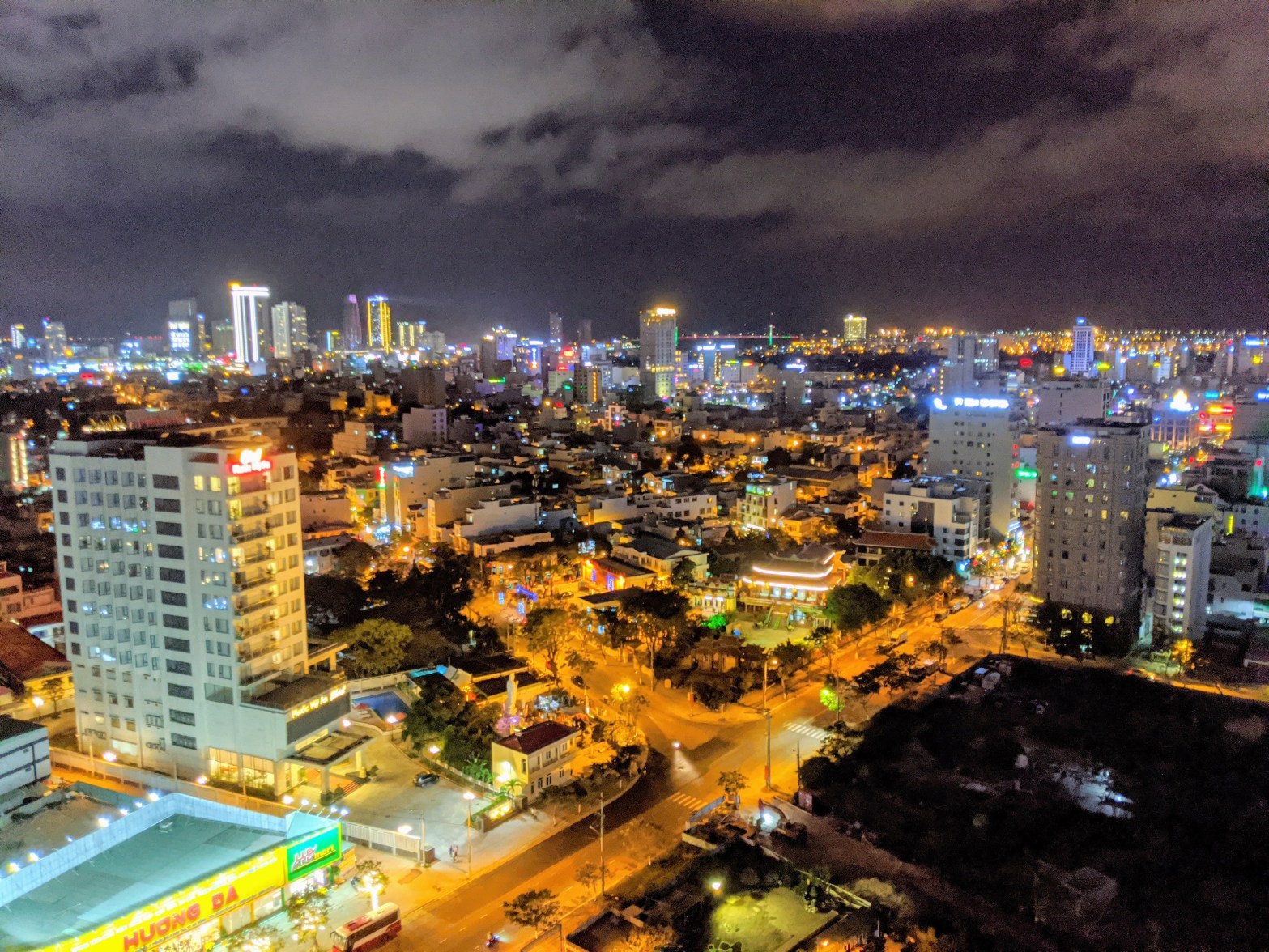
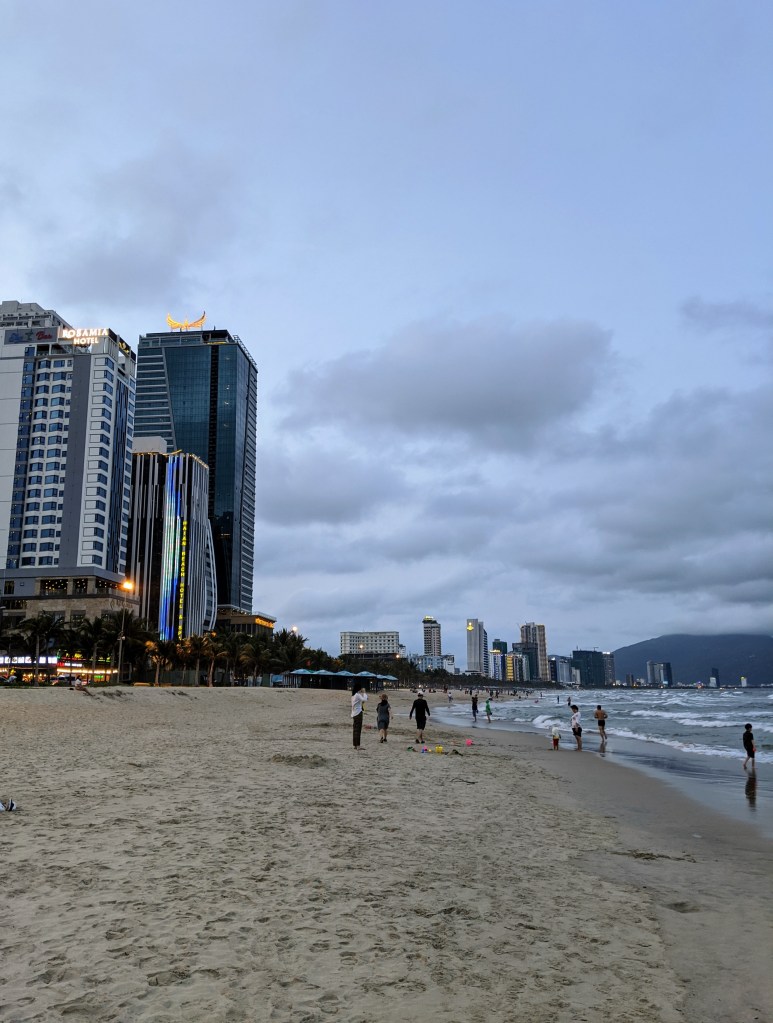
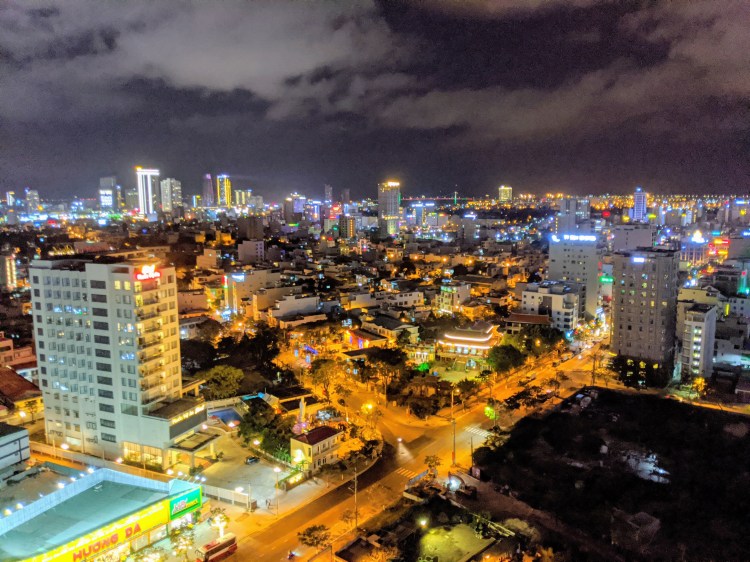
Once we’d gorged ourselves on napping, we decided to taxi up to Danang to see some of the Tết festivities. We started with a walk down My Khe Beach, which is a bit like a cleaner Atlantic City shoreline. Flashing, neon, multi-colored lights drew attention from the waves to Danang’s hotels and resorts, but the cityscape was a dazzling backdrop for our walk. Once it got dark enough, the sand crabs emerged, and there were a heck of a lot of them. I’m not going to say I’m scared of some measly, little sand crabs, but I’m not going to deny it either. We left the sand for the safety of the boardwalk. 

Our dinner reservation wasn’t for another couple of hours, so we stopped in a skyscraper hotel with a rooftop bar for a pre-dinner cocktail. The glass railing at Skybar left an unimpeded view of Danang’s flashing lights. 

Dinner was at Fatfish, which was sort of a weird name for what seemed like, predominantly, a pizza restaurant. Our reservation had secured us a table on the edge of the balcony, overlooking Danang’s Hàn River. I ordered a pale ale; I normally would not, but this was a juicy and not-too-bitter creation from Heart of Darkness, Saigon’s craft brewery. Aaron and I had several spirited debates while we chowed down on some delicious ‘zza: whether every restaurant with a pizza oven was a pizza restaurant, whether white chocolate was chocolate (Aaron said it wasn’t because chocolate comes from the root word for cocoa, I tripped him up by asking if peanut butter was a nut butter and then pointing out that peanuts aren’t nuts), whether hot chocolate and chocolate cake were acceptable forms of chocolate. Mostly food-related, friendly disagreements. For dessert, we found agreement on a passion-fruit crème brûlée. 

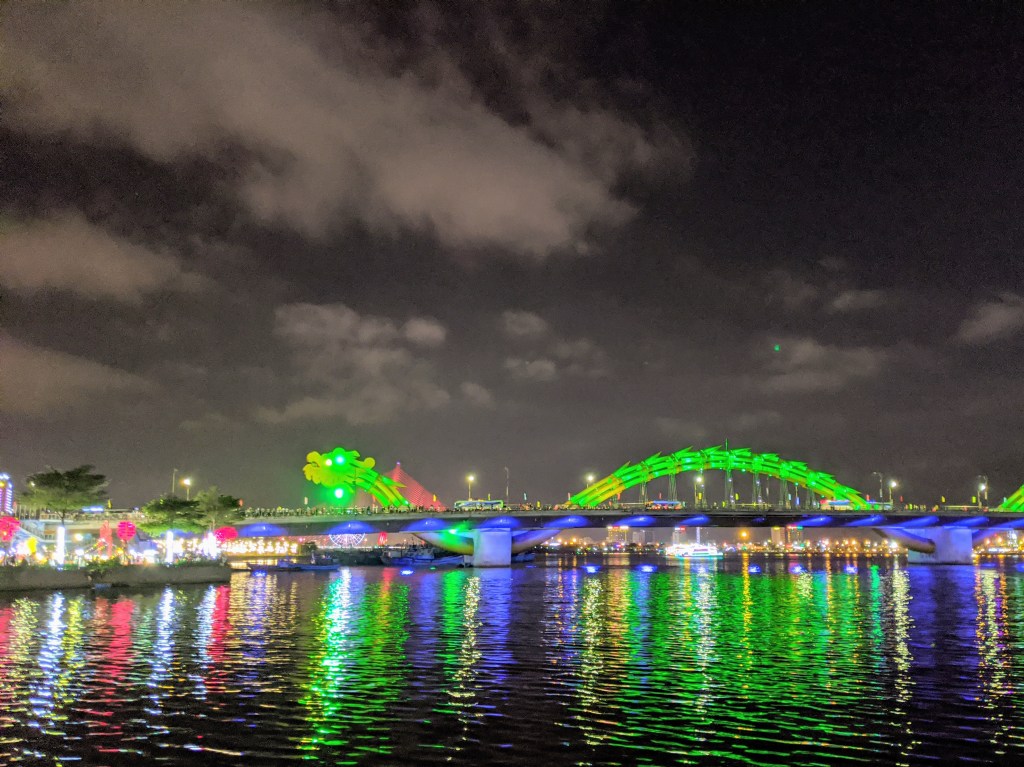
We finished and paid just in time to catch the Dragon Bridge’s show, which takes place every Saturday and Sunday at 9pm. Crowds had already gathered along the river to watch, and Aaron and I squeezed into them. The Dragon Bridge is a working, automobile bridge that crosses the Hàn. Several, consecutive arches run along the bridge’s north side, with a giant, metal dragon head at both ends. Tour boats on the river crowded around these heads now. When the clock struck nine, a giant plume of fire issued forth from the dragon’s maw. Then he did it again, then again. Then he switched to water, raining it down on the gathered masses. It was a sight to behold.

Aaron and I spent a couple of hours exploring Danang’s night market, which had turned into more of a fairground for the Tết holiday. Booths where you could pop a balloon with a dart to win a stuffed animal were mixed in with craft sellers and food vendors. There was also maybe a drag show? This was an interesting thing to witness at such a family-oriented event-space, but there seems to be a lot more tolerance for it here. I think America would benefit from this sort of attitude, cause these Queens were killing it and the kids were loving it and clapping along. 

After, we cabbed back to Hoi An. We stayed up late drinking beer in the room and talking about life, the universe, and everything until we couldn’t keep our eyes open anymore. 

Animal Cruelty: Seen and Unseen

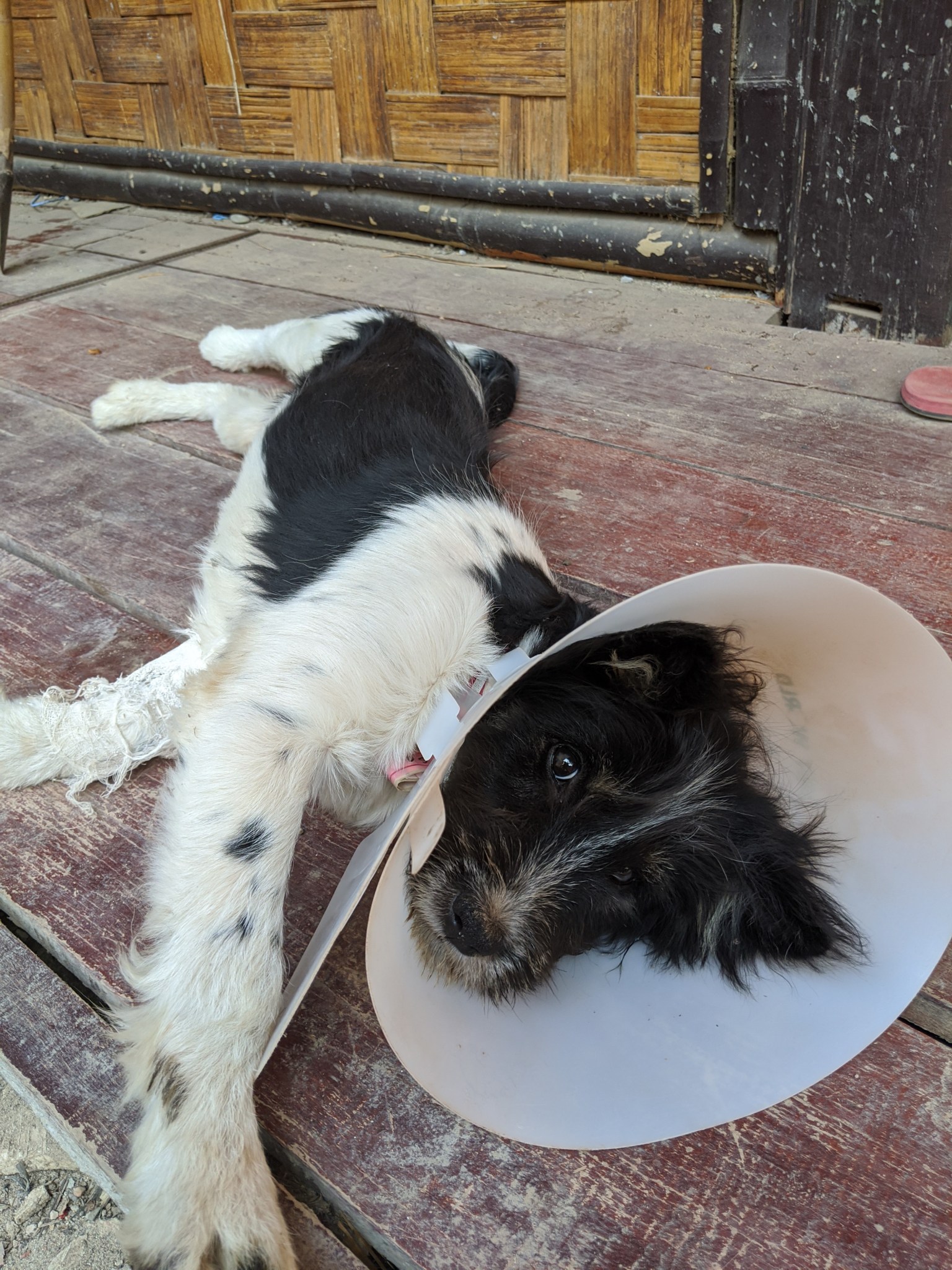
During our travels, we’ve witnessed a number of upsetting scenes featuring cruelty towards animals (skip the rest of this paragraph, if you’re sensitive to animal cruelty). We’ve seen Couscous, our favorite Laotian dog, beaten until he whimpered for chewing at his casted, broken leg. We saw a monkey indefinitely tied to a tree in a backyard on a 5 foot chain, a hellish fate for such a social animal. We’ve seen chickens in tiny cages at a bustling market, literally piled atop each other. Fish in a bucket of water, deep enough to keep most of them alive, but shallow enough to keep all of them almost dead. And scores and scores of malnourished, mangy street dogs–as friendly as if they were homed, even at the brink of death. Sometimes, we’ve even been brought to tears by the things we’ve seen.

Last night, we came upon a pug sitting under a street vendor’s table. When we asked her owner for permission to engage, she gave us a confused nod–a confusion which we initially attributed to language barrier. But her eyebrows only furrowed deeper as we bent over to pet her pet. As soon as we touched the dog, it went absolutely buckwild. It was like our dogs when we get home from an especially long workday. As wads and wads of hair peeled off with each stroke, it became clear that this simple show of affection wasn’t a regular part of its life. This dog was hearty, hale, and starved for attention. As our tour guide to Trang An told us, dogs just aren’t pets in Vietnam (though that fact is changing). It may have been the reminder of our own much-missed pugstrosity Bob, or just the unbearable normalcy of the situation, but this one really tore us up.

This is not to say that Southeast Asia is more cruel to animals than the United States. Much to the contrary, in fact. Considering that 60% of mammals on Earth are livestock, and there are about three livestock animals per person, we can probably conclude that agricultural animals comprise the Lion’s share of living domesticated animals. And there can be little debate that animals in factory farms are subject to abysmal conditions of abuse and neglect. With the United States consuming more than twice the meat, per capita, of Vietnam and Malaysia, and more than four times that of Indonesia, Thailand, Cambodia, and Laos, it’s fairly certain that the United States carries out far more animal cruelty than Southeast Asia (Note: I hate to rely on so many extrapolations. Abroad and without my computer, it’s difficult to research much deeper than Wikipedia. I’m trying to limit myself to self-evident assumptions).

Still, the witnessing of cruelty and neglect in the open has been eating at both of our brains, and I imagine that we aren’t the only ones. While the abuse may be less widespread, it is certainly more visible. This may harm both non-human and human animals alike.

What’s often left out of the debate about animal cruelty is the effect it has on its witnesses. Research has shown that witnessing animal cruelty has a profoundly negative effect on children. Children, particularly in difficult situations, confide in pets and see them as family members. When they witness the abuse of those same animals, they are often forced to harden themselves to the very creatures they consider family. Others may just be haunted by memories. “I remember my mother selling my dog to the neighbour for dog meat. I saw him drowned and cried for him to be saved. I’m still haunted. I love dogs and will never eat dog meat.” said Ngoc Linh, a young Vietnamese woman.

Perhaps even worse than the effects on witnesses is the effect on perpetrators. When I see videos of factory workers excessively prodding cattle, or fur traders skinning live animals, my first response is self-righteous anger. But upon consideration, it’s hard to stay angry, given both my own culpability and the basic fact that nearly every one of us would do the same given the same conditions. Farm workers are people like you and me. They have families they love, friendships they cherish, and often pets they love and care for.

Yet each day, they are compelled by supervisors and economic necessity to be villains in the lives of thousands of animals. This sort of dehumanization has deep and lasting effects on perpetrators and their communities. After controlling for many demographic factors, US counties with slaughterhouses suffer violent crime arrests at four times the national rate.

Having worked in science and witnessed (and perpetrated) things that I would consider necessary evils, I’m familiar with this pattern. What kept me up at night early in my studies was cold and routine by the end. While I wouldn’t consider myself to be traumatized, I lost a certain amount of empathy that I’m not sure I’ll ever recover.

I wonder how the harm we’ve seen in our short stay in Southeast Asia affects both its witnesses and its perpetrators.  How do children feel watching their parents beat their beloved pets? How does the normalness of a man walking down a crowded market with terrified parakeets chained to a post affect the locals who know him by name? What’s the human cost of witnessing all of that suffering?

The intuition that originally inspired me to write this post was this: if mistreatment of animals is visible, people will be inspired to action. But the anecdotal evidence doesn’t seem to support my hypothesis. The United States has manifold, if insufficient, animal protection laws. Vietnam enacted its very first enforceable animal welfare legislation in 2018, despite having far more visible animal cruelty. This was a milestone achievement, but also suggests a historical lack of activism and action concerning animal rights. It’s hard to identify the causality in this case; it may be that a lack of activism and legislation allows a greater visibility of cruelty, but it may be that desensitization to cruelty slows action.

Recalling my previous post about morals, culture, and self-determination, I’ve also been thinking a lot about our moral responsibilities as outsiders and witnesses. Anna and I have a running joke since we’ve been here: “It’s our job as tourists to leave a legacy in this country.” A Hanoi scooterist flying through a crowded market (which doesn’t faze locals a bit)? It’s definitely my job to stand my ground and teach him what sidewalks are for. But it’s no laugh when the Hanoi scooterist is a teenager beating little Couscous, earnestly believing that this is an effective and humane way to train him.

Anna earned her PhD in Animal Behavior. She is a professional animal trainer. She can say with near certainty that using punishment to teach a dog is both less effective than reinforcement and has significant side effects (beyond the obvious suffering physical punishment causes in the immediate). Our saying something would, in theory, be beneficial to both Couscous and his owners. From a utilitarian perspective, it seems a very straightforward moral dilemma. An animal is suffering, has no way to advocate for itself, and we are observers with the ability to intervene to the benefit of both parties. The worst case scenario is that someone gets their feelings hurt.

But in these situations, both of us have consistently failed to speak up. In part, that’s just bystander effect: people tend not to speak up in the face of injustice provided there are others around to witness it. Surely someone else will say something, right?

But there’s an additional layer of complexity. If I were a tourist in Cambridge and witnessed a middle class family mistreating an animal, I doubt many would oppose my saying something. But there’s a long history of white people forcing the hands of other cultures on the basis of alleged moral superiority–the proverbial white man’s burden. In response, many on the left, ourselves included, have developed a strong aversion to white folks intervening in the lives of people of color. It’s a completely understandable response to a long history of brutality and self-righteousness. But it seems that, at times, it may discourage individuals from taking action in what seems a morally straightforward situation. If I equate a conversation with peers to imperialism, I may choose inaction at the expense of the very people I’m trying to respect.

However, there’s one other layer, and that’s a simple fact about people: everyone believes their cause to be worthwhile and morally obvious. Evangelical Christians truly believed that missionary work in Africa was saving souls from eternal damnation, even though their work justified atrocious regimes that maimed and murdered countless indigenous people. I’m writing from a country that my own country ravaged in the name of “democracy.”

Scientists are still bickering over whether what animals experience as pain can be called suffering, so can we really assume the minimization of pain towards animals to be a universal moral good? Maybe I’m an ignorant colonialist–and I don’t mean that sarcastically–but I believe that minimizing harm to animals would have far-reaching benefits. Even if animals don’t experience true suffering, the human cost is too great to ignore.
Halong Bay: Day 2

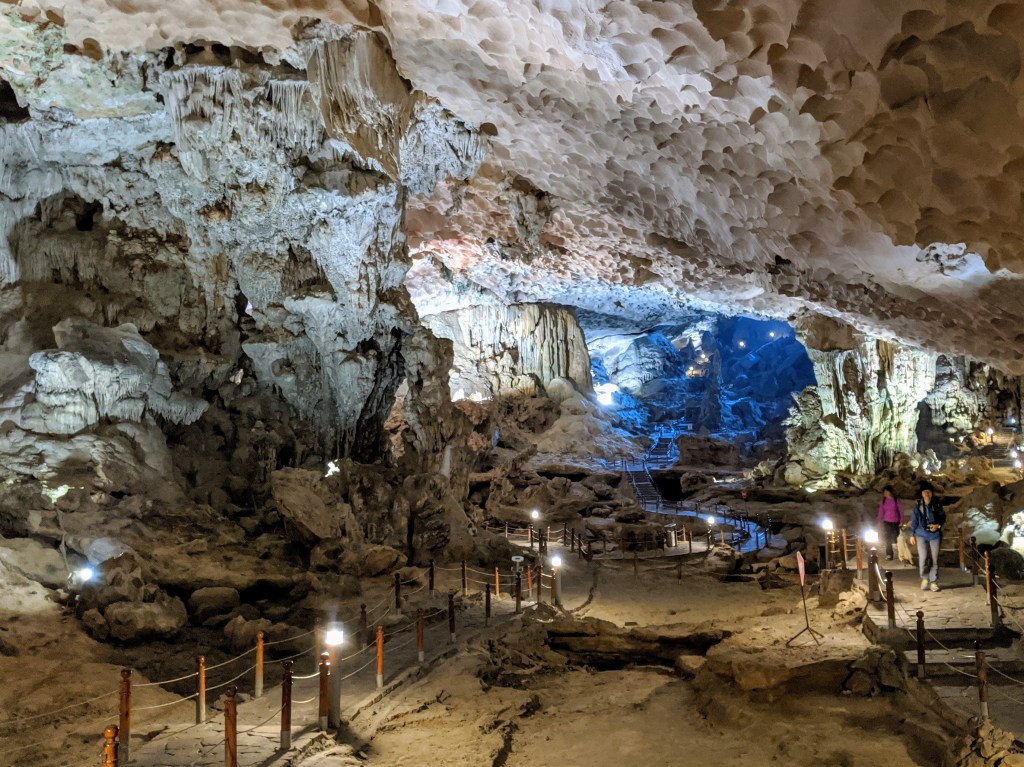
Breakfast was served at 6:30 in the morning. We were told this the night before, but Last-Night Aaron and Anna were fine with making that Next-Morning Aaron and Anna’s problem. Those guys can be some real jerks. The reason for our early rise was that we were trying to beat the crowds to the most popular grotto of the bay: Sung Sot, or Surprising Cave. This plan worked; we arrived early enough that we only shared the cave with one other small group. This cave was significantly larger than the other ones we had visited in Vietnam, but not as large as Tham Lot in Thailand. It was lit by colored bulbs, giving it a gimmicky glamour. As with all previous cave tours, our guide (this time, Binh) once again told us very little about the cave, and instead pointed to different formations and told us what they looked like: a woman washing her hair, an elephant, a monkey clinging to a tree. This was made all the more comical by the fact that the other tour group’s guide was giving a full-on lecture on the history and geology of the cave, while Binh… well, Binh was pointing to a rock and telling us it looked like a dick. That’s right–a dick. To be fair, he wasn’t wrong. The cave led to an impressive overlook that gave an expansive view of the islet’s natural harbor. We stopped here briefly for photos, then returned to the pontoon. 

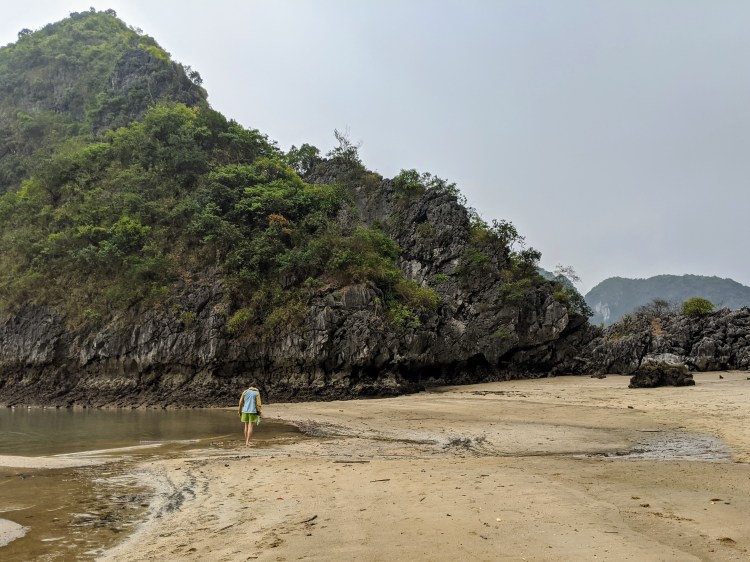
A while later, we were pulling up to the docks of Titov Island. Now, by this point, Aaron was falling asleep on me during the boat ride. He was miserable. I had gone to bed at a late, but reasonable-ish hour the night before–not so with Aaron. He just wanted to lie down on the beach of Titov and take a nap. But everyone was insisting that we climb to the top of the island’s steep hill to reach the panorama at it’s summit. We climbed, stopping everyone on their way down to ask if it was worth it. “Totally!” they all said, “but the view is better from the balcony at three-quarters of the way up.” Aaron and I agreed that three-quarters of the way up was good enough, especially if the top wasn’t all that nice anyways. We did get a long view of the different bays from up there, but we were both happy to go back down without having conquered the mountain. We spent the rest of the time lazing around on beach towels. 

We transferred boats, because of some confusing maritime laws, to get to Cat Ba Island. Everyone picked out a bike at the dock’s rental shop, while I secretly pouted about how I wasn’t going to get to go on the super fun cycling tour because I never learned to ride a bike (are you reading this, Mom? Why didn’t you teach me to ride a bike?). Instead, I was getting a scooter ride to the next stop. I never caught the man’s name who drove me, but he was very kind. He only spoke a few words of English, but we quickly developed a rapport with hand gestures and simple phrases. We left my tour group in the dust, and I stuck my tongue out at them for having the gall to do something fun that I couldn’t join. Then, we made a game of wishing everyone we passed a happy Lunar New Year. “Chuc mung nam moi!” I would yell at passersby, and they would look at us confused. And my driver would laugh his head off at this white lady mangling his language. If you know anything about Vietnamese, you may have noticed that I left the diacritics off that phrase. This was intentional. I didn’t pronounce these words like they had diacritics and I might as well be honest about the fact that I suck at tones.

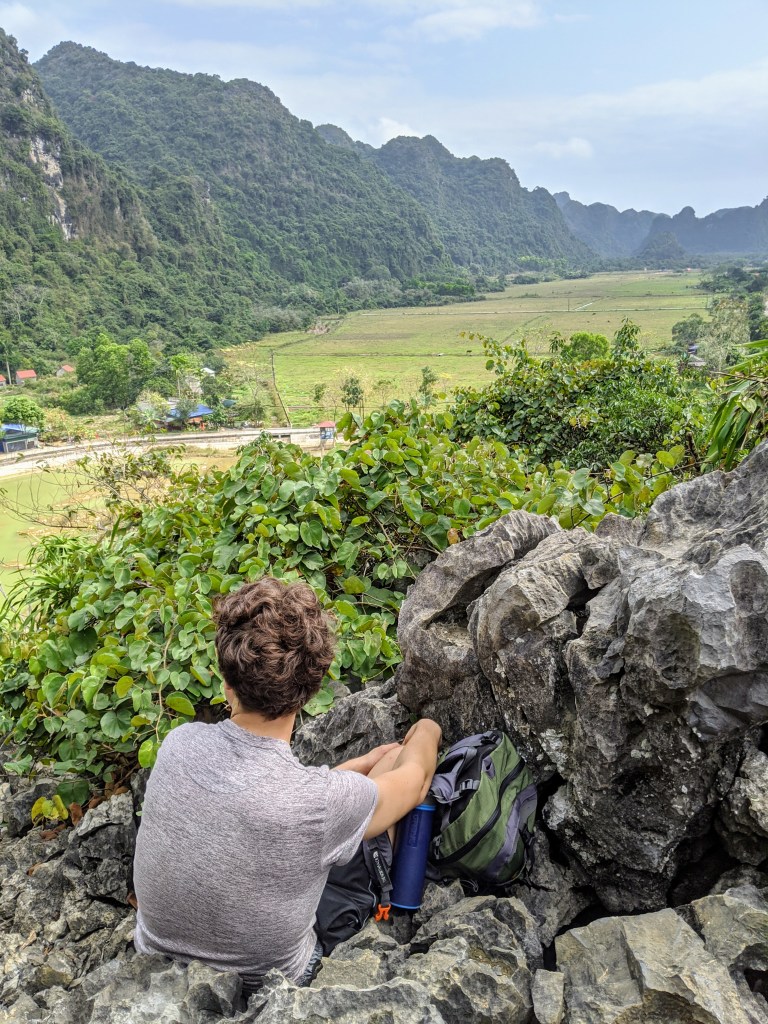
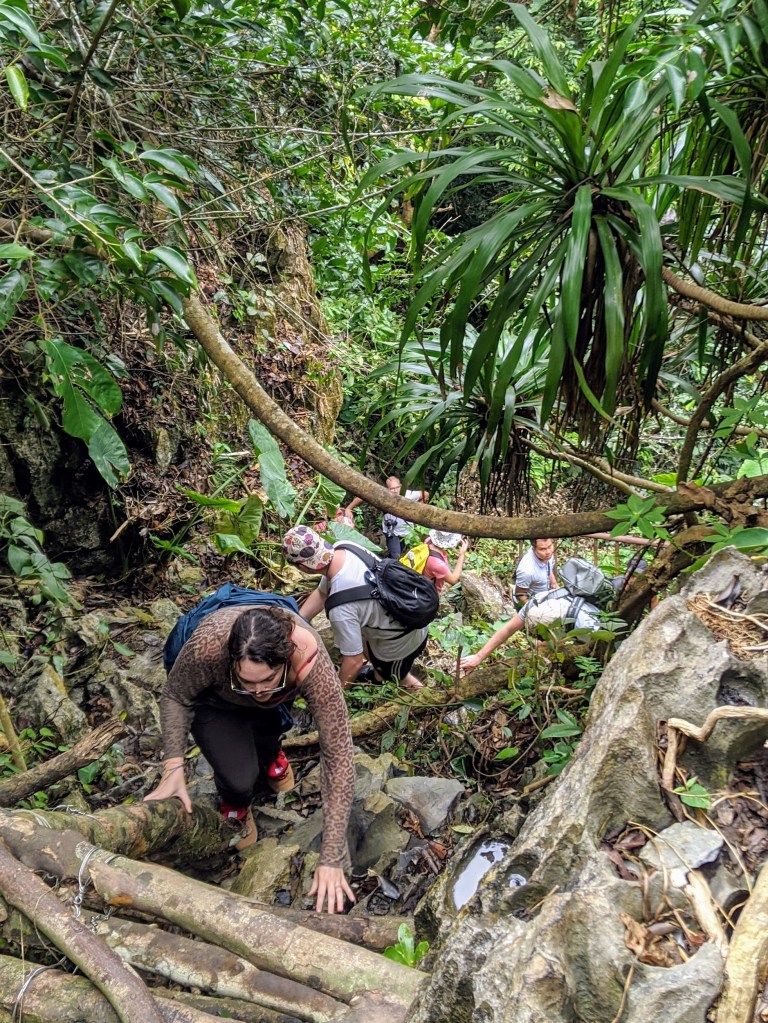
I arrived at our meeting place only fifteen minutes before the others. Once we’d re-grouped in Viet Hai village, we set off on our jungle trek. We walked through the well-maintained trails of Cat Ba National Park until we came upon yet another small cave. Bat Cave was inaccurately named, but served as a gateway to another beautiful vista. Our trek then led us to a rock scramble. Binh warned us it was 30% dangerous. After, once we’d all survived, our Australian friends joked that if that was 30%, they’d hate to see 60%. It was heart-racing, and only partly because of the athleticism. There were a couple of points where I thought, “Cool, hope my ankle doesn’t give out like it has a bajillion times in my life, or I’ll be a mangled mess on those sharp limestone crags below.” You know, fun thoughts like that. But as scary as it was, it was also enjoyable and rewarding. I could see myself getting into rock scrambles. 

I got another scooter ride back to the docks. My driver told his daughter to tell me it was nice to meet me and then asked for a picture. I’m guessing it was so he could make fun of my inability to ride a bike or pronounce simple words with all his friends. 

All of this–Surprising Cave, the hike up Titov, relaxing on the beach, the scooter ride, the jungle trek, and the rock scramble– all of it took place before lunch. It was genuinely a wonder we didn’t resort to cannibalism. This lunch was probably the closest we ever came to actually finishing off the food we were given. 

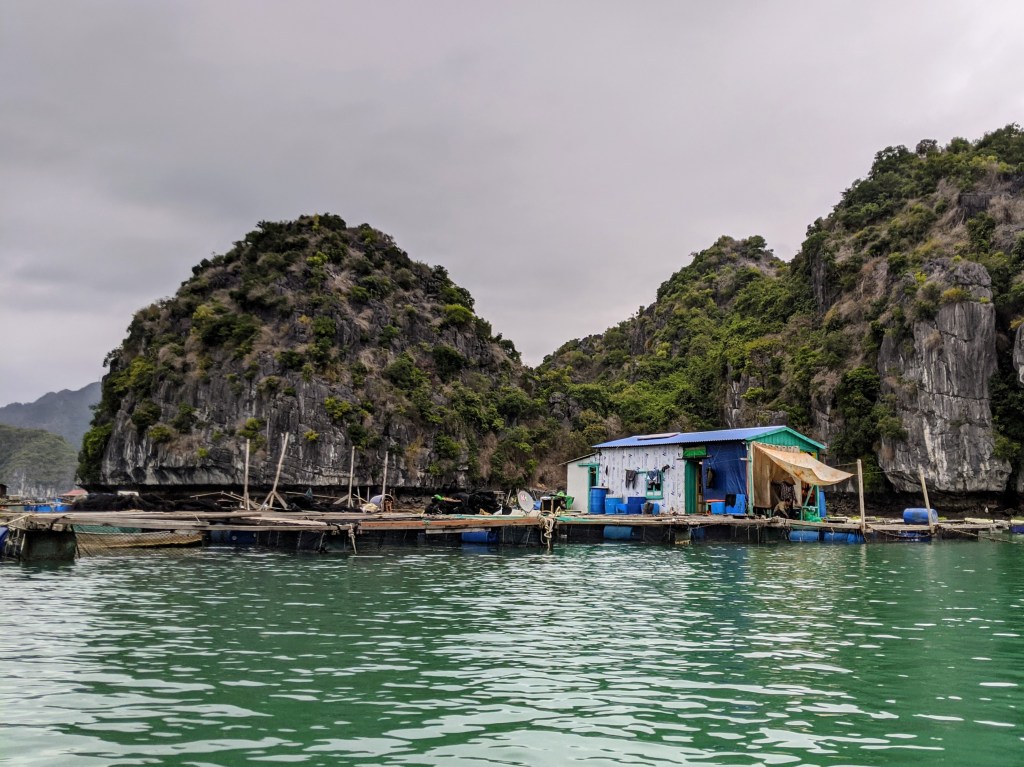
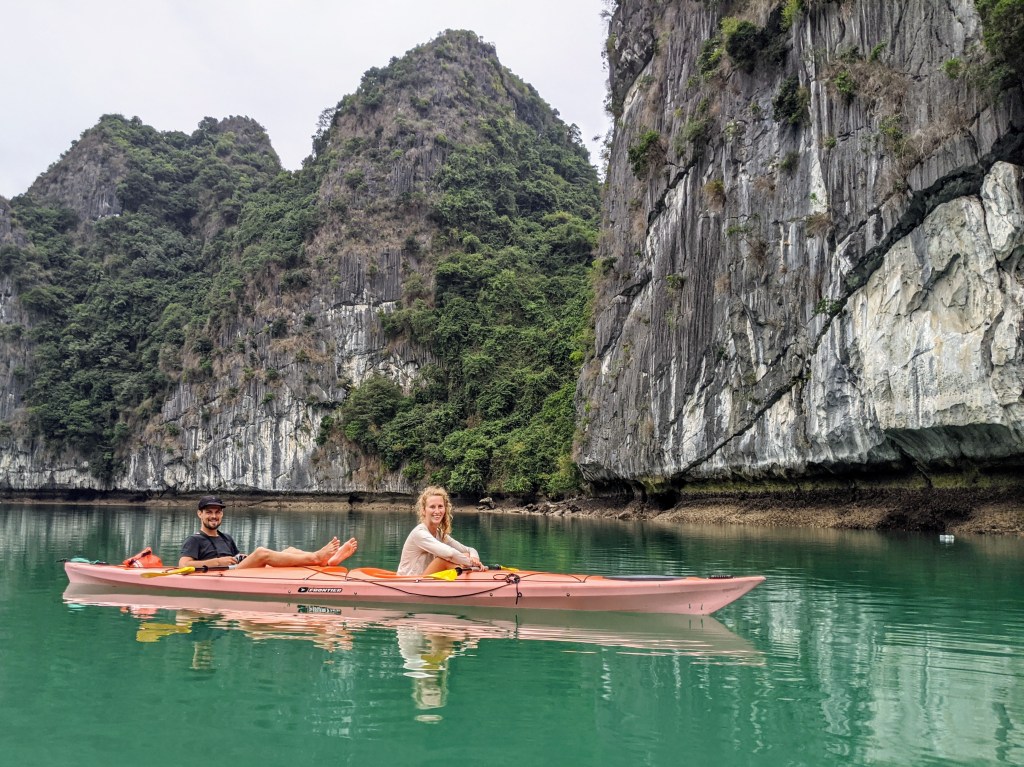
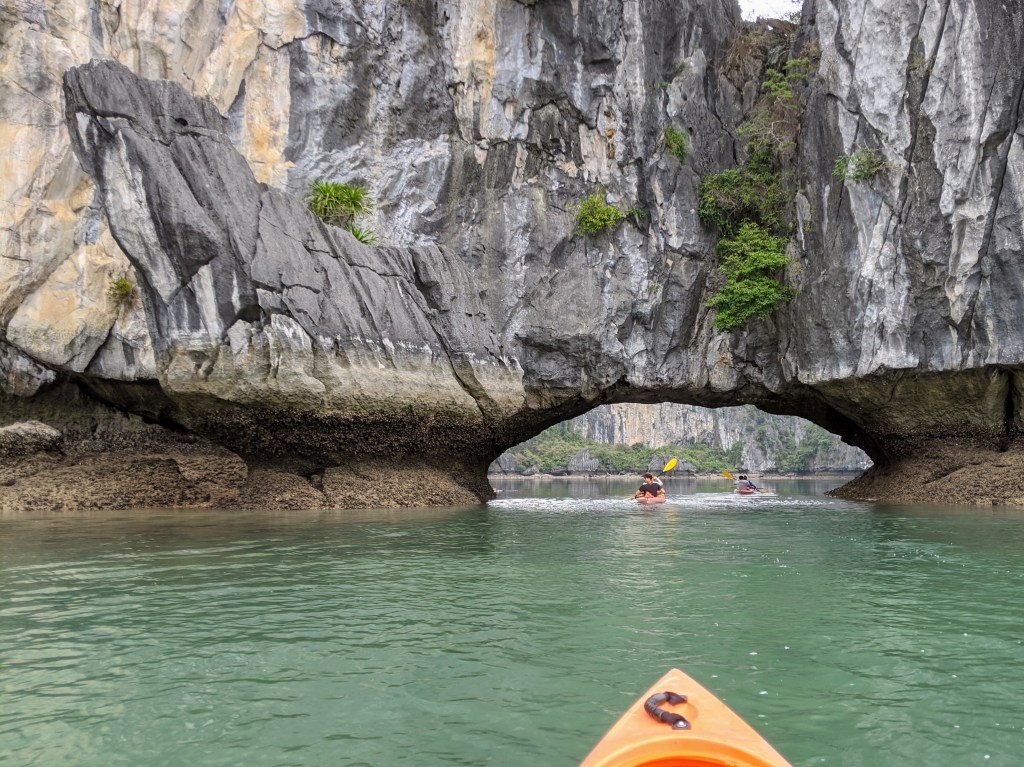
But we weren’t done. We spent lunch docked at a floating pier with an adorable dog (also, she had just whelped some equally adorable puppies–awww). Now we disembarked onto that pier and got into our second kayak of the trip. Binh led the way again, taking us past fishing villages, under a natural arch in the limestone, into a small, still, sound. We rested here long enough to appreciate its peace, then paddled past a floating homestay. A shirtless dude called out to us as we passed, “Party here at dusk! You’re all invited!” I don’t think any of us made it, but if you ever read this, shirtless stranger, I hope it was a rager. 

After our kayaking outing, our boat took us to a pristine piece of the bay for swimming. Our Swiss friend kicked it off by jumping from the second-level balcony of the boat. Aaron and the Aussies soon followed. I just climbed down the ladder on the side. I’ve jumped off tall things into water before, and it was mostly an exercise in getting a swim wedgie and some saltwater up your nose. The water was crystal clear and cool. Some might say too cool, but to them I say, “you get used to it after a little bit!” 

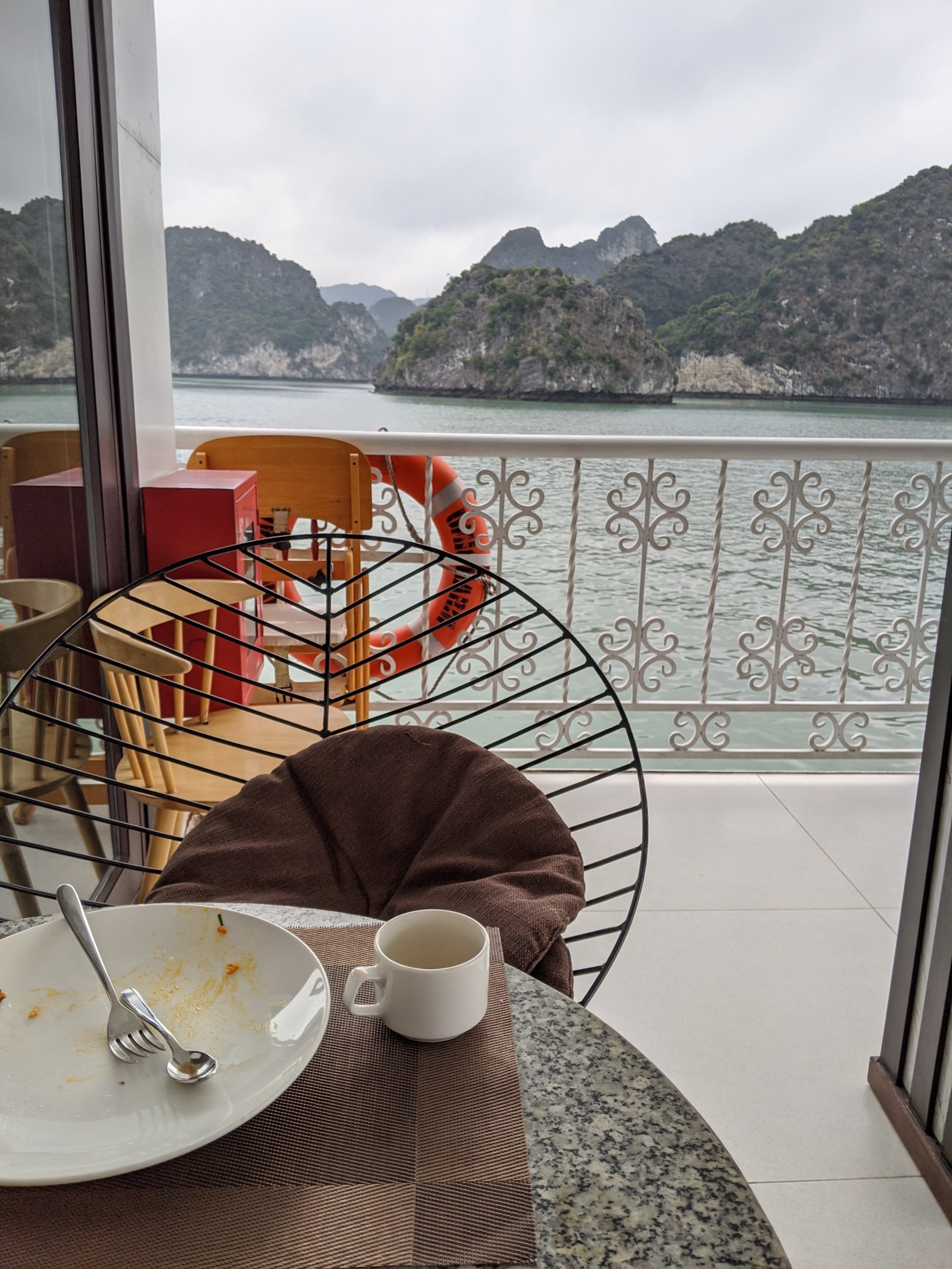
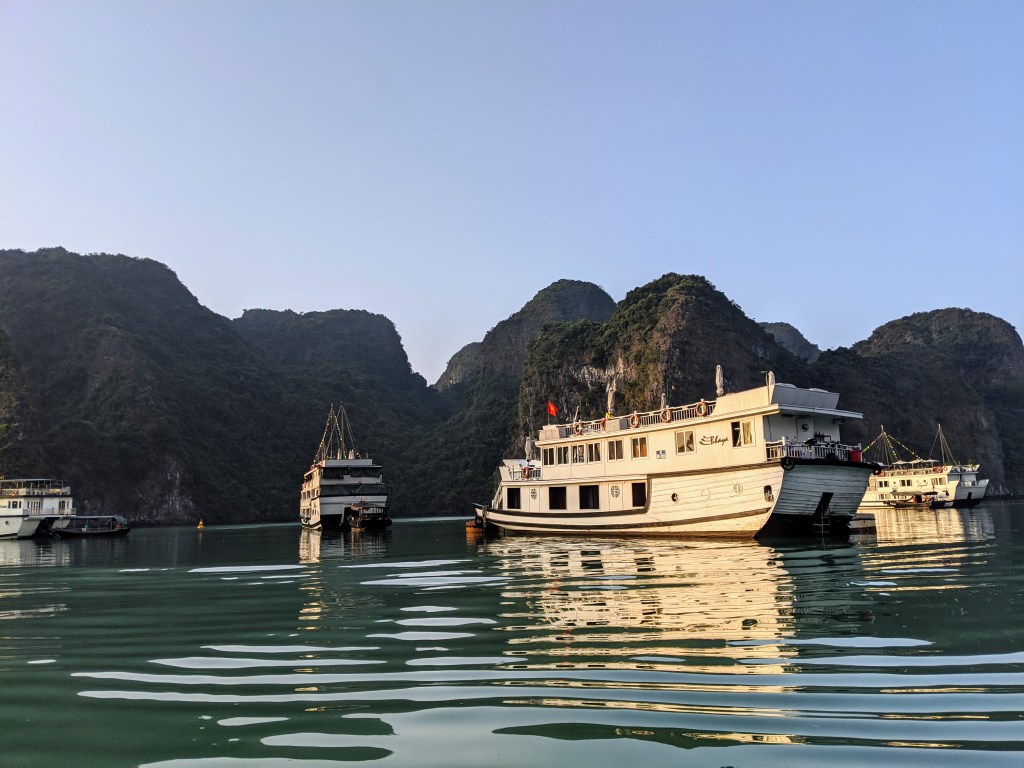
Finally, and somewhat tragically, it was time to part ways with some of our group. Half of us were going to a hotel on Cat Ba Island for the evening, and the other half, which included Aaron and me, were transferring to a luxury cruise ship for one night. We said our goodbyes and promised to Facebook, then boarded the shuttling pontoon. This cruise ship was much larger than our last one, and also much more lavish. The floor was polished granite. Our room had wide, floor-to-ceiling windows looking out at the bay. There were bottles in the shower labelled “men’s shampoo” and “women’s shampoo”–that’s how fancy this ship was. 

Aaron and I napped until happy hour, then went to the upper decks to watch the scenery float by, while sipping white wine and talking about music with our Swiss companions. Before dinner, there was another cooking demonstration, this time with fried spring rolls. Our instructor went by the nickname Qua-Qua, and he was the biggest ham we’ve met in Southeast Asia. He pretended to be an MTV VJ the entire time, holding up a napkin like a microphone. It was endlessly charming, to tell the truth. Once again, it came out that Aaron and I were on honeymoon, and of course, that got incorporated into his whole routine. 

Dinner was a barbecue buffet that was basically the same quality as the food we had on the last ship. We got to try the spring rolls we made, though, and they were scrumptious. The rest of the night was spent chatting with our boat-friends, but we were wise enough to know when to quit this time. Every now and then, Last-Night Aaron and Anna look out for Next-Morning Aaron and Anna. 

Halong Bay: Day 1

The ride to Halong Bay from Hanoi is about 2 and a half hours. We rode on a bus with the other tourists on our cruise, as well as our tour guide, Binh. Binh was to-the-point, but also charming and funny. He spoke impeccable English. He asked us all to introduce ourselves. There were a pair of Taiwanese sisters and their friend, a mom and her two daughters from Belgium, two young Australian dudes, a solo German guy, and another couple from Switzerland. When it was our turn, I made the mistake of letting everyone know Aaron and I were on honeymoon. From then on, our romance was the butt of every joke, but it was all in good fun. “In Vietnam, we have one of the fastest-growing populations. This is because we eat a lot of warm sweet potato. Maybe a man, he eats sweet potato. It’s warm in his belly. He wakes up in the middle of the night and wants to wake his wife up. Anna, maybe if Ann [everyone calls Aaron “Ann” here] eats too much sweet potato, you tell him slow down,” Binh said, laughing. “I don’t know. They are on honeymoon!” someone called out from the peanut gallery. This continued most of the way to our port of call. 

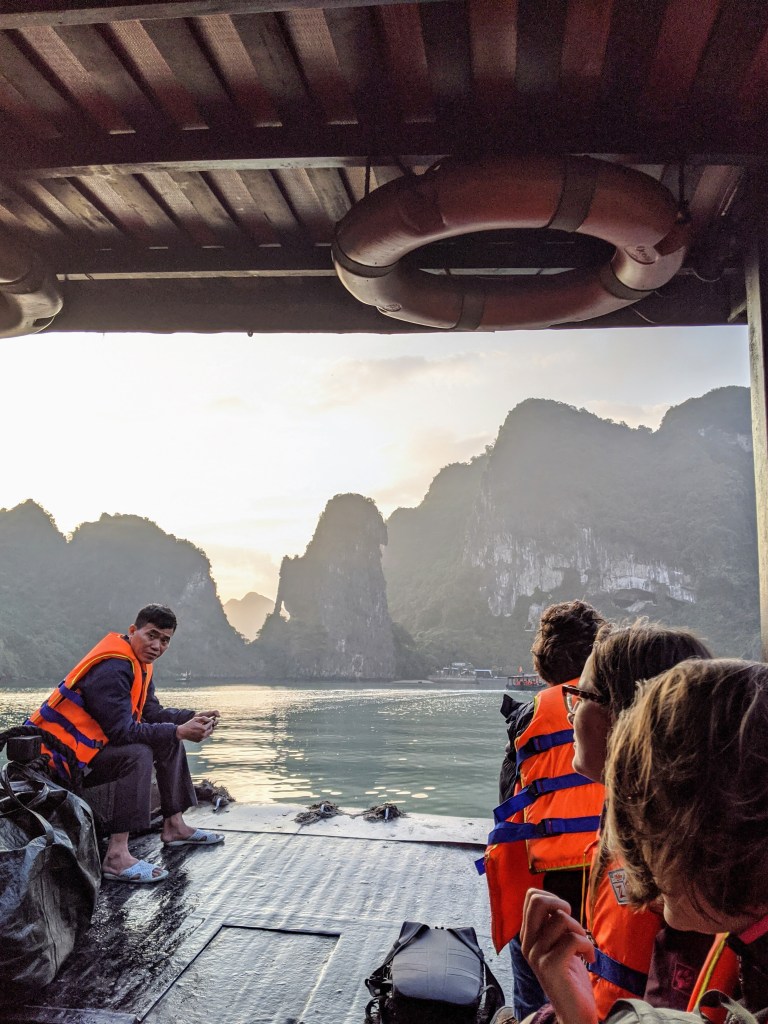
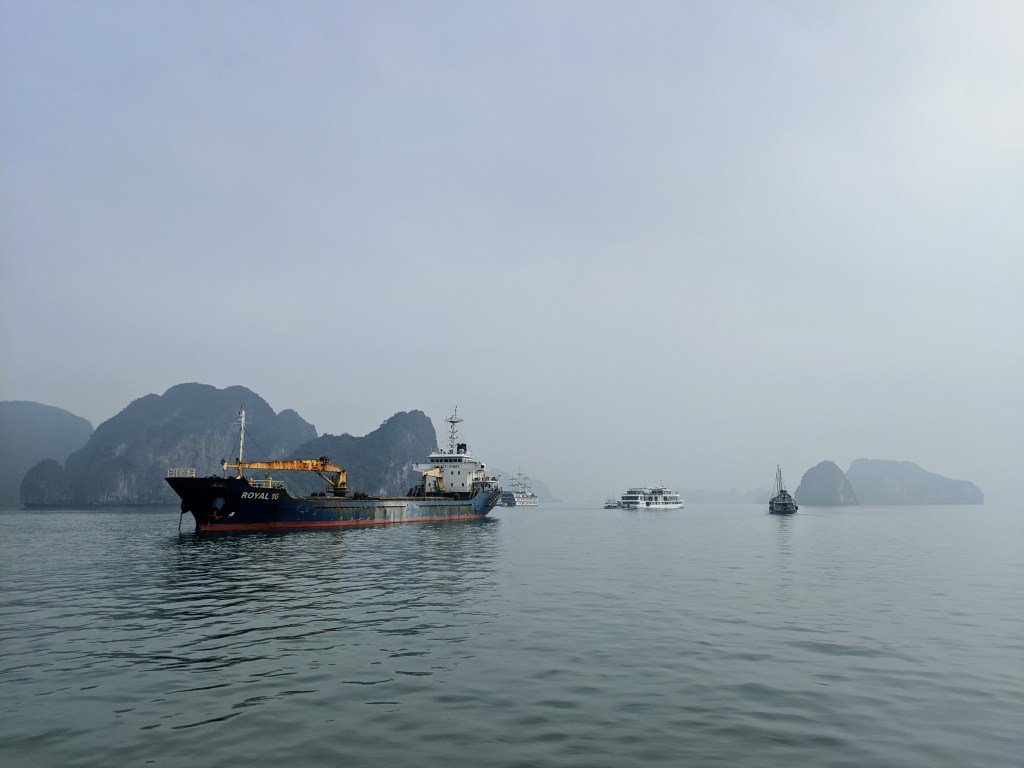
We transferred from our bus to a pontoon, and from our pontoon to a small cruise ship. It had wood panelling and a general 3-star feel, but it was small and comfy enough to seem homey. The air was chilly today, and the bay was foggy. We stood on the deck and watched the hazy, mammoth karsts drift past us. There were no other boats for as far as we could see: nothing but olive green waters and the rocky forms jutting out of it, enveloped in gray. It was like a lost, ancient world. A Jurassic sea monster would not have looked out of place here. I shivered to see the shifting, Stygian shapes. And then, it was time for lunch. 

I don’t really remember our first lunch. Every meal on the tour was neither good nor bad, and was remarkable only in the amount and variety of dishes presented. Inevitably there would always be enough leftovers to feed another tour group of the same size. What I do remember, though, is getting acquainted with some of our fellow passengers. Aaron was, at this time, giving a go at being a vegetarian on the trip, so we were sat with the other similarly-diet-restricted travellers. They were genial, intelligent, and well-traveled. We asked them about their plans and where they’d been, and I told them about a certain canal they needed to row down in Ninh Xuan. Both the German and Swiss guy worked in tech, while the Swiss woman was a neuroscientist, so we also had a lot to talk about career-wise. It was a very pleasant conversation, and set the tone for the rest of the trip, when we would get to know all of them a bit better. 

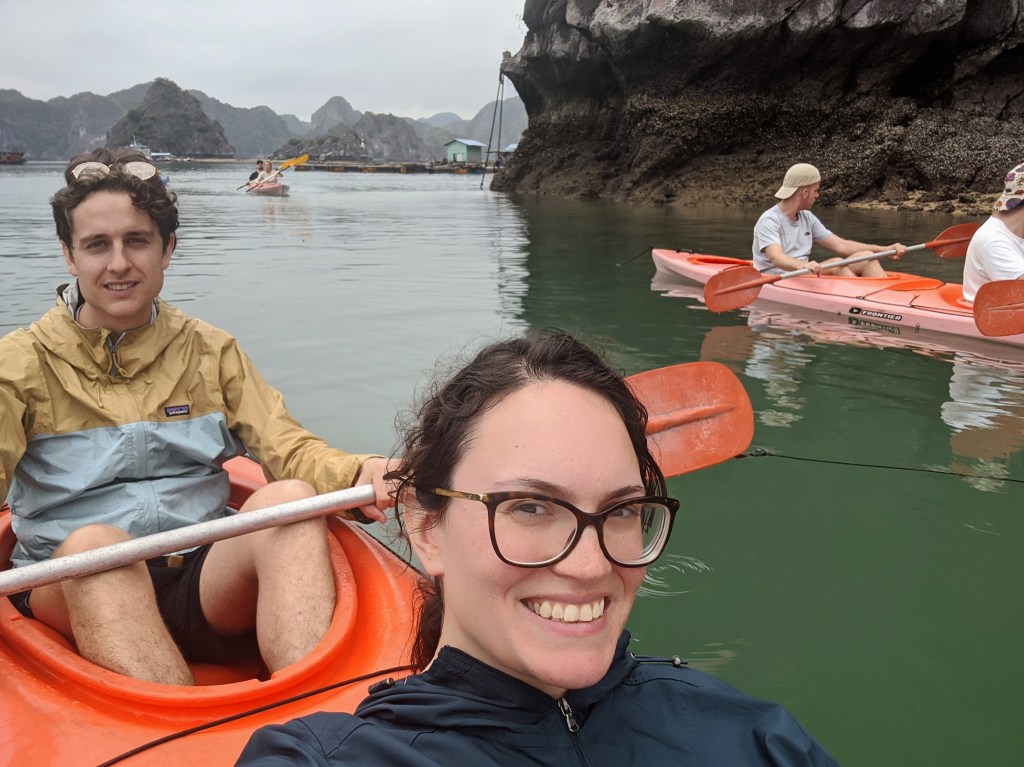
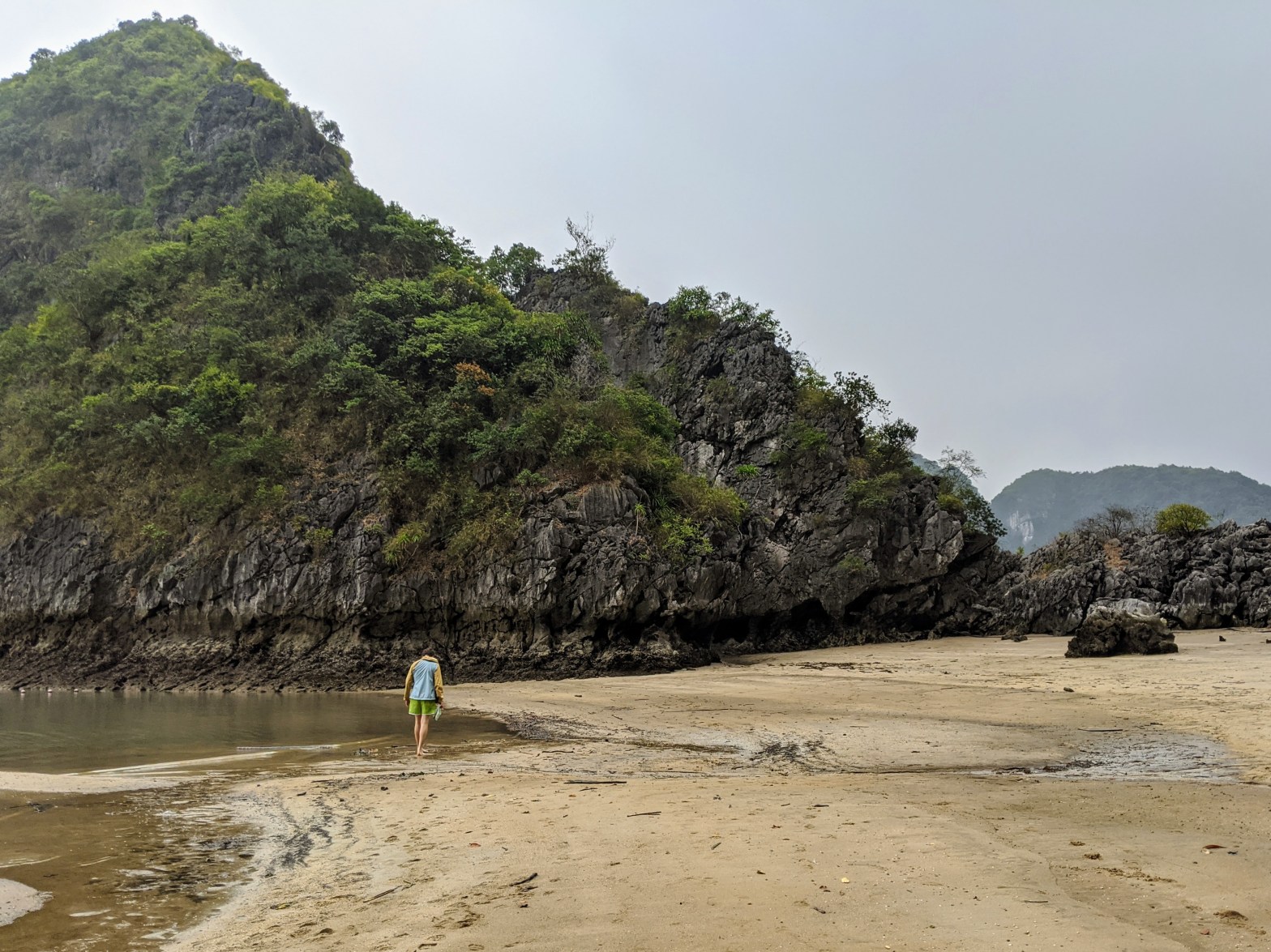
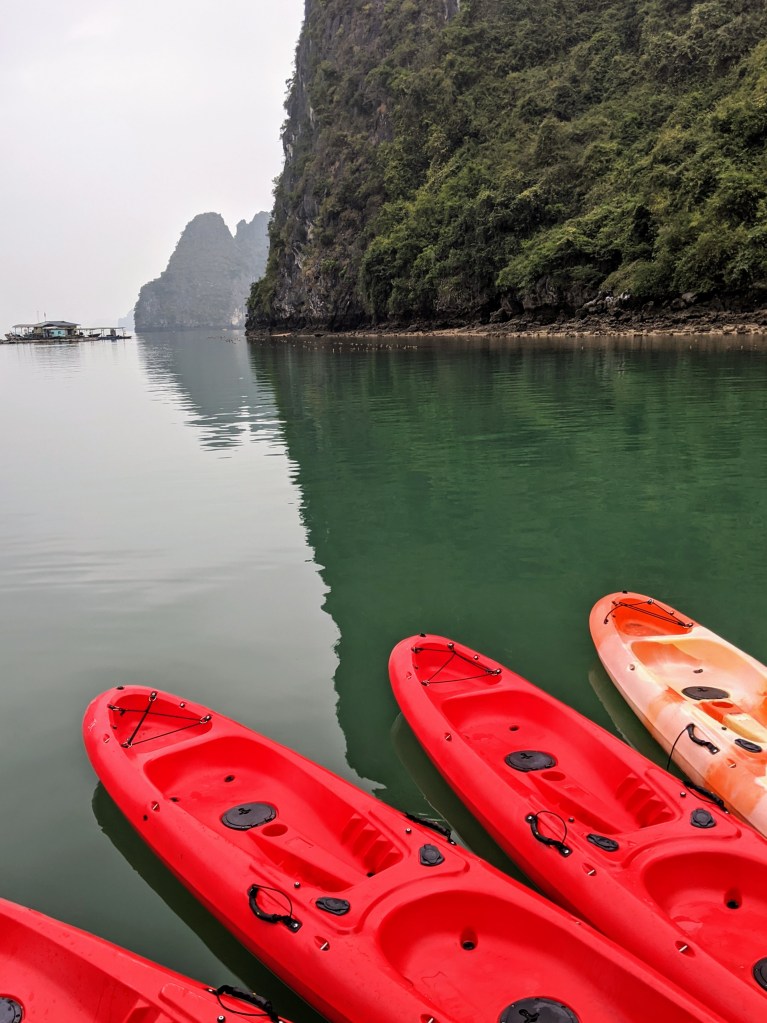
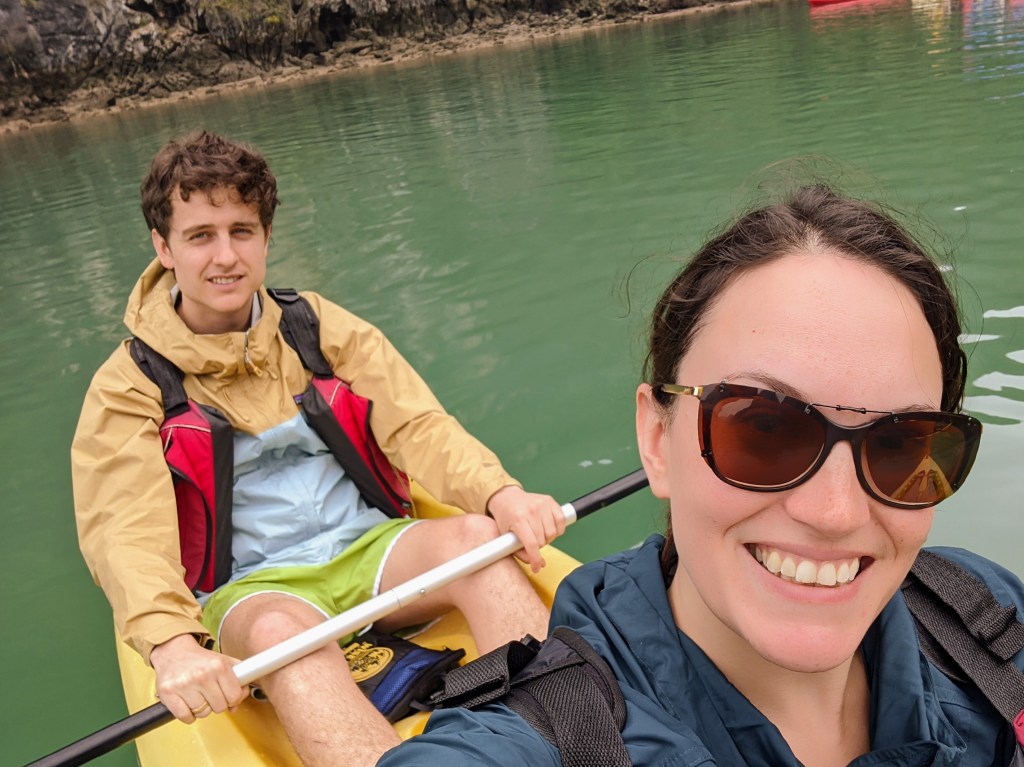
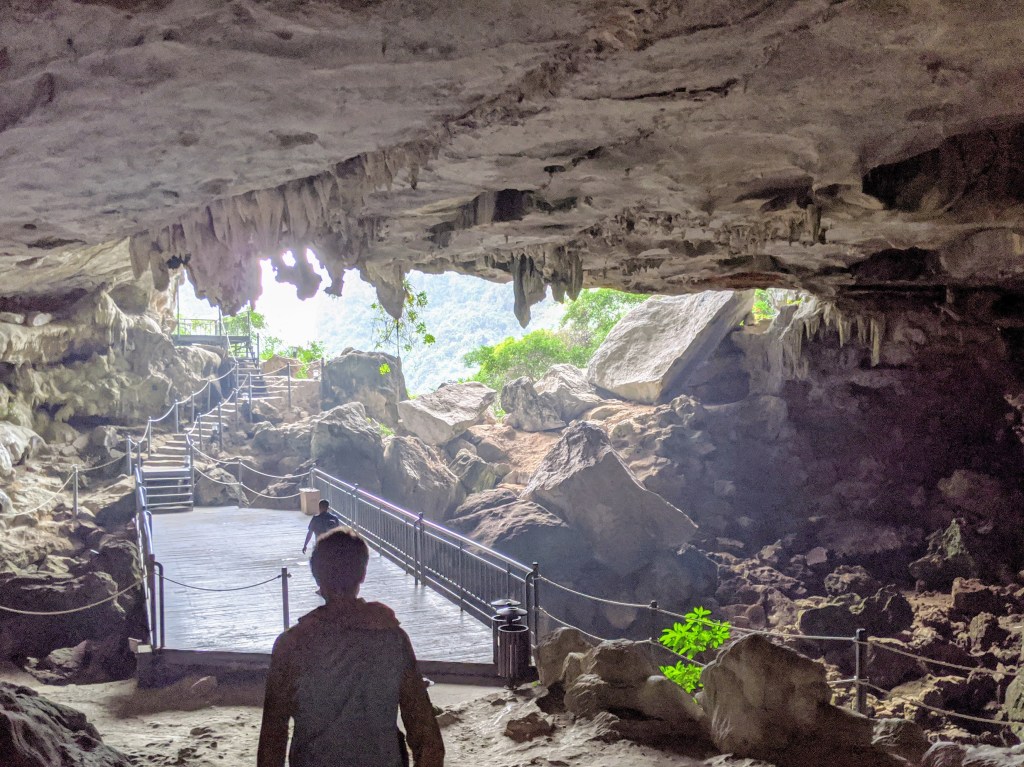
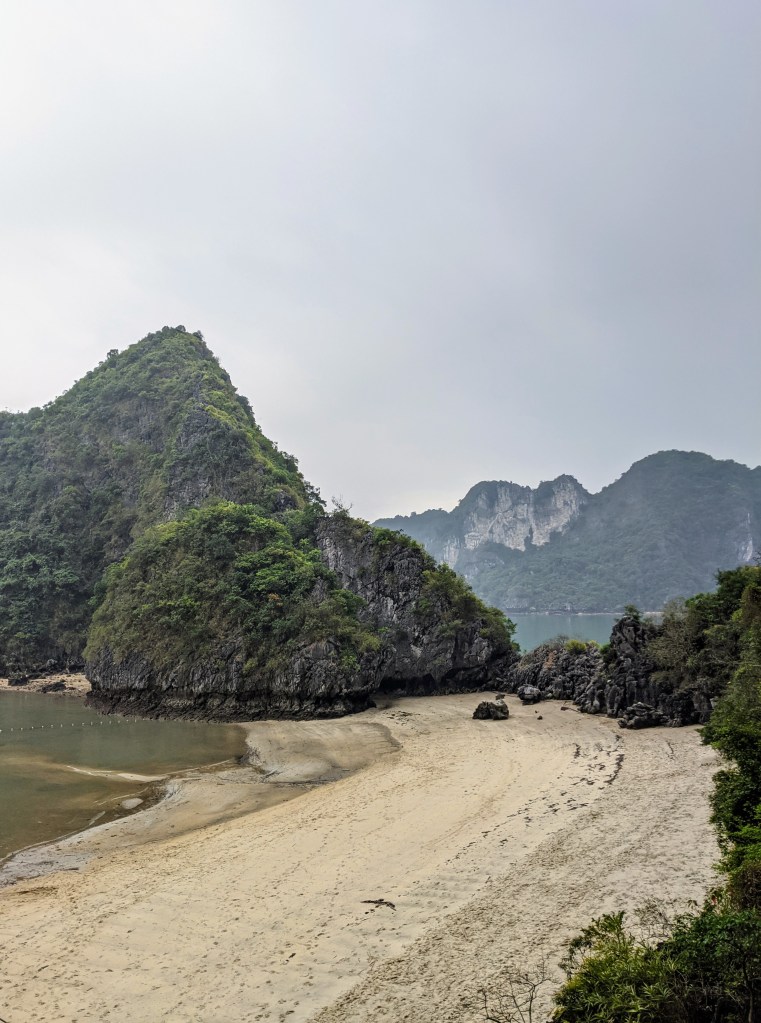
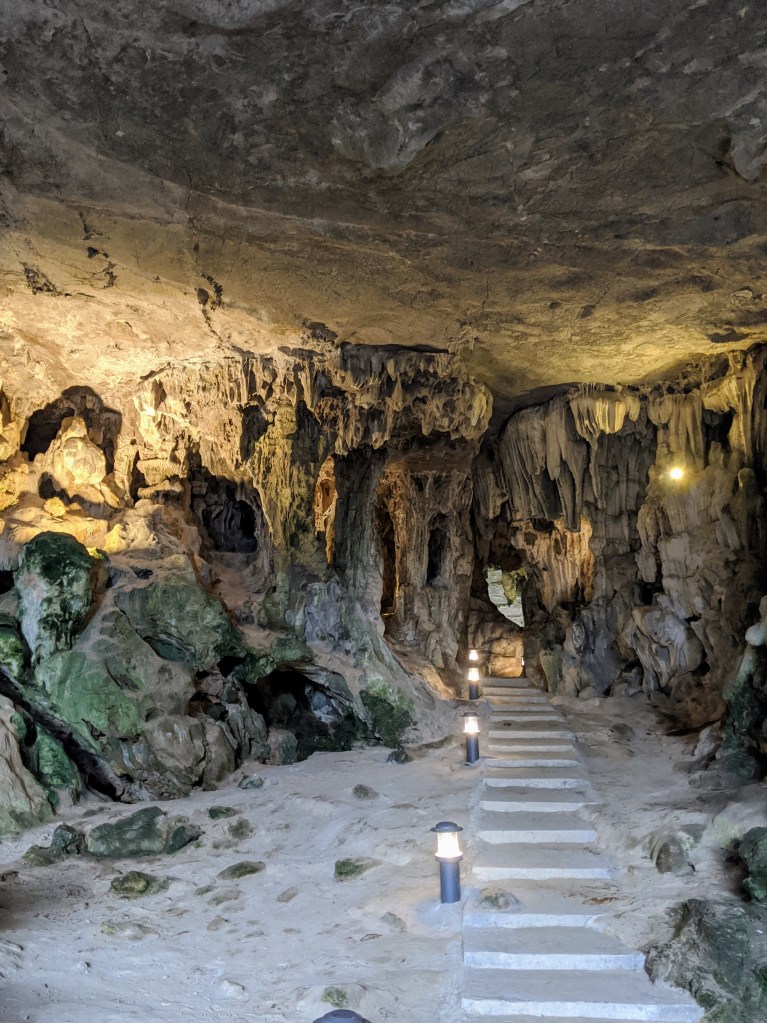
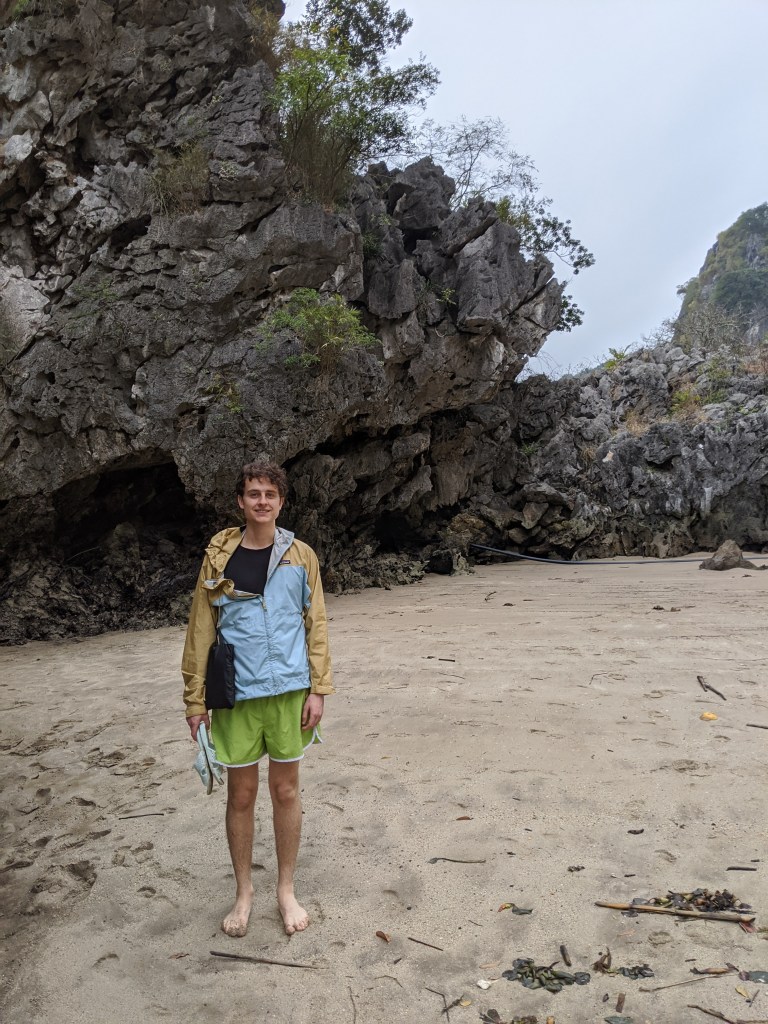
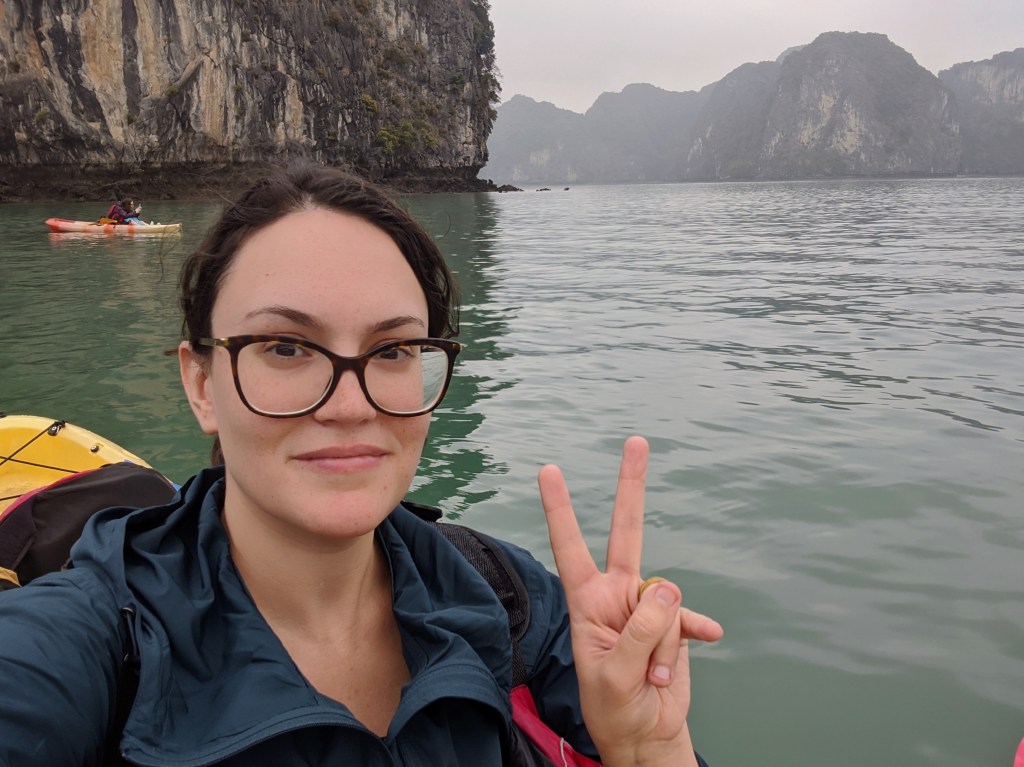
Once we were sufficiently fueled, it was time to burn some of those calories. We returned to our pontoon, which dropped us at a dock. The dock was piled with kayaks and oars in bright, primary colors. Each boat could hold two people, so Aaron and I got in a yellow one and started paddling. Binh led the way, but Aaron and I (surprisingly, if you know how lazy I am and weak my upper-body strength is) were able to keep pace. Binh would stop every now and then, to explain how the fishing traps nearby worked or to tell us some trivia about the bay. Eventually, we shored at the gaping entrance to a cave. The cave was small compared to some of the caves we had visited recently, and definitely heavily touristed; it had stairs cut into its inclines and footlights installed along the path. Binh told us it was called “Virgin Cave,” which was kind of an ironic name for a cave that was obviously frequently entered. It led to a deck overlooking a tiny beach. We climbed down to the shore, and spent some time with the sand between our toes. Then, we went back the way we came and returned to our kayak. 

We rowed around the large karstic island until we came to a small inlet. Binh told us this area was good for swimming. I was tempted to give it a try, until Binh explained that we would have to haul ourselves back onto our kayaks after. I have only ever tried to get back in a kayak from water once, and I ended up tipping the kayak and being unable to right it. Aaron went for a dip in the chilly waters, though, as did several of the other young men on the tour. There was a lot of “Ooh! It’s cold. It’s really cold!” and the ever-popular “you get used to it after a little bit!” 

Our next stop was another cave, this time named “Drum Cave.” This one had a spunky, vocal dog waiting for us on its shore. He seemed wary of us, and kept a sharp eye out. Binh explained that this cave used to host dinner parties, but that local authorities had put the kibosh on that business. It still held several tables and chairs leftover from that time, and the dog was kept here to guard them. Vietnamese people, or at least the ones we met in Hanoi, really seem to have a completely different attitude towards dogs. Everyone we talked to said dogs were for guarding things, and seemed to think it was weird that westerners treated them as companions. Aaron and I were pretty bummed to think about this dog spending every day alone on this island, its only visitors tourists it had been trained to distrust. But, you know, we keep pigs in metal crates so small they can’t turn around, so who am I to judge? 
After returning the kayaks and boating back to the cruise, it was happy hour. We went to the topmost deck to enjoy our passion fruit mojitos, and found a group of the others there, already in conversation. Our vegetarian cadre was there, as were the two Australian bros. Australian travellers always remind me of Americans in that they are extraverted, a little bit louder than other tourists, and enjoy drinking. Whenever I travel abroad, I always find myself making friends with an Australian or two. These two were fun and friendly. Everyone there made great drinking companions. None of them, for example, were the kind of people who would make fun of you for spilling an entire passion fruit mojito all over your new pants. Just, you know, as an example. We all bonded over a mutual love of Rick and Morty, which, apparently, has a huge international following. 

Before dinner, Binh taught us to roll our own fresh spring rolls. Dinner was as adequate and superfluous as lunch, except now the conversation flowed a bit more easily, having broken the ice  over cocktails. 

After dinner, we had the night’s entertainment. Like a trickster in a children’s story, Binh had devised three tests for us. Whoever proved themselves worthy would earn their just reward of a free beer. Binh placed a glass beer bottle on the table, then set a 10,000 dong note on top of it, and finished his arrangement with another, identical, upside-down beer bottle on top of all that. Whoever could remove the bill without toppling or touching the beer bottles was the winner. A few tried and failed, then Binh did it easily, to show it could be done. I went next and crushed it, but I’ll never tell how (I googled it). Next, he placed a bill under just one overturned bottle (psh– too easy). Aaron had an insight into this one, but ultimately, it was our Swiss amigo who got the bill out. The trick is to continuously bang on the table. Aaron tried just banging once, hard. The last challenge was simply to drop a coin into a beer mug on the floor: except, instead of using your hands to drop it, you had to use– erm– your butt. Many tried, but in the end, there could only be one champion. And that champion was (drumroll, please)… Aaron! No trick to this one. You just have to be able to drop a coin into a mug using your butt. Some people are the kind of people who can’t do this, and some are the kind that can. Apparently, I married someone in the latter group. 

Aaron and I stayed up late with our new boat-friends, drinking and talking and basking in our victories. We knew we were going to have to get up very early the next morning, but that would be another day. 

https://photos.app.goo.gl/B8Q1MkBtqmBdsGsp7

Hanoi: Highlights Reel

Best Experiences: Anna

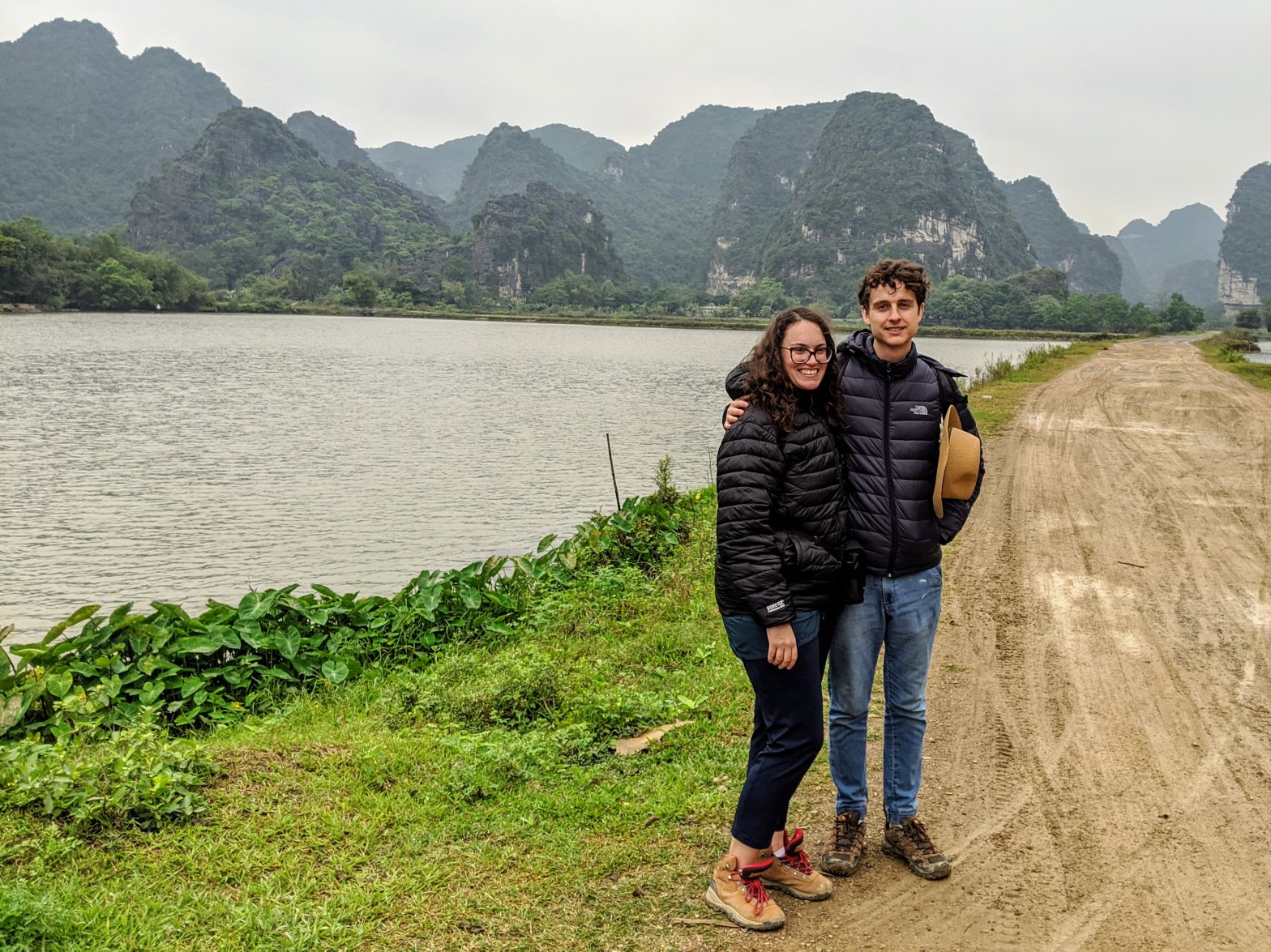
  1. That unforgettable canal ride in the Ninh Xuan area. From now on, when someone tells me to go to my happy place, I’ll think of that quiet, concealed cove. 
  2. Coffee on our first day in Hanoi, out on the balcony of Coffee A. I enjoyed my first ever egg coffee, looking out on the busy traffic below and thinking “what have we gotten ourselves into now?”
  3. Exploring all the traditional homes and community houses at the Museum of Ethnology and learning more about Vietnam’s 54 diverse ethnic groups.

Best Experiences: Aaron

  1. Looking for monkeys and playing charades with our rower in the most beautiful place I’ve ever been. We passed her the binoculars and she used them backwards, humoring us in pretending they helped. Should this be a blooper?
  2. Staying up “late” and talking with Anna at Blue Butterfly and Social Club, discussing punishment/reinforcement, performative gender expression, and just enjoying each other’s minds.
  3. Walking around the Museum of Vietnamese History. Ancient Chinese/Vietnamese sculpture seems so much more imaginative and whimsical than its western contemporary. 

Best Meals: Anna

  1. Look, I’m usually a pescatarian. But that steak at La Badiane. With the truffle potatoes and the blue cheese and the prosciutto and the wine sauce? Are you kidding me?!
  2. Sometimes you just need pizza. But even when you don’t need pizza, you would still love the pizza at Pizza 4 P’s, because I’m pretty sure one of those P’s stands for perfection.
  3. Poke Hanoi’s savory salmon poke bowl: so nice, we ate it twice.

Best Meals: Aaron

  1. Poke Hanoi. Believe it or not, raw fish is the single food most agreeable to my sensitive tummy. After subjecting it to weeks of low-level trauma, poke was exactly what we both needed.
  2. Pizza 4 P’s. Hey, don’t judge; it was some bomb pizza.
  3. Bun Cha @ Bun Cha 34. It may not have been Obama Bun Cha, but it was O-mazing.

Blooper Reel

  1. One time our room smelled like a cheese made a fart, and that fart died in the walls. It was so bad that we thought it might be noxious. Turns out, the boys’ dorm was the room below us and someone had shoes so smelly, it was killing us.
  2. After our Red River Delta tour, we realized we no longer had our credit card. When we contacted Ethnic Travel to ask if it was in the van, they told us they found a camera–and then asked if it was our credit card. Turns out, we left our binoculars, which are neither a camera nor a credit card.
  3. Everytime I (Aaron) left the hostel alone, I was waylaid by tens of shady characters trying to sell me weed and prostitutes. Guess I’ve just got one of those faces? 

Hanoi: Day 8

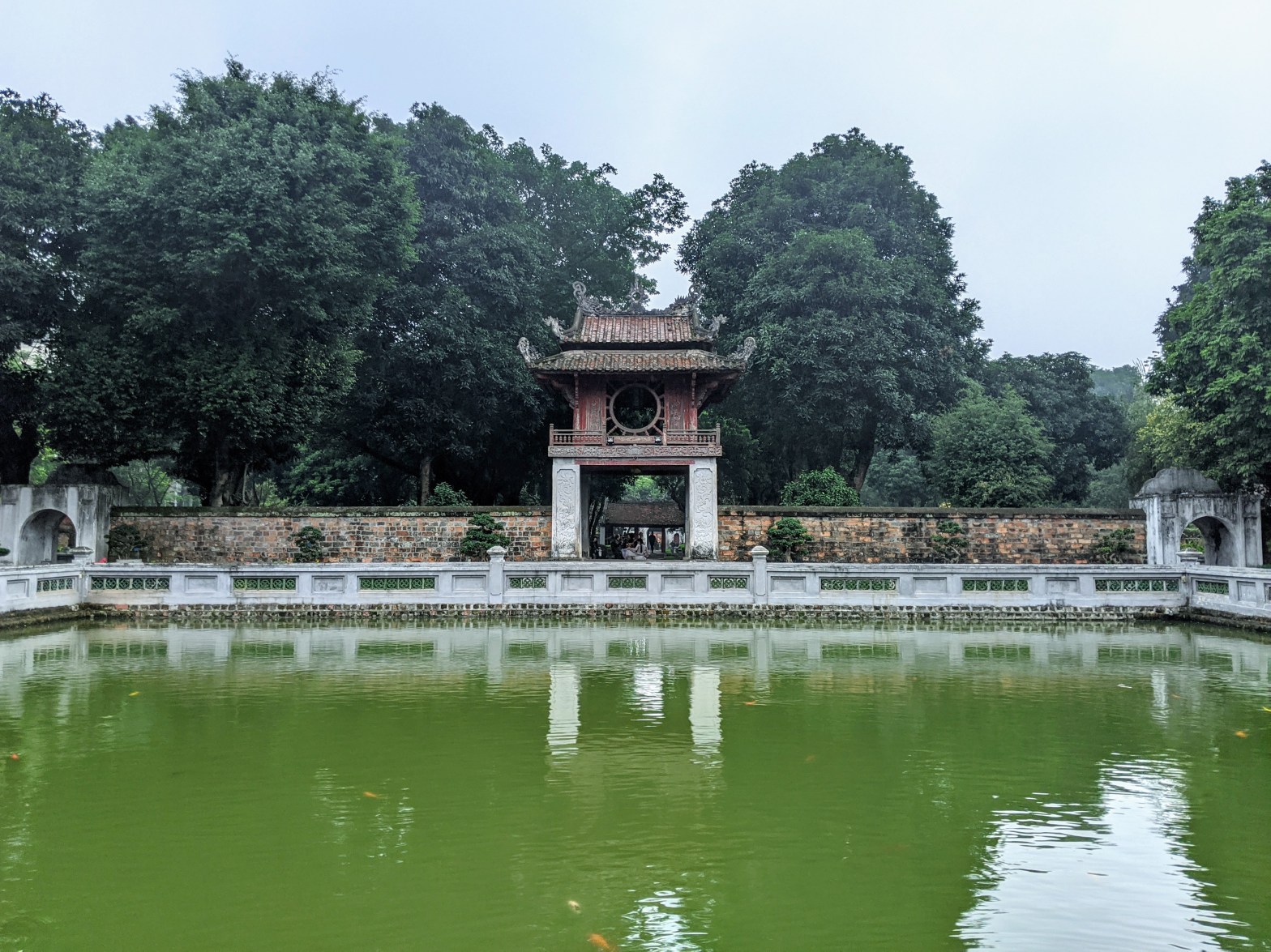
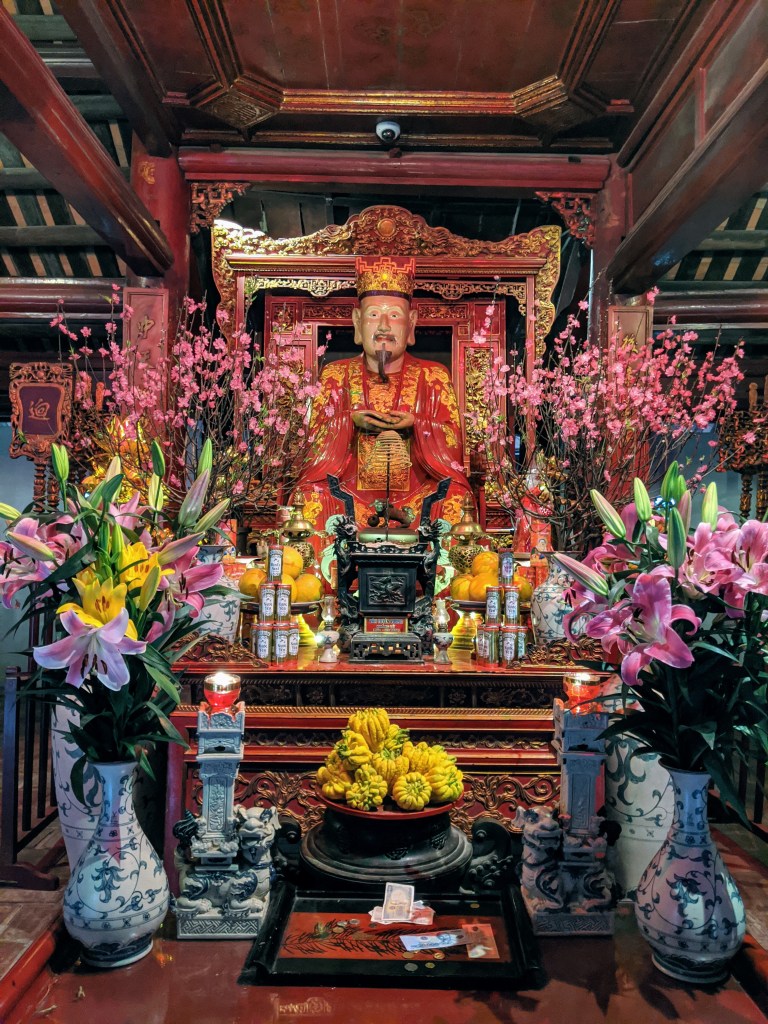
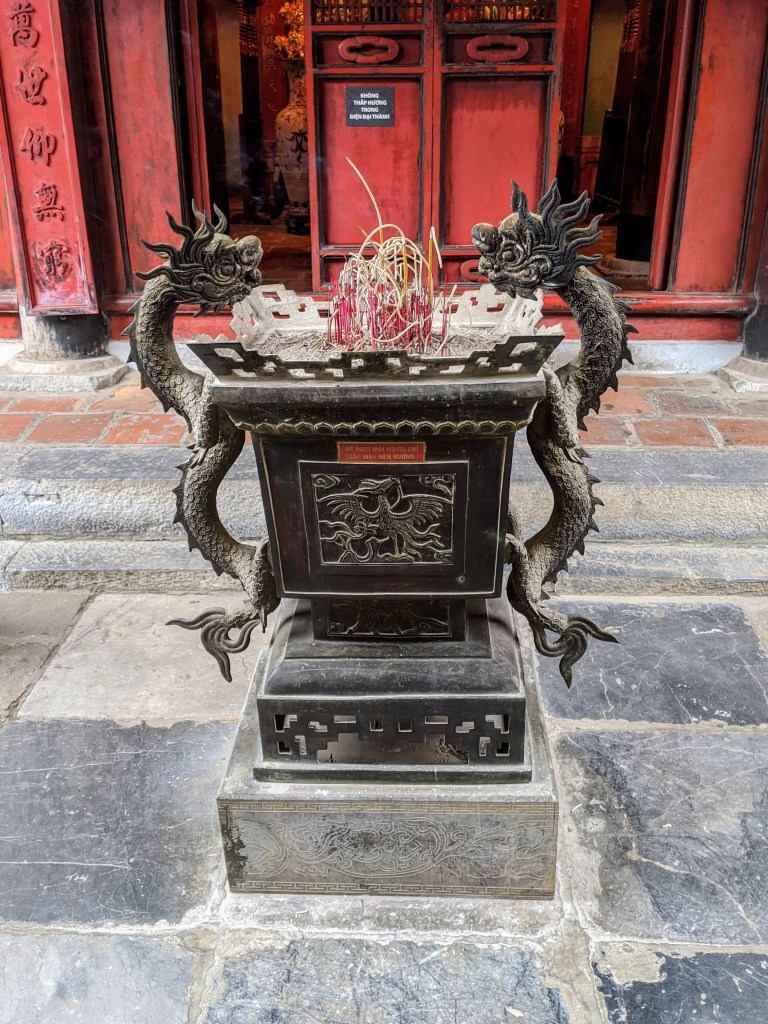
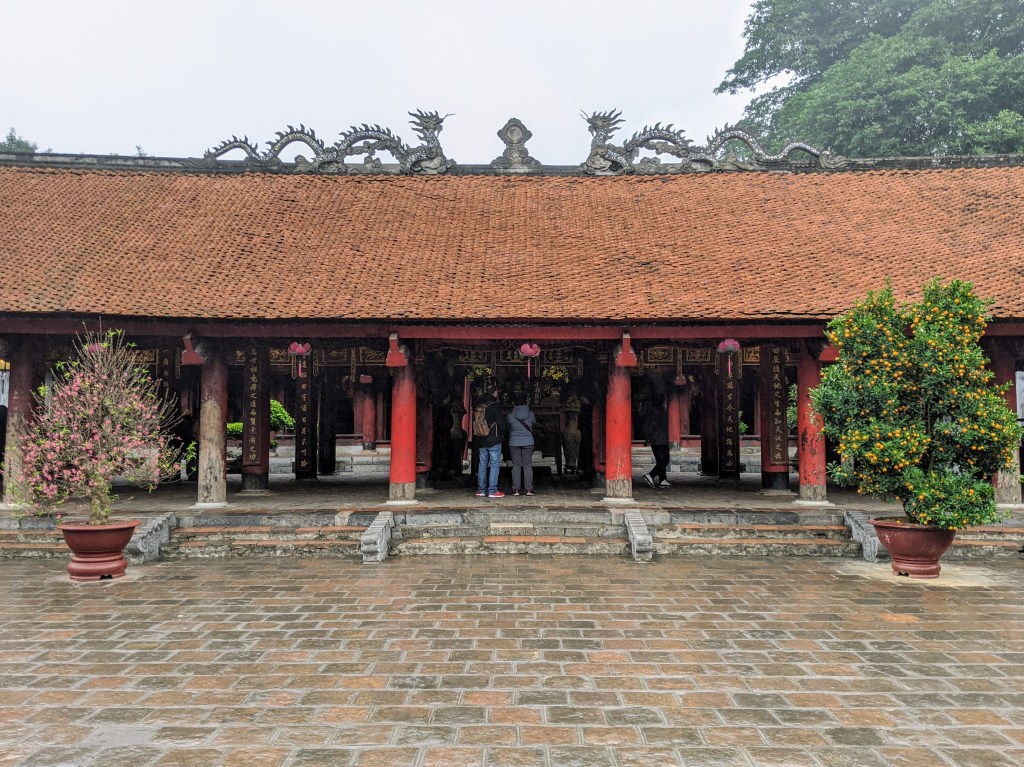
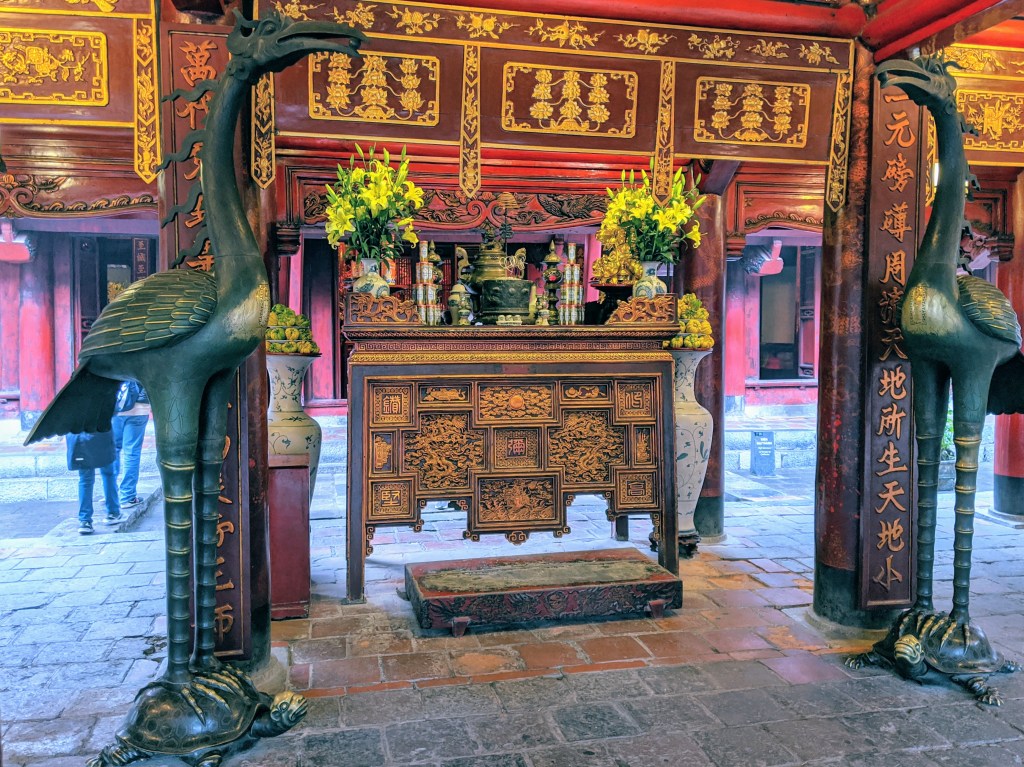
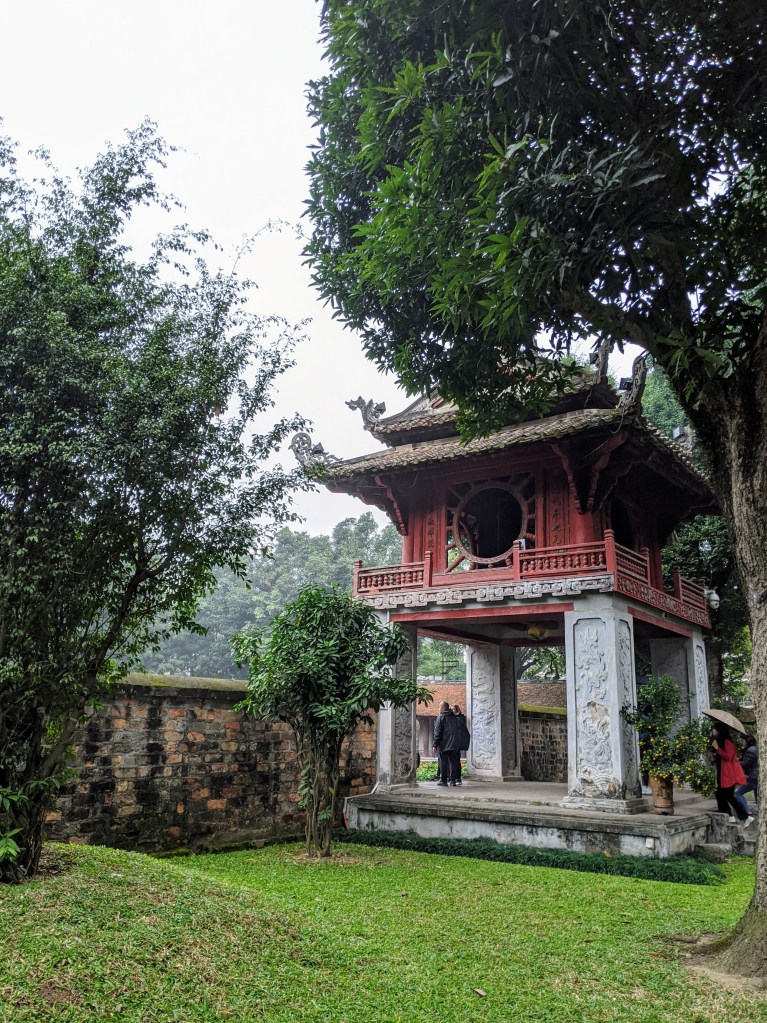
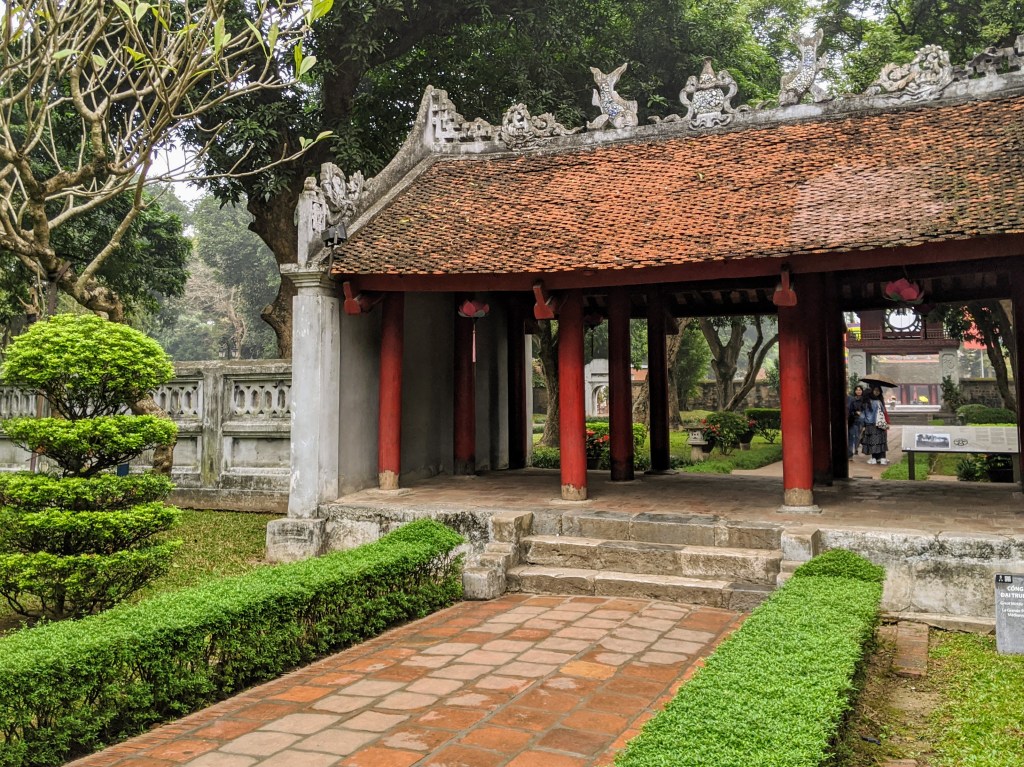
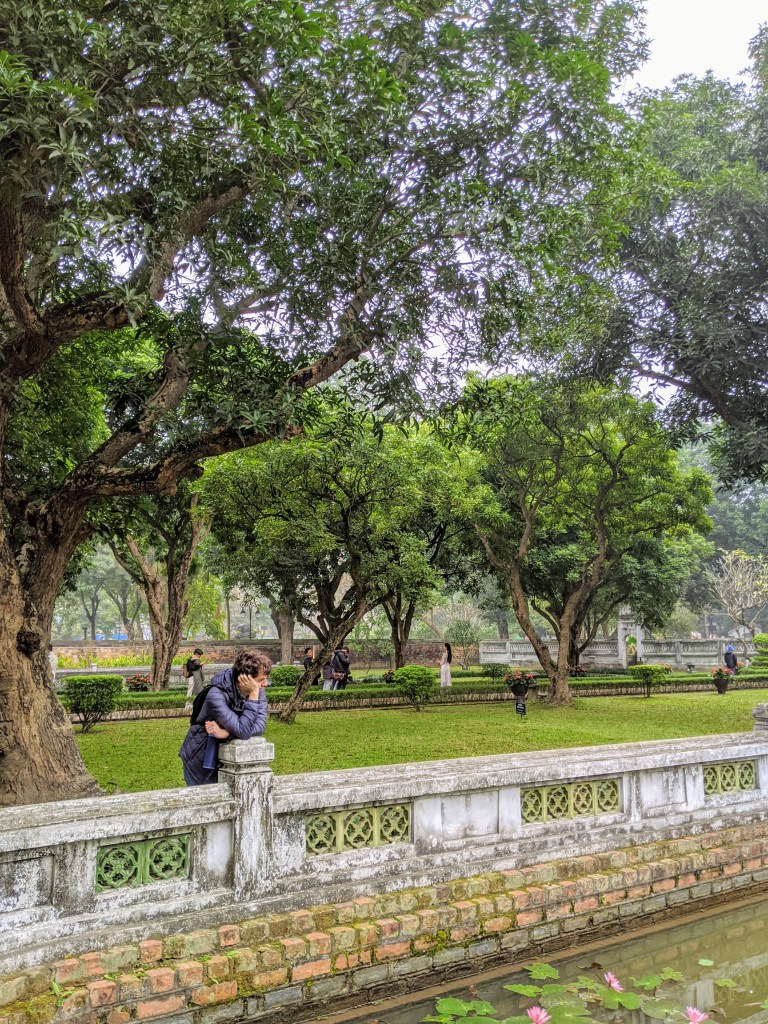
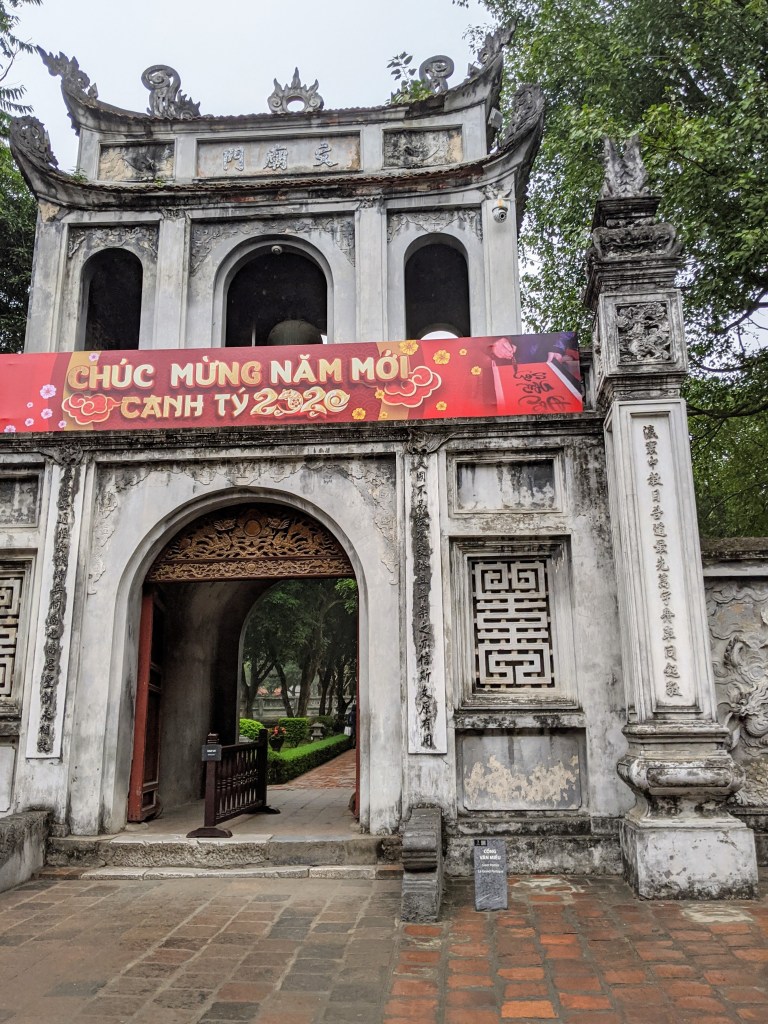
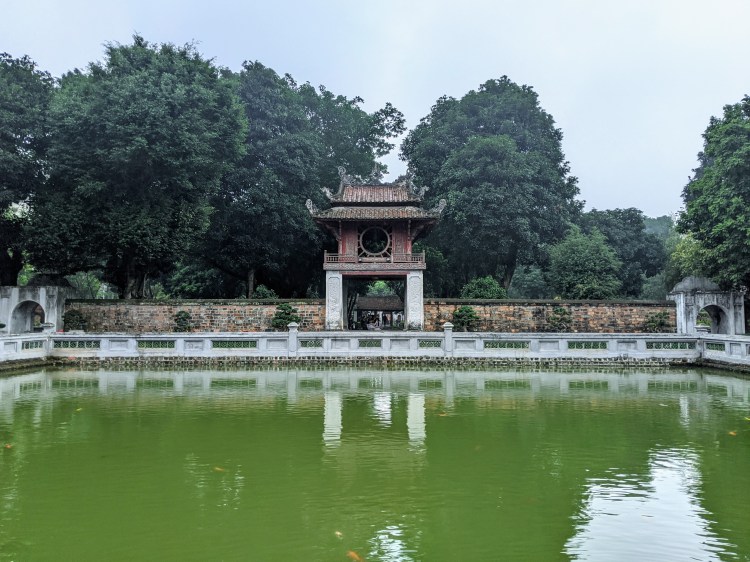
The Temple of Literature is a centuries-old botanic garden and temple complex dedicated to the exaltation of Confucian ideals and learning. It has several pool-embellished, garden courtyards, and ornate pagodas, leading to a shrine at the back of the complex. I was enjoying my time in the historic temple, but Aaron seemed listless. He kept resting his head on his hands next to ponds, sighing, and putting on a general air of melancholy. My heart broke for him. 

While I don’t really understand what it’s like to be hypomanic (seems a lot like having 5 cups of coffee, but without the jitteriness), I am all too familiar with depression. If you’re not, let me explain: it feels 1) like all is boring, useless, meaningless crap including yourself and everything you usually love, 2) like happiness is a lie we tell ourselves, and really this is how it is, how it always has been, and how it always will be. It’s pretty insidious. It changes your perceptions of the world, your image of yourself, and even your understanding of the depression itself. Most people think of it as being very sad, but sadness is at least an emotion. Sadness stabs, stings, and wrenches. It makes you feel, so it makes you feel alive. Depression is just a gray wall between you and life. 

So, when Aaron goes through it, I know all too well what he’s going through. As I said, my heart breaks for him. I also know that it’s not really helpful to try to cheer him up or do something fun; these methods often just make depression worse. It’s not an absence of happiness– it’s an inability to feel. Knowing that you should be happy, given the circumstances, just makes you that much more aware of how incapable you are of being happy at the time. The best thing for depression, usually, is just basic self-care. Get enough sleep, go for a run, shower, eat healthy, take your meds, and give it time. If you’ve found an approach that works for you, eventually your brain chemicals will balance out and you’ll be back in the land of the living.

I told Aaron to let me know if I could do anything, then gave him space. I knew no matter where we went or what we did today, it wasn’t going to hold a lot of meaning for him. The worst thing I could do for him would be to try to force him to enjoy himself. So, I walked through the gardens mostly alone, and let him wander where he liked. I took photos and bathed in the many pagodas’ pulchritude and peace. 

After, I found Aaron. He seemed miserable. “I think I’m just going to go get our binoculars back from Ethnic Travel [we accidentally left them in the van] and rest at the hostel. Nothing is going to do anything for me today,” he said. I agreed, and told him he could go pick out a backpack, too. This backpack conversation had a history. I thought, by telling him he could pick one out, I was throwing him a bone, but there were a lot of sensitivities around this backpack on both sides. A couple of days earlier, we had decided that we should get another backpack, so we’d have room to put gifts we wanted to buy or anything extra we figured out we needed. Aaron wanted a certain kind of backpack, I wanted a certain different kind of backpack, and we had quarreled a few times about this already. So now, in the Temple of Literature, we quarreled again– over a backpack. We did not part ways on good terms.

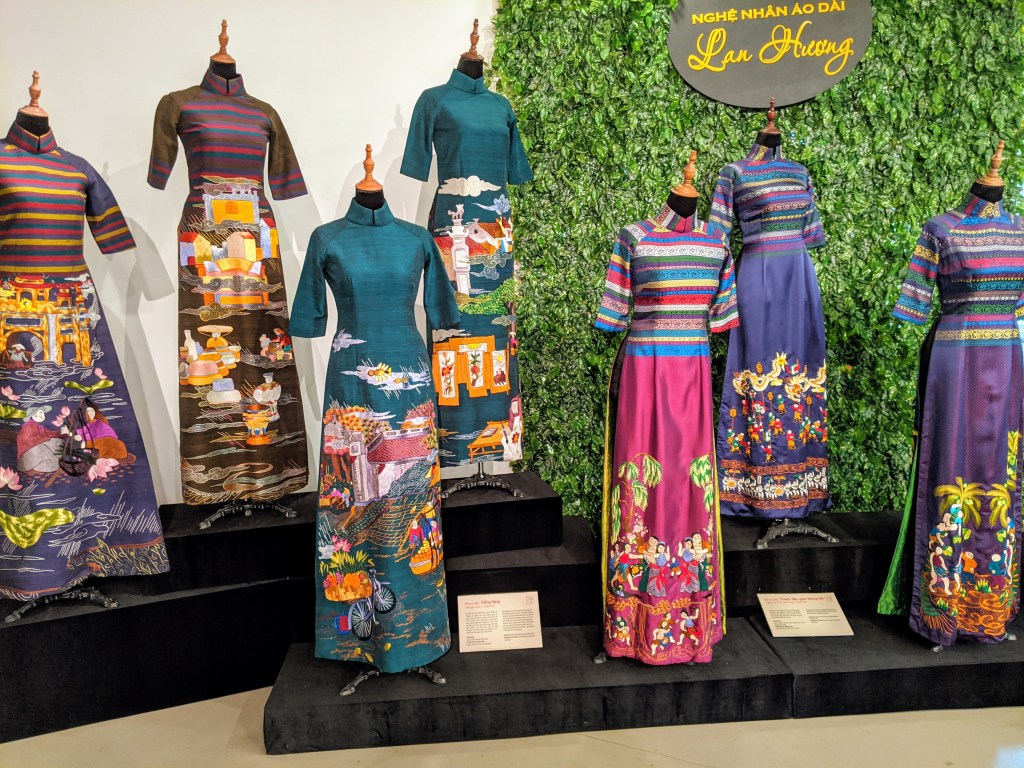
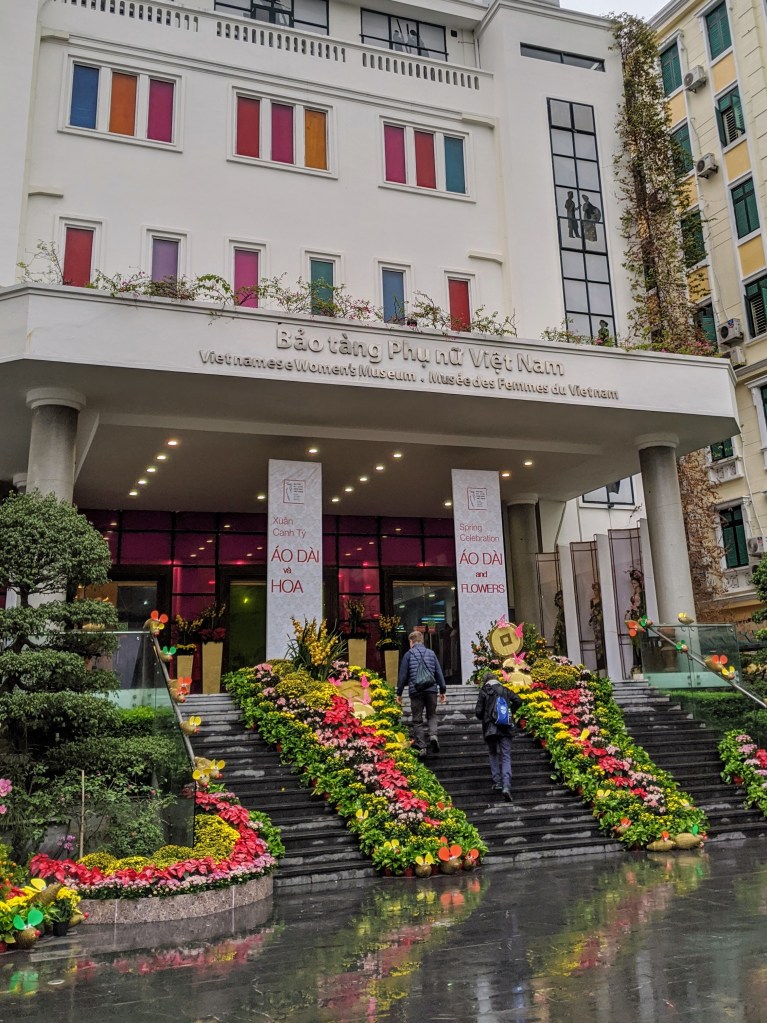
The rest of the afternoon was spent fighting over text, descending into pettier and more emotionally-driven responses. I went to the Vietnamese Women’s Museum, which was fascinating, but I was extremely distracted the whole time. I kept having to find benches to sit on so I could craft the perfect retort to Aaron’s last message. It was turning ugly, too. Both of us had crossed the threshold of self-righteousness. The whole thing was about something bigger and extremely important. We were in that space where you start thinking things like “I’m not gonna let them make this about them,” and “if they don’t even care about this, why should I care about that?” You know, those really irrational thoughts your angry mind tells you to hold on to with all you’ve got. Finally, we decided to meet in person and figure out what to do from there. 

I stopped on the way back to the hostel to get Aaron an Auntie Anne’s pretzel. He had been eyeing it for a couple of days, so I thought it might serve as an olive branch. It did the trick. Sort of. I mean, there was also a lot of apologizing on both sides and working through feelings and mending hurt, but it was probably the pretzel. A fight started by a backpack ended by a pretzel. We stayed in, ordered in Poke Hanoi savory salmon bowls, and binged Rick and Morty until we both felt a little better. 

This was our last night in Hanoi (sort of; technically, we were spending one more night here before our flight to Da Nang, but that was probably just going to be sleep and getting to the airport). It was fitting. We started our trip to Hanoi frightened and we were leaving it grumpy. Both of these are emotions this city frequently invokes. But, we also started it surprised and relieved, and were ending it growing as people. These states, too, are frequent invocations of this city. This city is challenging. It’s crowded, loud, busy, and not particularly pretty. It’s uncomfortable. But so is growth. So is challenge. Do I want to come back to Hanoi anytime soon? Probably not. But am I glad I came? Yes. I came, I saw, I was conquered by its congested concrete. And in the end, I’m sure a lesson was learned– even if I haven’t figured out what it was yet. 

Hanoi: Day 7

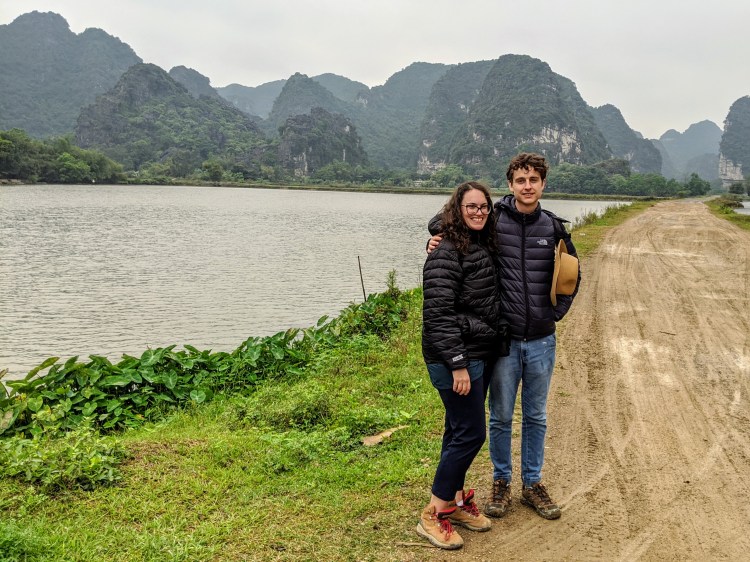
After lunch, we trekked around the karsts some more. Our overstuffed bellies couldn’t have handled much more than a leisurely pace. We enjoyed one hour more of Yin’s company, discussing our cultures further as we ogled the mist-shrouded landscape. We took a few photos, then it was time to return to Hanoi. 

The ride back was longer because of Tet traffic. Roads were being redirected and closed off to help stymie the tide of families reuniting in Hanoi for the holiday. Aaron and I slept most of the way home, exhausted from our busy, mind-blowingly beautiful day. 

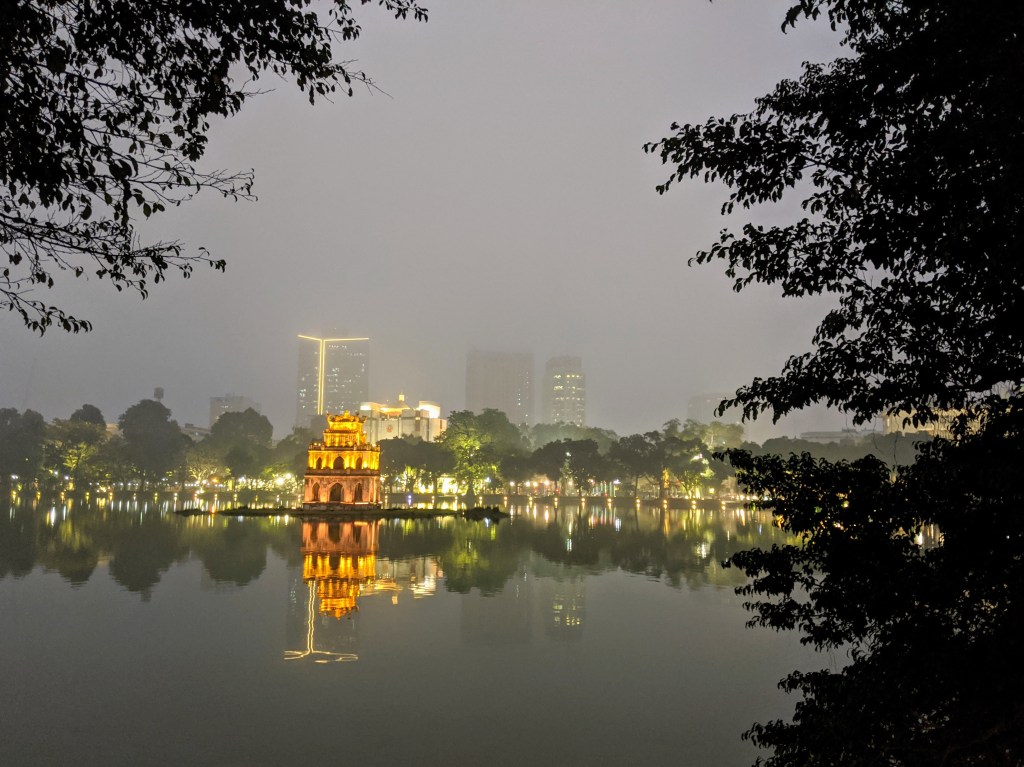
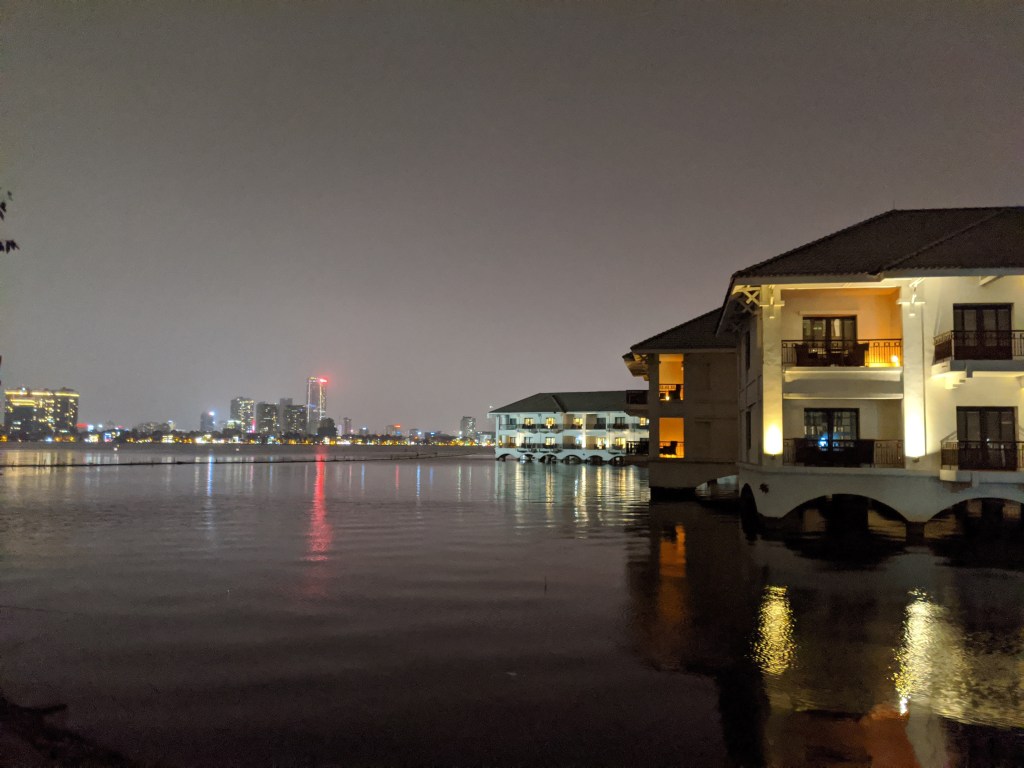
Once returned, we grabbed a car to the West Lake, Hanoi’s upper-crust neighborhood centered on its largest lake. The lake was lit by a couple of resort buildings on stilts over it. We walked along it’s edge until we reached our destination: Maison de Tet Decor. Dinner here was passable, but after all the hype from my guidebook, I was let down. Aaron didn’t even really eat his. At least the excursion provided a romantic, if short, walk along the lake. 

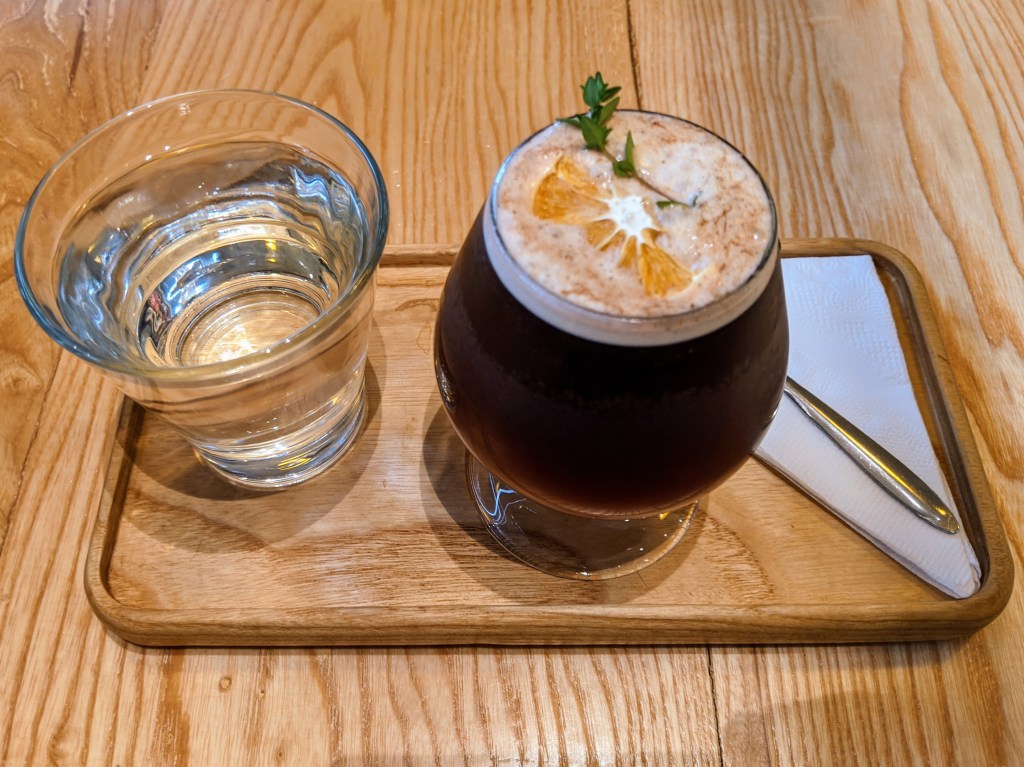
The next morning, we returned to Atelier, the cafe with the nitro cold-brew. Again, we got an orange-and-raspberry-flavored concoction that tasted more like a cocktail than a coffee. Aaron seemed out of sorts at the cafe. For those that don’t know, Aaron has Bipolar Type II. He works hard on his mental health, and generally has a good handle on it, but he still goes through ups and downs. The last few days had been quite up, and now came the crash. Tired and depressed, we walked to get banh mi. 

Banh mi is both Aaron and my favorite Vietnamese dish. At least, it was before we came here. We had been excited to taste it in its origin country. In Vietnamese, banh mi literally just means “bread,” but it’s used to refer to a particular kind of sandwich. It’s French bread with herbs, veggies, a mayo-based spicy sauce (usually), and some sort of protein (traditionally, pate). To get our banh mi fix, we went with Google’s recommendation: Banh Mi 25. And… it was bland. I’m excited to try it elsewhere, but banh mi I’ve had in the States was, hands down, better. I don’t know if it’s just less flavorful here (that would be a first), or if this was bad banh mi. Watch this blog for future banh mi reviews, I guess. After finishing our substandard subs, we walked to the Temple of Literature.

Design a site like this with WordPress.com
Get started