Luang Prabang: Day 1

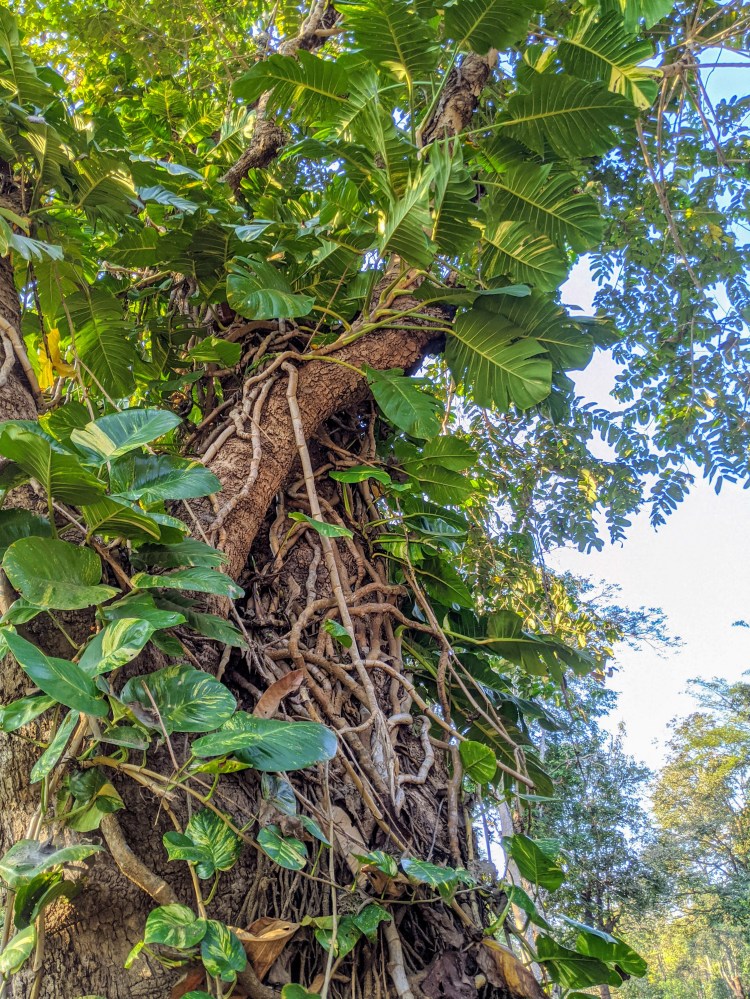
The flight to Laung Prabang was short and uneventful. We walked past the airport gates, because I had read you could get a tuk-tuk for cheaper than the shuttle-taxis in the airport. No such luck. Tuk-tuk was charging the same price as the taxis, so we shrugged and forked it over. We were staying at Fan Dee, an “ecoresort for the budget crowd” as Lonely Planet put it. It’s a bit outside of Luang Prabang’s main drag, so we got to go on a short scenic drive to get there. “Luang Prabang seems more… primitive,” Aaron observed. He was right; it was a far cry from the bustle of Chiang Mai. It reminded me more of our trip to Pai, passing roadside stands and jungle flora. 

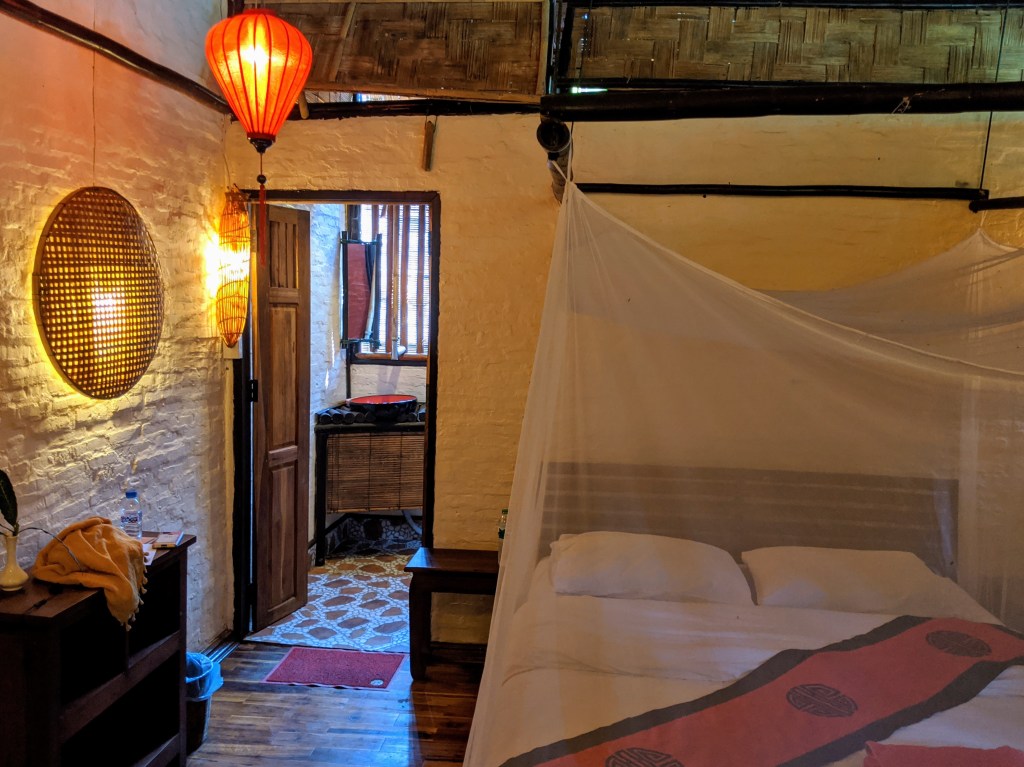
Fan Dee was dee-lightful (forgive me). Everything was thatched from bamboo and held together with teak and mahogany. We were staying in our own little bungalow, complete with teak furniture and a serious mosquito net for the bed. It didn’t have AC, but the evenings here are cool and there were two fans. The windows were paneless openings in the side of the bungalow that could be covered with some thatched bamboo attached by rope. We opened them, made sure we were wearing enough mosquito repellent, and unpacked. 

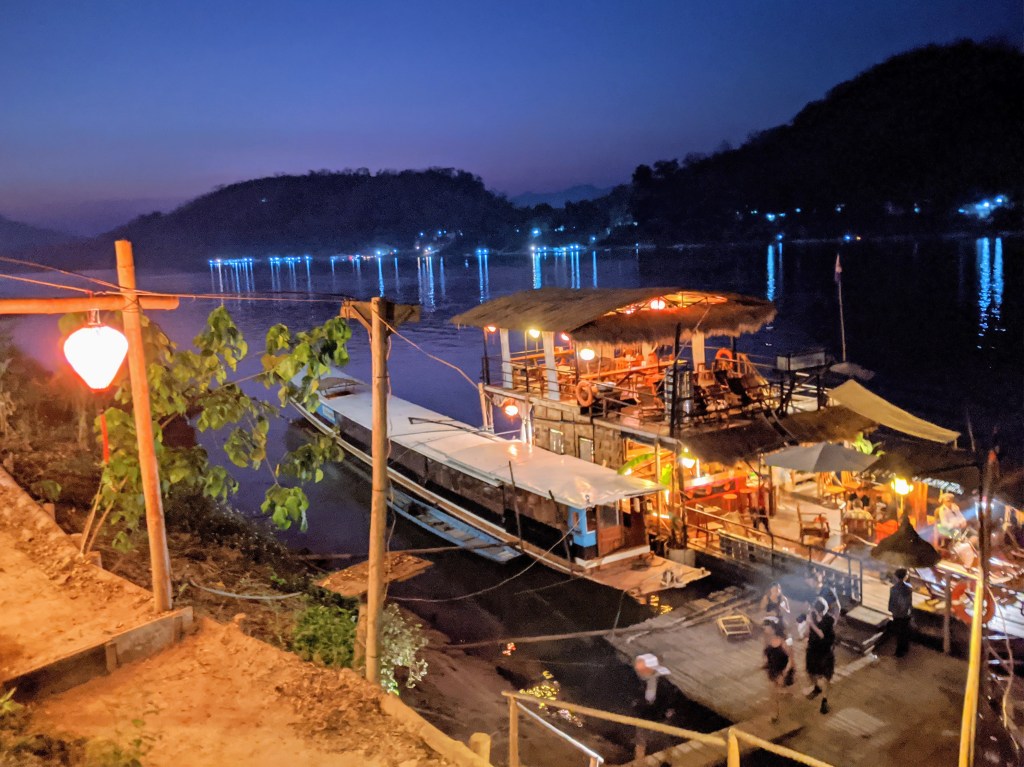
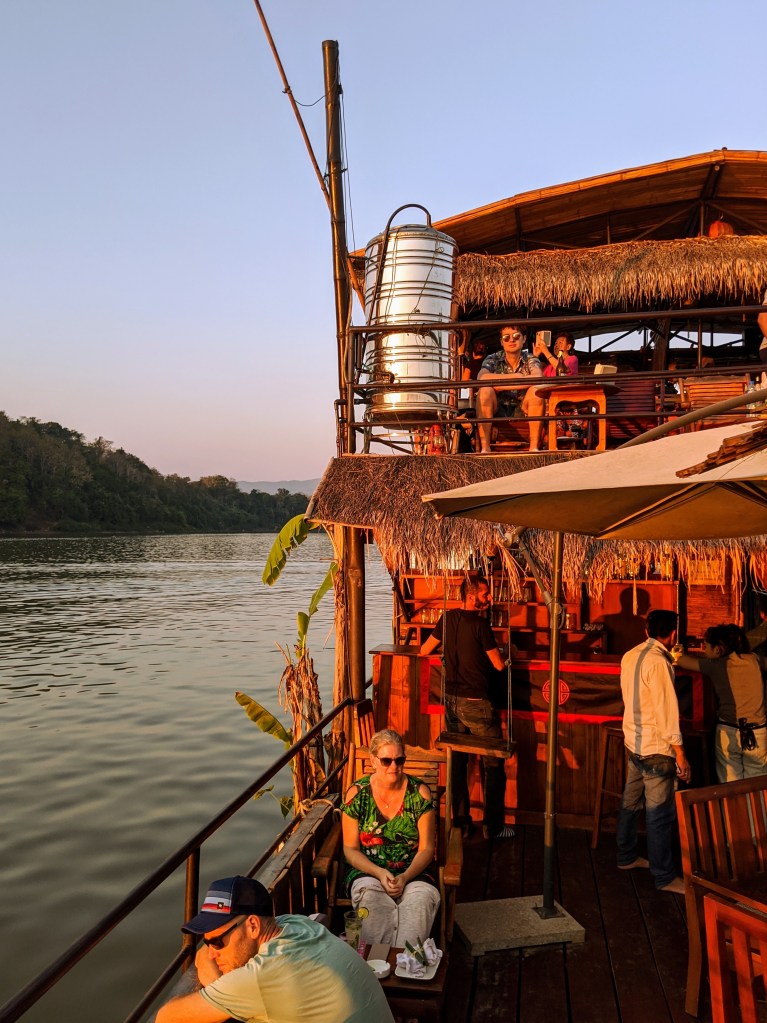
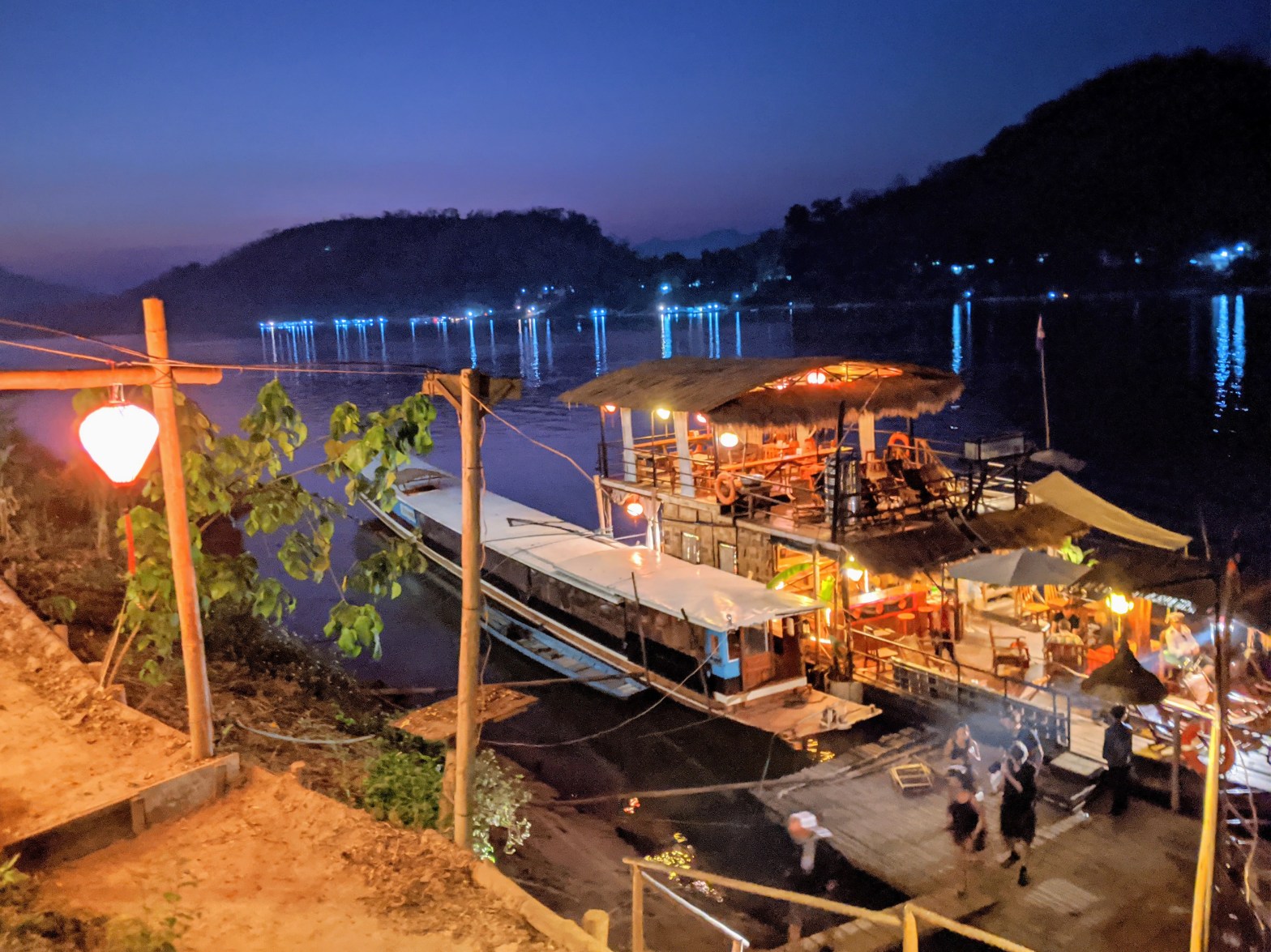
When we checked in, the desk (sort of, it’s in an open-air patio area) clerk told us we could get a couple of free chicken skewers if we took their sunset cruise. Aaron thought that might be just what the doctor ordered for our ongoing fatigue, so we last-minuted it and hailed a tuk-tuk to take us to the dock. Once there, we were handed a bunch of painted sticks, which apparently functioned as some sort of rudimentary currency onboard. Our boat was a two-level houseboat-style cruise ship, with a bar on bottom and balcony-seating up top. We chose a couple of lounge chairs right at the front of the second floor, where we could take in all the sunset action. 

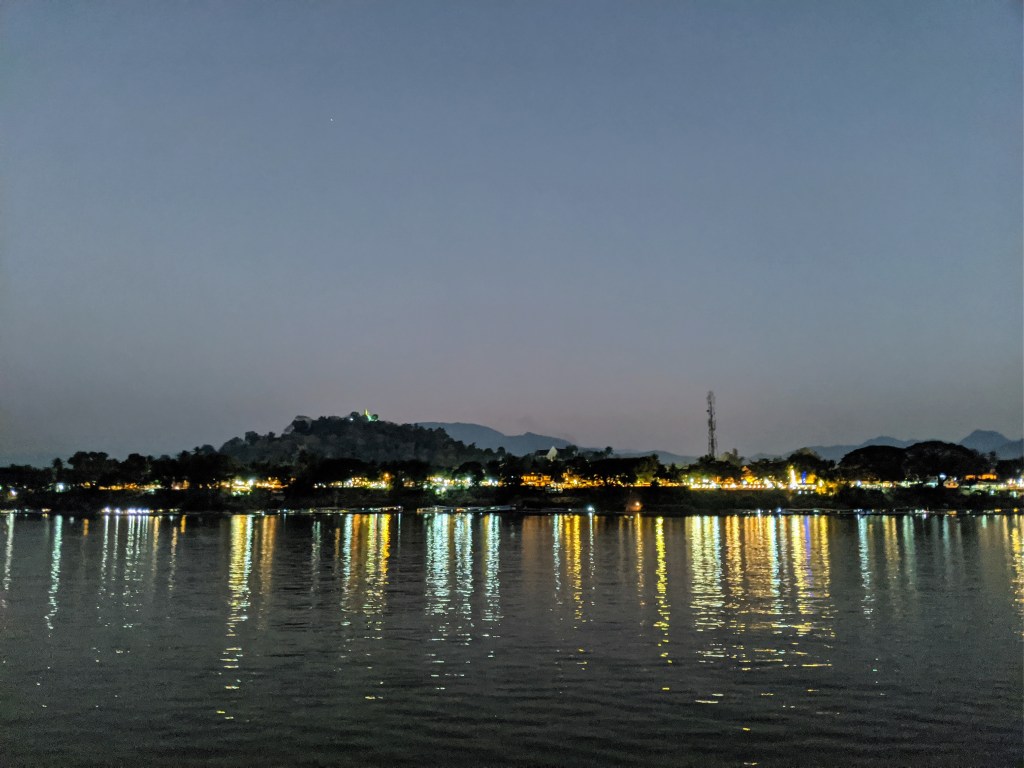
We set off down the Mekong with some pretty righteous tunes playing on the speaker system. Someone had put together a playlist that included Devendra Banhart, Beirut, and The Shins. Our mojitos weren’t anything to blog home about, but they were free (or 2 red sticks, depending on your perspective), as were some deliciously-marinated chicken skewers. The sunset over the Mekong was as beautiful as you would think it would be, with the misty mountain backdrop and the palm & river foreground– not to mention the swell of some Sigur Ros song providing a soundtrack to the whole experience. Sorry, Mom, but I don’t know if I can go home after that. It was dark by the time we got back, so we got to see the city lights from the river, too. Cute cafes with French-colonial architecture were transformed into romantic tableaus with paper lanterns. 

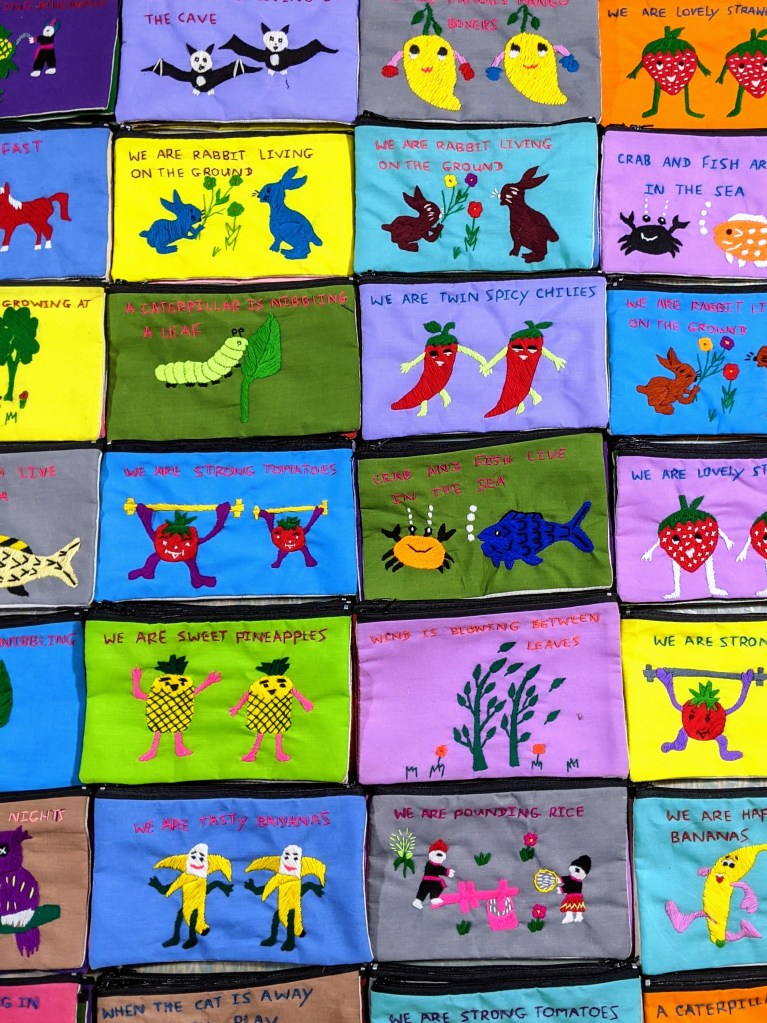
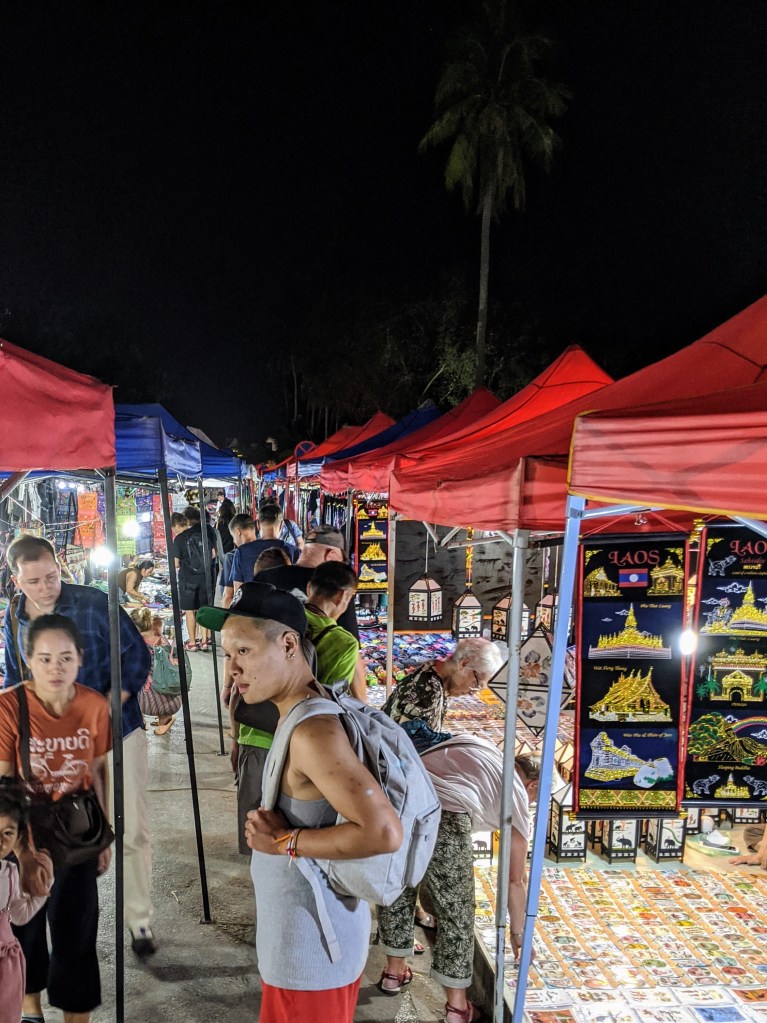
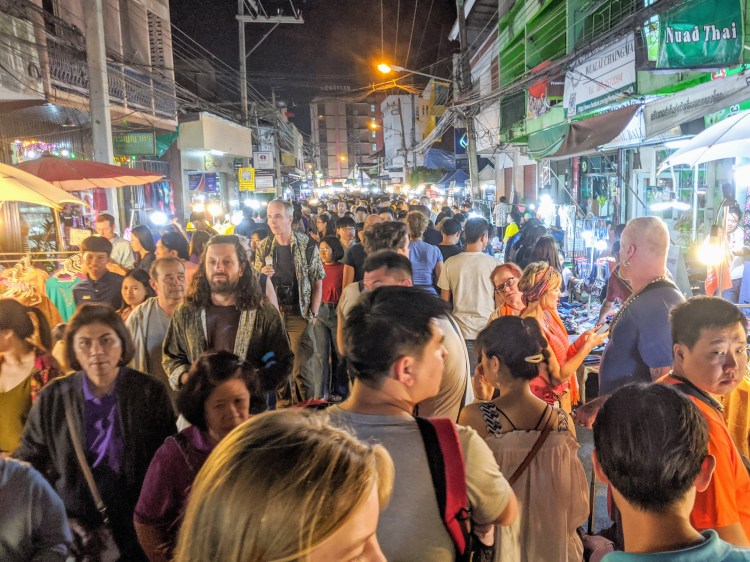
After our cruise, we decided to stroll over to the handicraft night market and perhaps find something else to satiate our hunger. Where there’s a craft market, there are food hawkers nearby. The night market in Luang Prabang was a much more pleasant experience than in Chiang Mai, where we had to contend for space with cars, motorcycles, and hundreds of other people. Firstly, they had blocked off the road, rather than inconceivably leaving it open to traffic. Secondly, there were far fewer people, so we could take our time and not have to jostle. Many of the “crafts” were of questionable origin. There were way too many signs insisting “handmade in Laos” on things that definitely did not look handmade, much less in Laos. My favorite type of stall (there were a few of them) was selling little bags with hand embroidery on them. Two bananas holding hands would be stitched beneath “We are bananas from the tree,” or a turtle looking at some stars with a rabbit would say “Rabbit and turtle have a wonderfull [sic] night.” Aaron’s favorite had some embroidered mosquitos with “Mosquitos carry dangerous diseases.” We stopped at a food stall that was selling a vegetarian buffet, and had a banana-nutella treat at a crepe stand. 

Aaron wanted coffee, so we popped into a nearby cafe. The Lao bartender spoke perfect English with an Australian accent, which is always a little uncanny. He poured me a pastis, a commonly-drunk digestif here in Laos. Aaron got a shot of espresso. We both got a good laugh at the bottle opener our barkeep was using, which he informed us was made from a kangaroo scrotum.

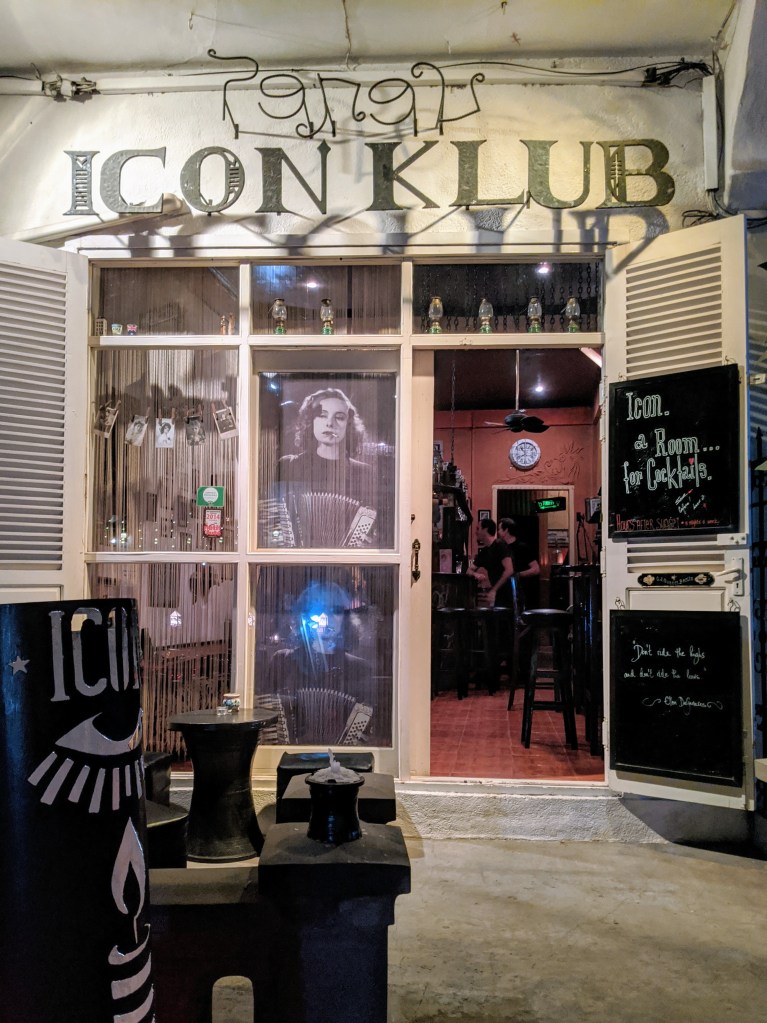
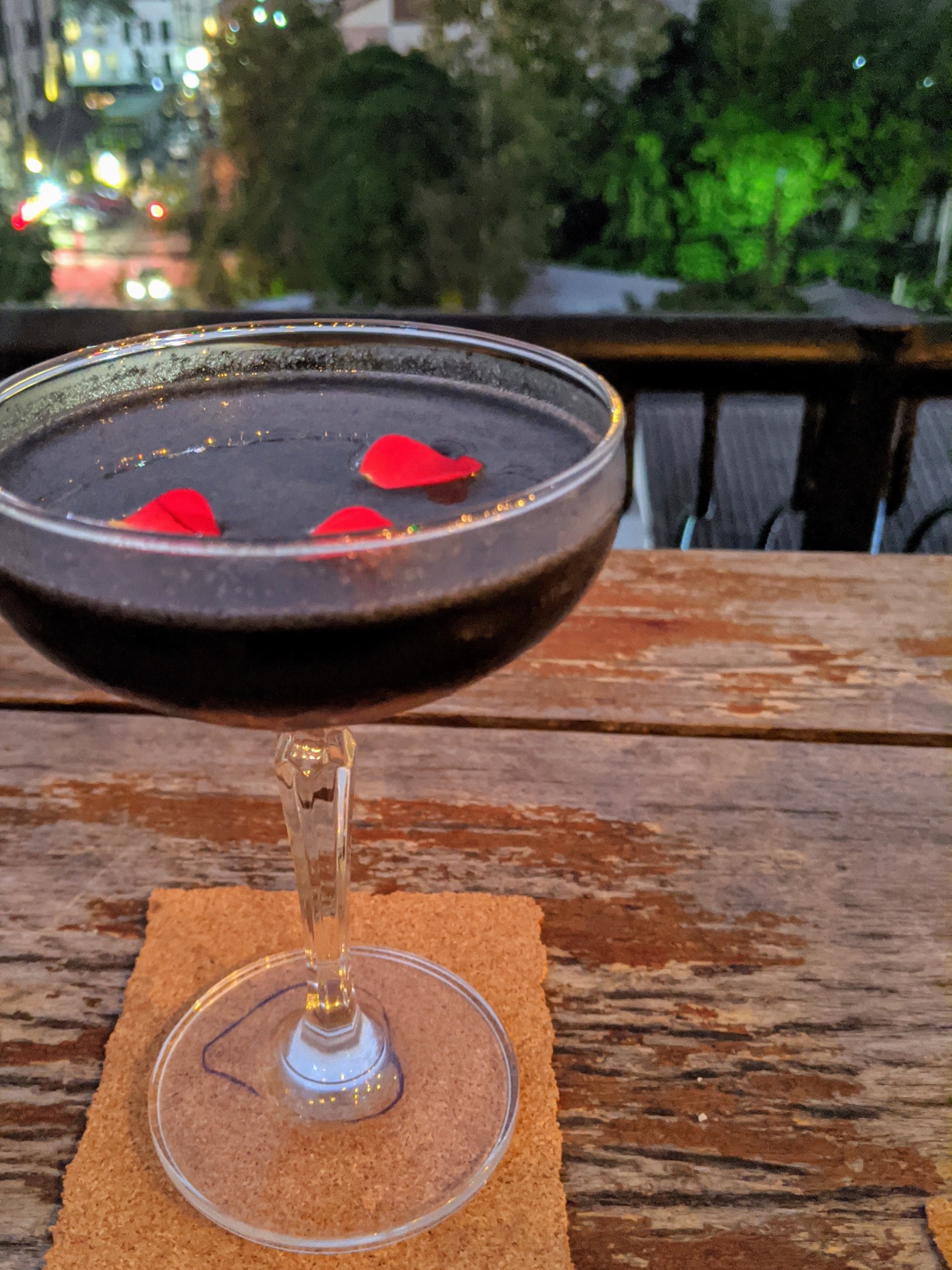
Lastly, we decided to grab a drink at Icon Klub, a Hungarian-owned bar known for its cocktails. I didn’t catch the owner’s name, but she was kind and had a gorgeous accent. She also made a mean Pimm’s Cup. Aaron ordered one of her homemade concoctions and it was also excellent. When we informed her it was our first night in Laos, she made us each draw a card from a little wooden box. On mine, it said something about seeing your problems from another angle. I only had one problem, but it would certainly be solved by seeing things from another angle– a horizontal angle, specifically. We caught a tuk-tuk back to Fan Dee and I fell asleep at 9.

And then I discovered that Luang Prabang isn’t such a quiet little city after all. Around 3 in the morning, some monks began chanting over loud speakers. Then, about a dozen roosters joined in the chorus. Finally, a cat in heat, that sounded like it was in the room with us, started in as well. The noise was non-stop. I kept hoping a tomcat would come along and eat the roosters and put this poor cat out of her misery. I don’t know how he could have helped with the monks, but at least the chanting was a monotonous hum; the roosters and cat seemed to have conspired together to make sure they only made noise as soon as I was drifting off. 

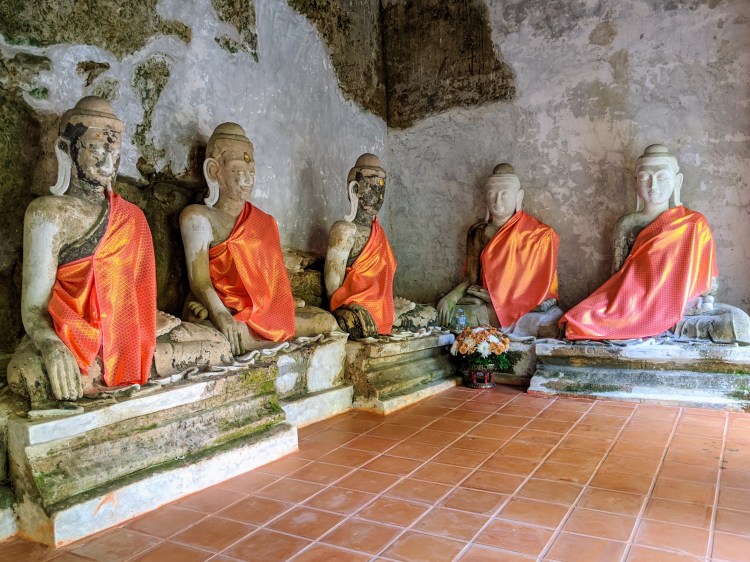
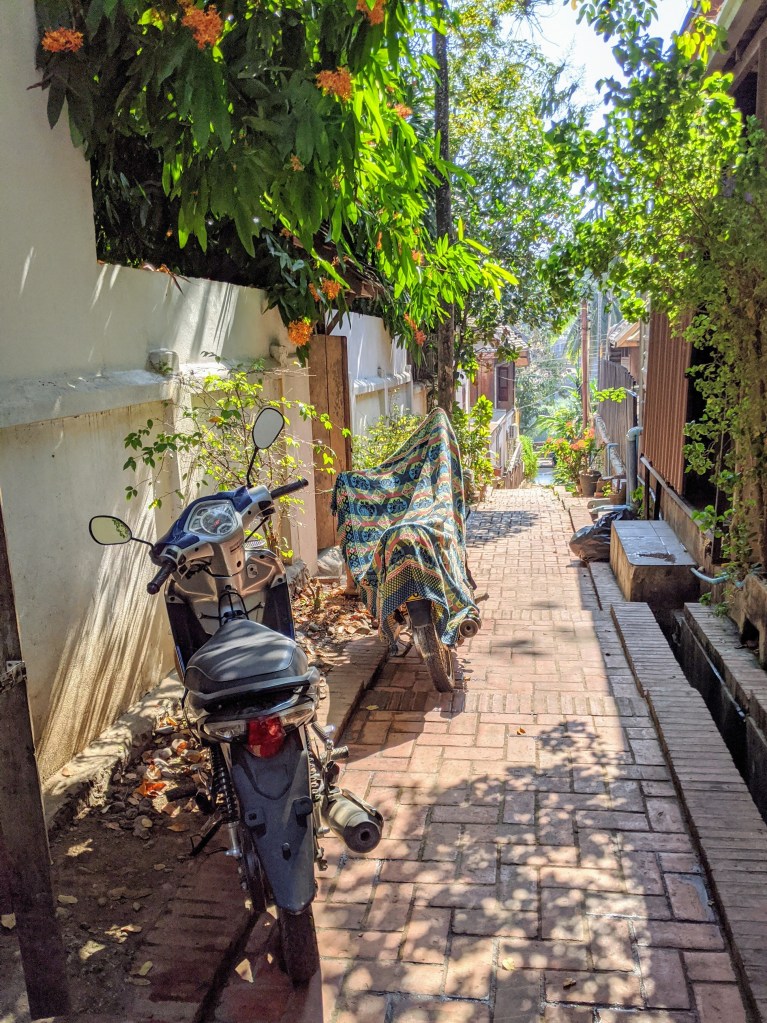
Depending on your perspective, I either woke up at 3 or 7. I certainly didn’t really sleep between those hours. At least today was going to be a lazy day. Mostly, we meandered the city, engaging in a bit of flâneur. Aaron and I were both a bit cranky, so we decided to get ahead of any nastiness and just split up for a bit and wander. I chose Sakkaline Road, the main shopping thoroughfare of Luang Prabang. It was lined with charming French-influenced cafes and Lao handicraft shops. Little stairway alleys with mopeds parked in them led between the businesses, down to the river road. The atmosphere was European-meets-Indochinese. It was all very quaint and dreamy. 

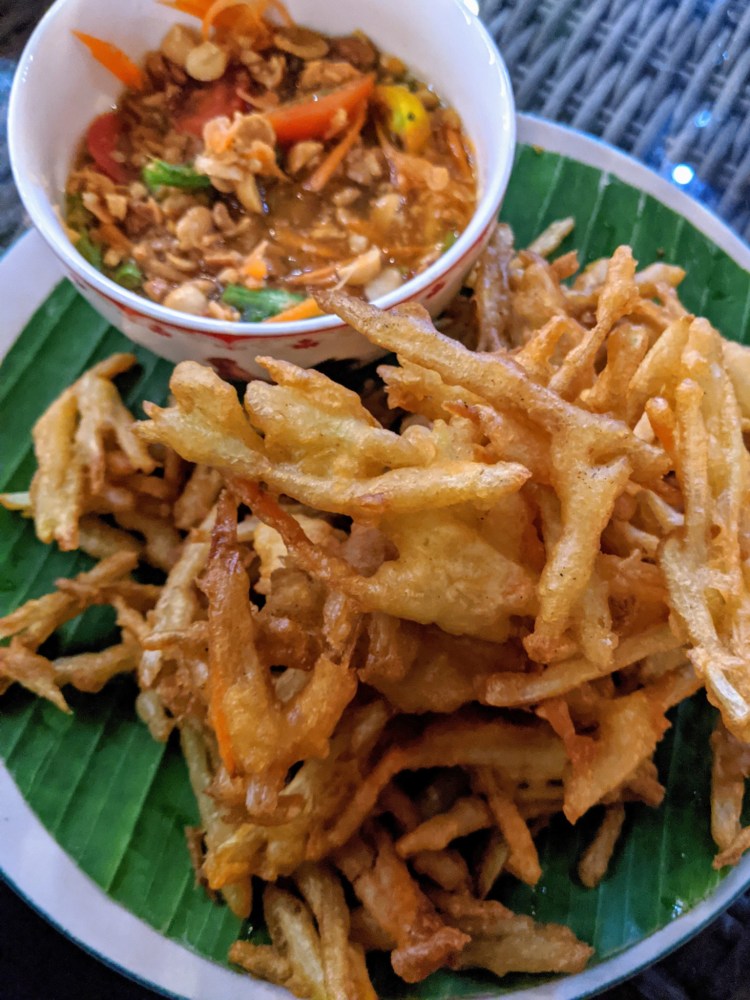
At lunch, we reconvened, a little more awake and a little less sensitive. We met at Khaiphaen, a restaurant named for a Lao riverweed snack. We ordered its namesake, as well as some duck laap, and red curry fish soup. It was one of the best meals we’ve had on the trip, in my opinion. The khaiphaen was crispy and paired well with chili paste and mushroom salad. The duck laap was completely different from Thai laap; it was filled with shallots and green onions and herbs, rather than just meat and spices. But the real star of the show was the red curry fish soup, which was everything red curry should be: hot, sweet, creamy, and just a touch sour. We ate until we were full and then we ate some more. 

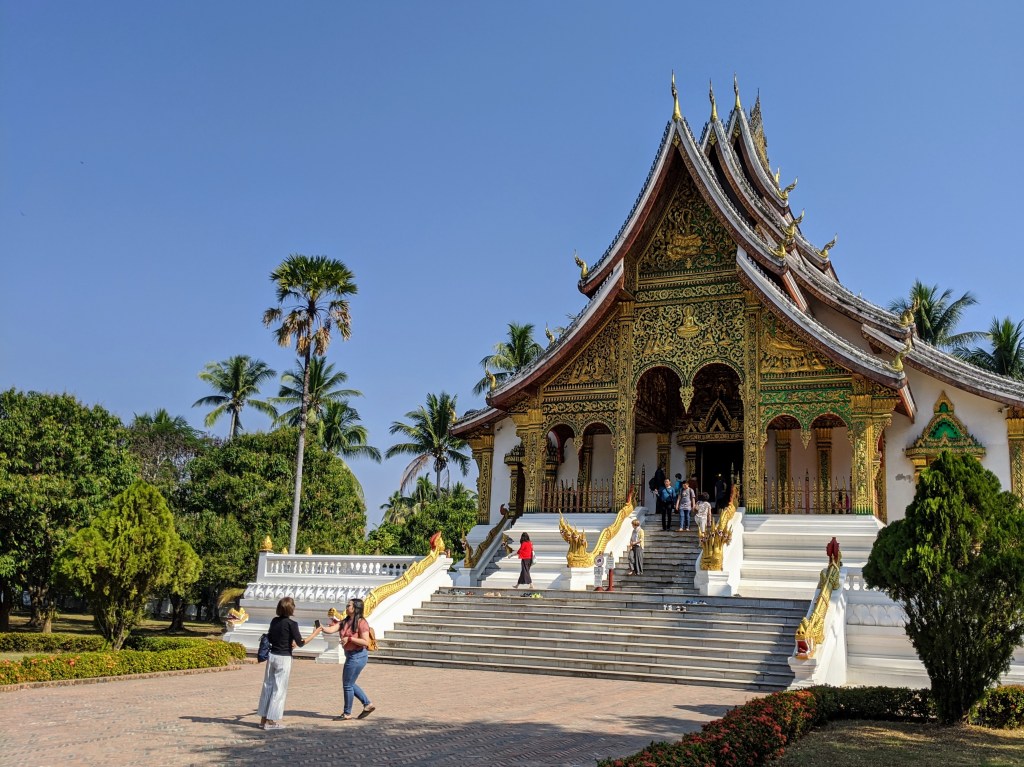
Tomorrow, I’ll tell you about our visit to Wat Xieng Thong, Luang Prabang’s most famous and regal temple. 
Chiang Mai: Highlights Reel

Best Experiences: Anna

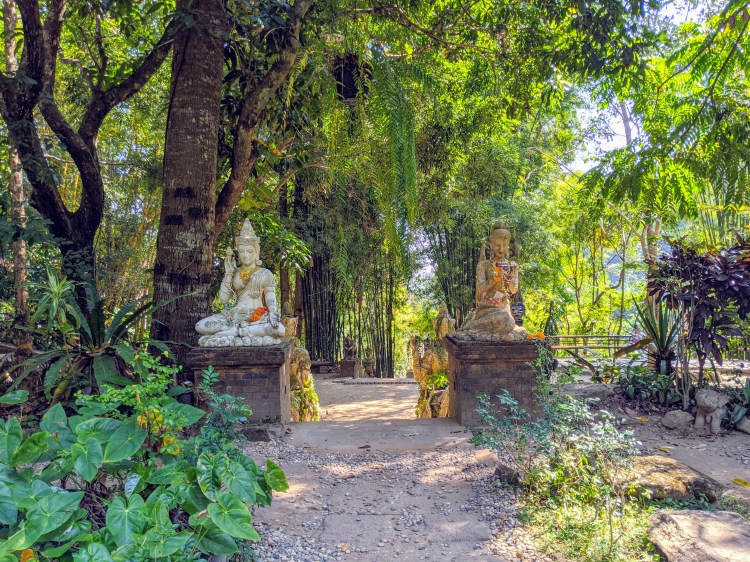
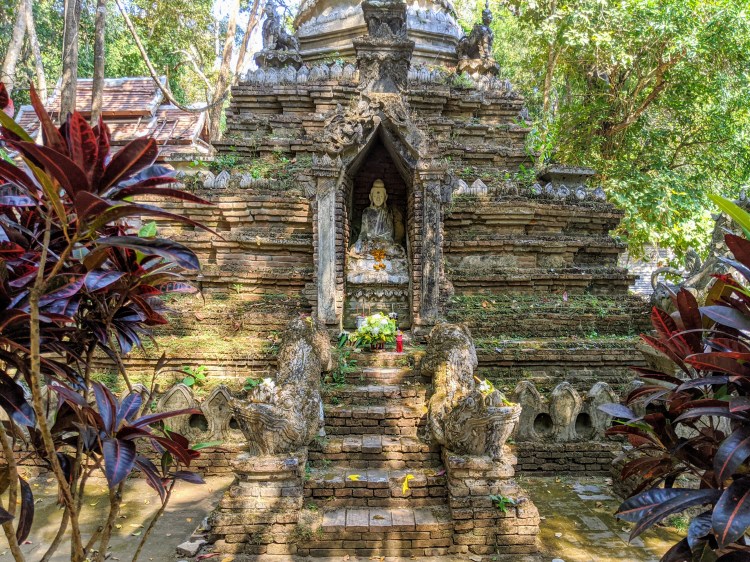
  1. The secluded, derelict beauty of the jungle temple Wat Pha Lat
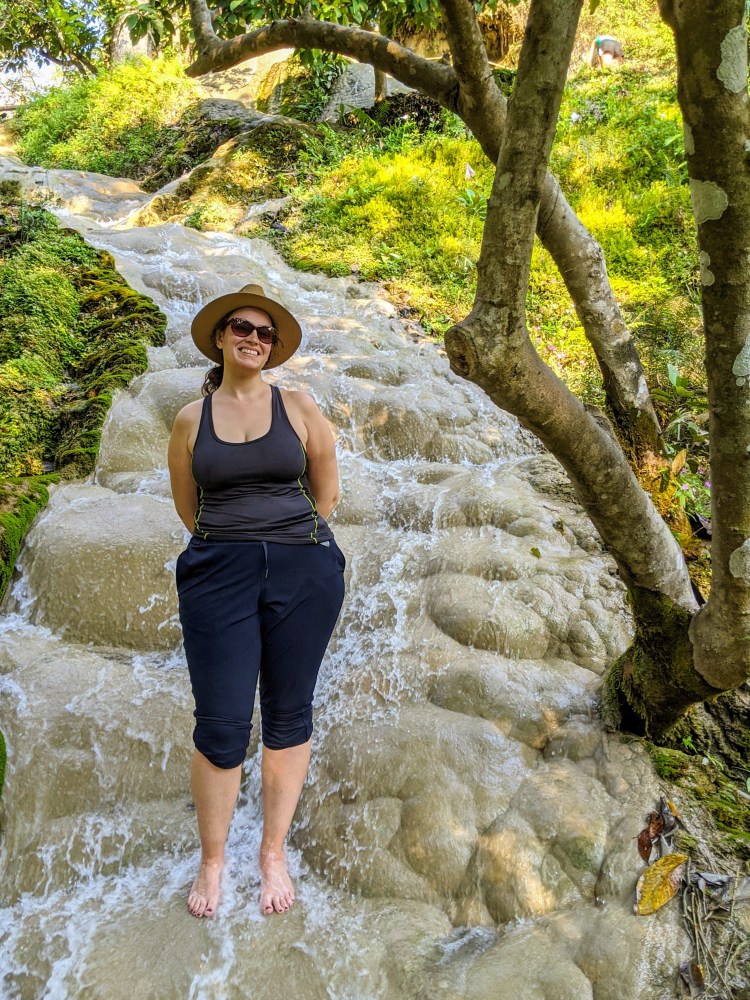
  2. Splashing around the sticky falls at Nam Tok Bua Tong
  3. Having my feet washed in the heavenly, perfumed water in the courtyard of Zira Spa after 72 hrs of travel

Best Experiences: Aaron

  1. Learning to cook laap muu with Arm, who followed everything I said with a flat-toned, perhaps sarcastic “wow”
  2. Feeling tiny and huge in my first cave, Tham Lot
  3. The incredibly normal first temple we wandered into; it was gilded, technicolor, wide-open, and just one of the three hundred temples like it in Chiang Mai

Best Meals: Anna

  1. Khao soi at Khao Soi Lam Duan Fah Ham: too spicy to eat, too yummy not to
  2. Barbecue red tilapia at Lert Ros: cooked to perfection
  3. Pork laap Aaron made at our cooking class: Arm’s recipe was salty, funky, spicy goodness

Best Meals: Aaron

  1. Barbecue tilapia at Lert Ros, as above
  2. Spring rolls at Awana House, because I’m basic
  3. Pork laap, as above

Blooper Reel

  1. Aaron tried to translate soy milk into Thai so his lactose-intolerant digestive system could have a latte. The barista he was trying to communicate this to looked at him like he was insane. We later realized Google Translate thought he was translating from Spanish instead of English. He had been saying “I am milk” over and over to this poor woman in Thai.
  2. A Thai man on the street walked up to us, smiling, and put his hand as high as it would go in the air. We looked at him quizzically. “Very tall,” he said to Aaron. 
  3. The owners of Coffee Plus gave Aaron some lychee to try. He ate it– all of it, skin included– and we spent the next 15 minutes trying to Google if he was going to die. 

Chiang Mai: Day 7

It’s our final day in Chiang Mai and I can’t say I’m glad to be leaving. Don’t get me wrong; I’m excited for everything that comes next, but Chiang Mai has been a dream. Our guesthouse is lovely, literally every single meal we have eaten has been incredible, and everyone has been so nice and full of good humor. We’ve had so many small interactions with drivers and vendors and waiters and people just walking on the street, and they’ve all been friendly and kind. That said, I do think we’ve gotten a good sampling of what Chiang Mai has to offer. It’s known for its temples, its food, and the surrounding mountains. If you’ve been reading this blog, you know we’ve gotten to try all three, even if we are not yet full of them. We will miss Chiang Mai and cherish our memories of her, but I don’t think we’ve missed out. We’ve drunk deep from her cups. 

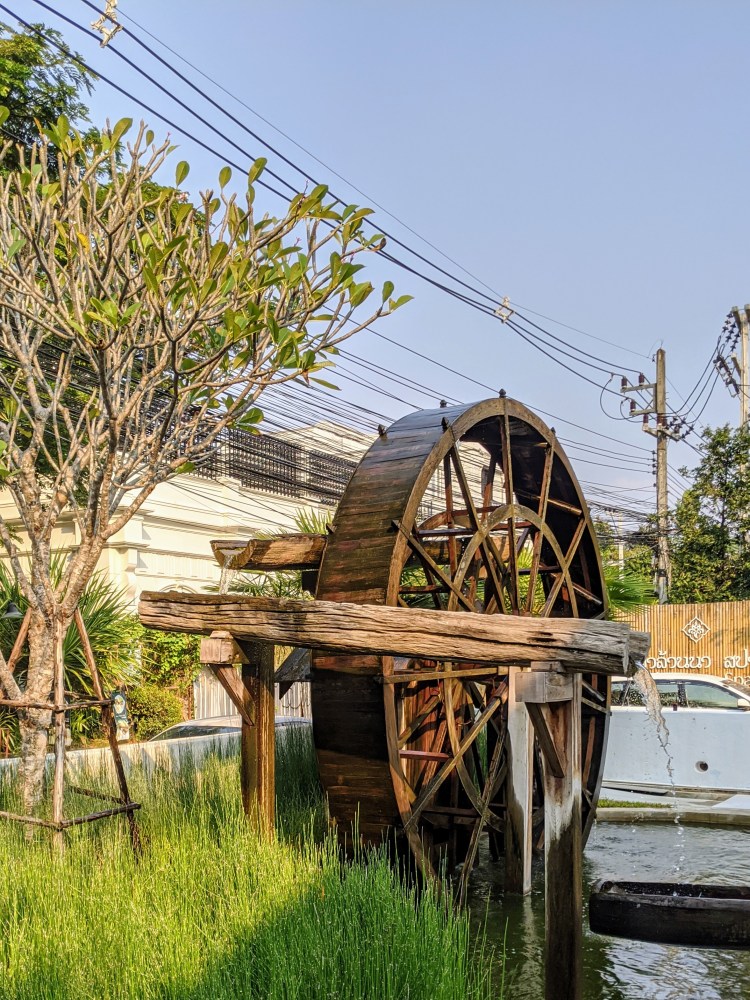
To prepare for our travel the next morning, we decided to get another Thai massage. This time, we checked out Fah Lanna in the Nimman district. We had been told that was the hip, up-and-coming area of the city, so we wanted to make sure we got to see it before we left. Fah Lanna was, as spas go, pretty great. The building was modern, but mostly bamboo. It also had a pleasant courtyard with a water mill. Our massages were also great. But, if I were going to compare Fah Lanna to Zira Spa, I would say there is no comparison. If I had never been to Zira Spa, I would have thought Fah Lanna was one of the nicest spas I had been to, but after Zira, I couldn’t help but be a bit disappointed. The courtyard was pretty, but it wasn’t so-pretty-I’m-almost-crying pretty. The massages were good, but they weren’t so-good-I’m-almost-crying good. Basically, Fah Lanna didn’t make me almost cry tears of joy and Zira did. Plus, the beds were just mats on the floor, so when they were working on your back, you had to twist your neck to lay your head on its side. And yes, I’m aware of the incredible privilege seeping out of these last few sentences (read: this entire blog). I’ll leave it at: it was nice and we needed it.

We went to look for a coffee place after our massages. We wandered into the Baristro. It’s an all-white decor, hotel cafe with a number of specialty drinks. I asked the barista what she recommended and went with it. It was a coconut espresso something-or-other and it was delicious. 

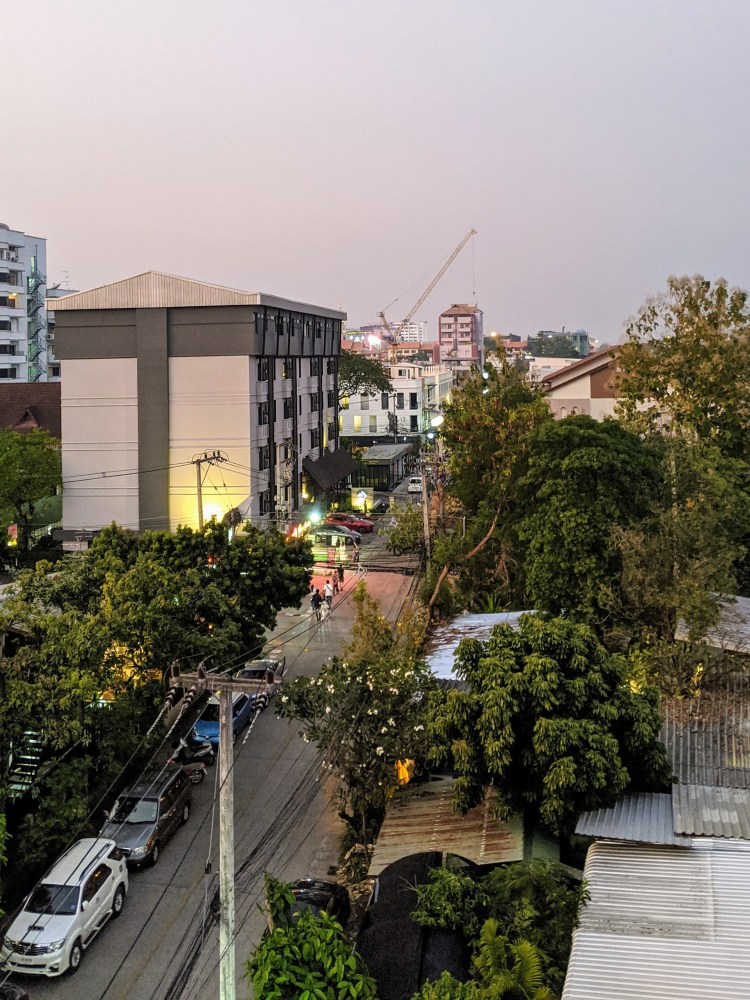
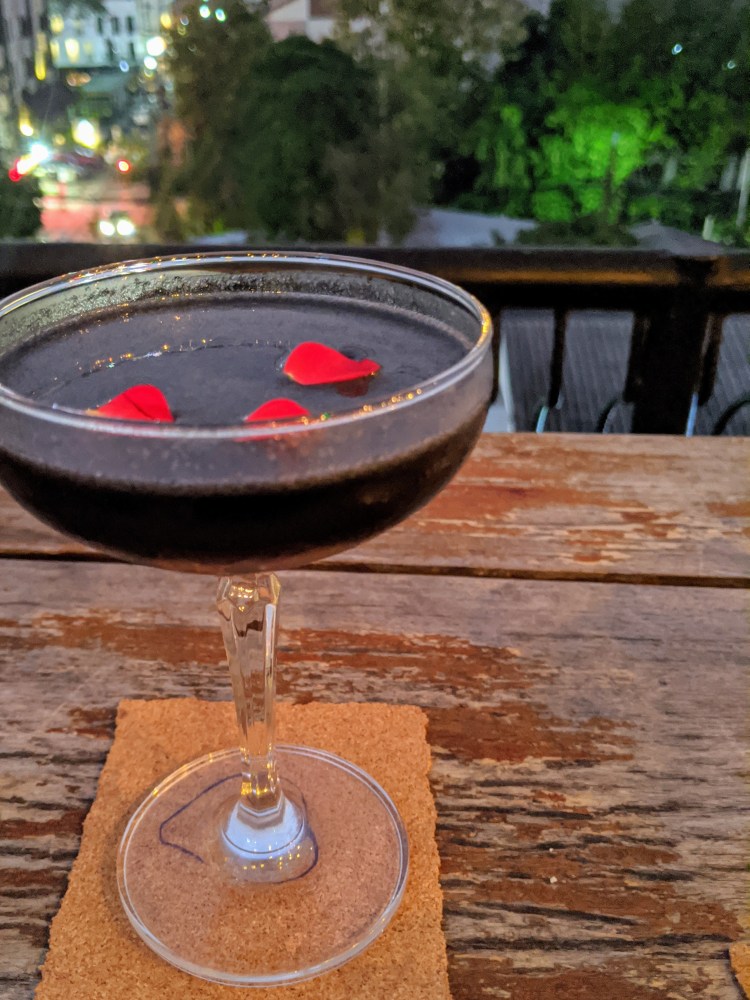
Next up in our Nimman checklist was Thai eatery Tong Tem Toh. There was an insane queue when we arrived, so we put our name in  and walked a few blocks to a rooftop bar to see Nimman from above. The rooftop at Hotel Yayee served artisan cocktails with a Thai twist. We enjoyed ours while watching the sun set behind Doi Suthep and getting the bird’s-eye view of Nimman. 

It took exactly one-cocktail’s-worth of time for our spot in the queue to come up. We were the only white people at Tong Tem Toh, which both excited and scared us– because everywhere else we ate that was filled with predominantly Asian clientele had been spicy as hell. Tong Tem Toh did not disappoint on this front. The sweet chili dipping sauce for my fried tilapia was the spiciest thing I’ve eaten in my life. I had to order a coconut just to keep my tongue from spontaneously combusting. Aaron tried to be adventurous and ordered some fermented pork, but it turns out we’re basic bitches. I was pretty proud of myself for eating my dish, until my stomach decided that actually, it wasn’t a fan of spicy food. Go figure. We returned to the guesthouse so I could have a little privacy while I writhed in pain. 

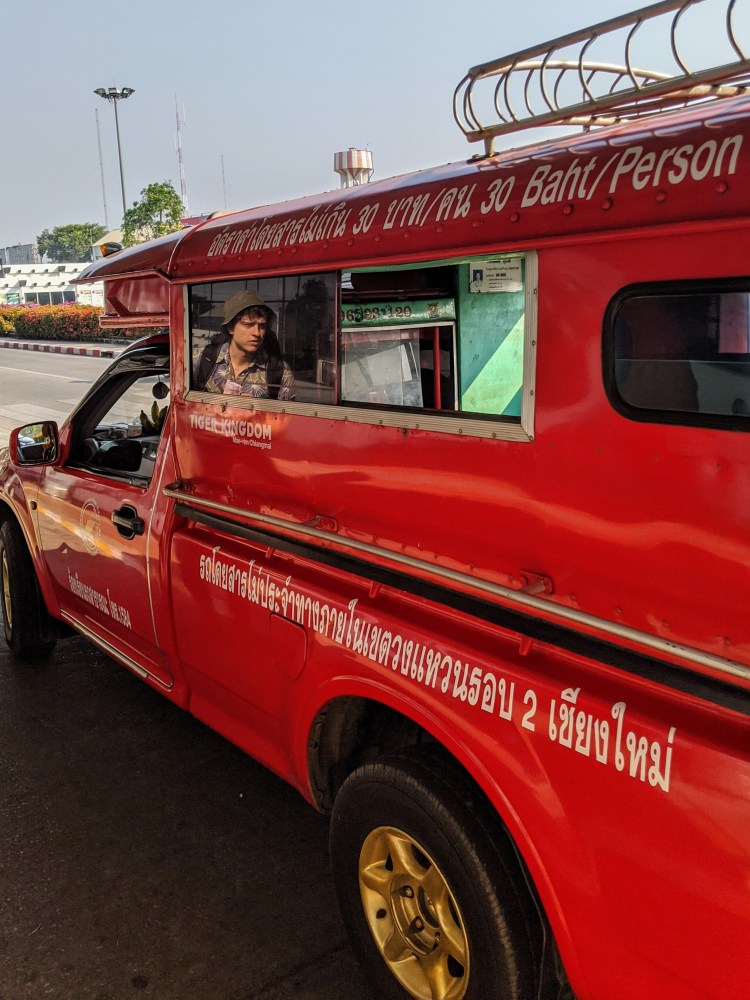
This morning, we flew to Luang Prabang. We had just enough time to fit in one last visit to Coffee Plus. I had started an antibiotic the day before because there’s a slim chance of contracting malaria in Laos, and this morning I took my next dose. On an empty stomach. So I made it as far as ordering a latte before my already queasy stomach decided it had had enough, thank you very much. “Are you ok?” the owner asked me. “Fine,” I said, green-faced, “just a little nauseated.” She produced a small amount of brown liquid in a large shot glass. “Drink this. It’s Thai herbal remedy.” Bottoms up, I guess. It tasted like licorice and some herbs that weren’t meant to be consumed, but I’ll be danged if it didn’t do the trick. My stomach instantly settled, just in time for us to catch a red truck to the airport. 

Next stop: Luang Prabang, Laos.

Chiang Mai: Day 6

Aaron and I are both starting to “need a vacation from our vacation.” I know; I hate me for saying it, too. But it’s been very go go go and there hasn’t been a ton of downtime. Not to mention the fact that I’m pretty sure I’m getting a stomach ulcer from all the spice and acidity in the food. Our next stop is Luang Prabang, which I have been told is a romantic, but sleepy town, and that suits us just fine. Until then, though, we needed a break. We took an extended rest at our hotel and decided that for dinner, we’d eat something other than Thai to give our tummies a rest, too. 

Good View was a restaurant on the river that supposedly served sushi, so that seemed to fit our needs. Once we got there, however, we discovered the menu was all Thai food. At least we were sat at a table by the river, far away from the live music. We shared some wine and the most palatable things on the menu: pad Thai and spring rolls. I have become the tourist I shaded only two posts ago.

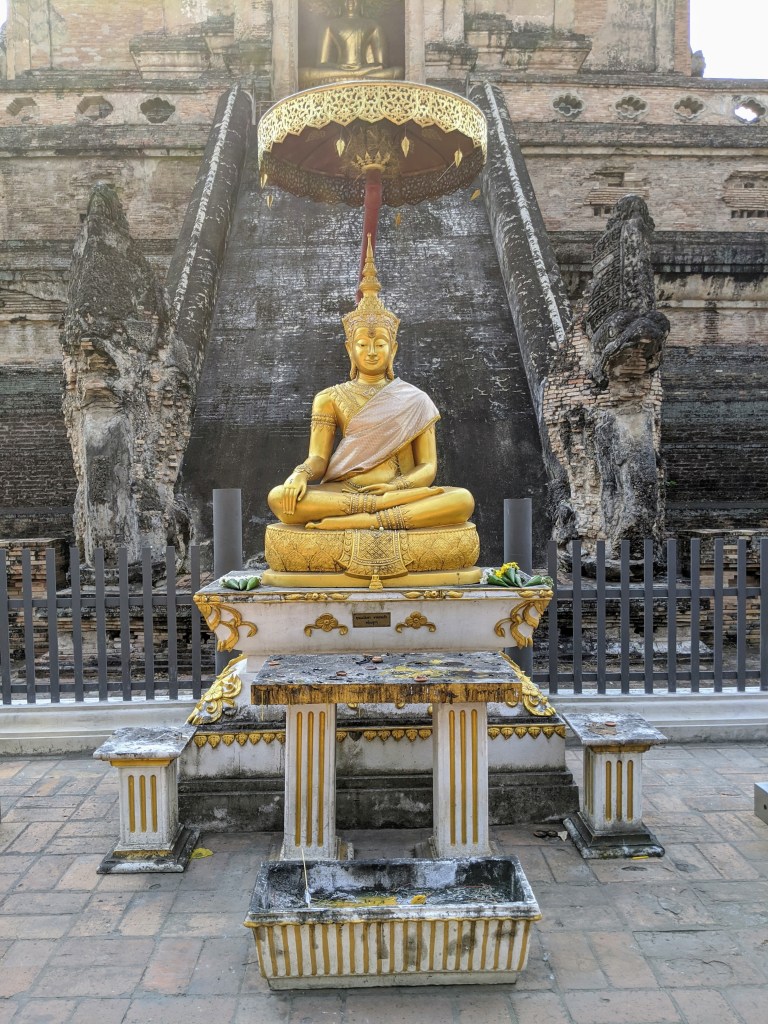
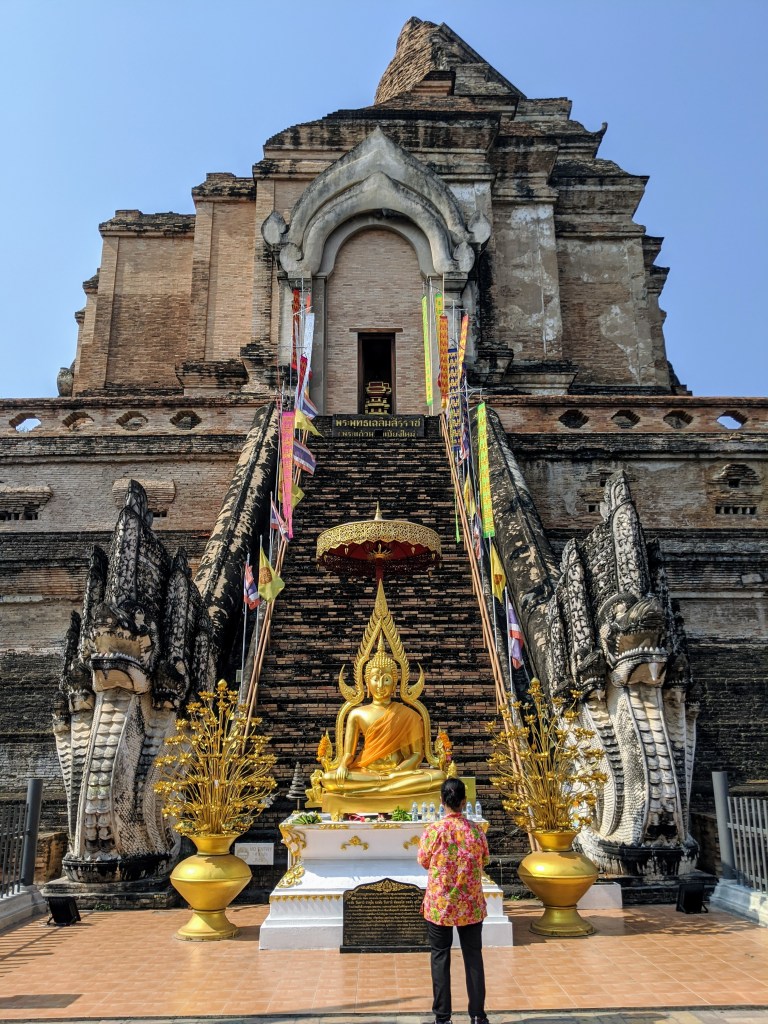
We had big plans to visit Doi Inthanon, Thailand’s highest peak, for our last day in Chiang Mai, but those were scrapped in favor of taking it easy and sleeping in this morning. We woke when we felt like it and broke our fast at the nearby Coffee Club. It was a bit overpriced, but we got to try a traditional Thai breakfast of congee (savory rice porridge) with egg, sausage, and ginger. Then we walked over to Wat Chedi Luang, which houses one of the oldest chedis in Chiang Mai. It’s a Lanna-style chedi, meaning it looks more like a building than a spire. Built in 1441, it’s bricks are now crumbling and it has a kind of decrepit charm. 

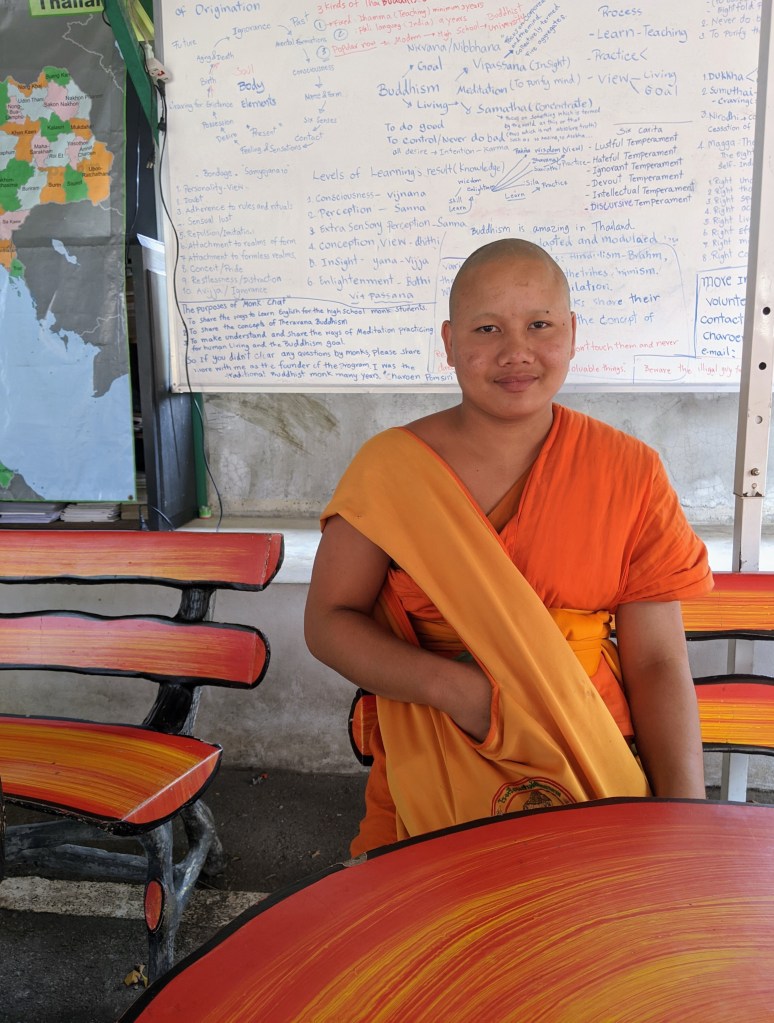
Chedi Luang is also known for its “monk chats,” which it hosts daily until 5 pm. The chats are a chance for tourists to learn a bit more about Buddhism and the Sangha (the monastic community). They’re also a chance for the young novices and monks to learn and practice their English. When we found the monk chat tables, gathered under a large tarp tent, only one monk was sitting at them. Next to him was a mid-50s-ish-looking Thai man wearing a polo shirt that said “Big Boss” on the sleeve. An Australian couple was speaking with the monk, teaching him how to say water. Big Boss, however, was doing most of the talking. We joined them and were handed a sheet of paper that listed some temples where you could learn meditation and a few questions you might want to ask. I started with what I thought was the most interesting: “is the Buddha a god?” 

Now, I knew the answer to this question– at least, in theory. But religious scholars and religious laypeople often don’t have the same answers to questions about their religions of choice. Ask a devout Catholic if God is Jesus, and you might get a simple “no”. Ask a Catholic scholar and you’ll get a pretty academic discussion of the Holy Trinity. It was my understanding that scholars of Buddhism might have a different answer to the question of whether the Buddha was a god than many of the Buddhists I had met here. Big Boss didn’t put the question to the monk, which was all the same to us because he looked about 14 and didn’t know how to say water in English, much less discuss the Godhead. “In all forms of Buddhism, there is no God. I respect other religions, but to me, this is more reasonable. Buddhism is very reasonable religion,” Big Boss said. Aaron and I nodded our agreement. This guy was speaking our language, in more ways than one. “But,” Big Boss continued, “Thailand is very old country. First, we were animists. Then, we were Hindu. Some people, they still have aspects of these religions in Buddhism. Some people treat Buddha like god.” 

We passed a half-hour or so with Big Boss– who we found out was not currently a monk, but had previously been one. He started the monk chat at Wat Chedi Luang 15 years ago. The actual monk left shortly after we arrived, but Big Boss was the one answering our questions anyway. We asked about how we, as western Buddhists, could be respectful without seeming performative. We asked about the stages of meditation in Theravada, and about how meditation varies across the different sects. We asked about Theravada’s ban on female monks, why the monks wore orange robes, what the symbolic meaning of the incense and flowers were. Another American couple who arrived after us asked why some statues show the Buddha sitting, others standing, and others reclining. “Because, as I was just telling them” said Big Boss, gesturing toward us, “Buddha was a man.” We couldn’t always follow his English, but it was, overall, a very rewarding chat– even if it was not, technically, a “monk chat.”

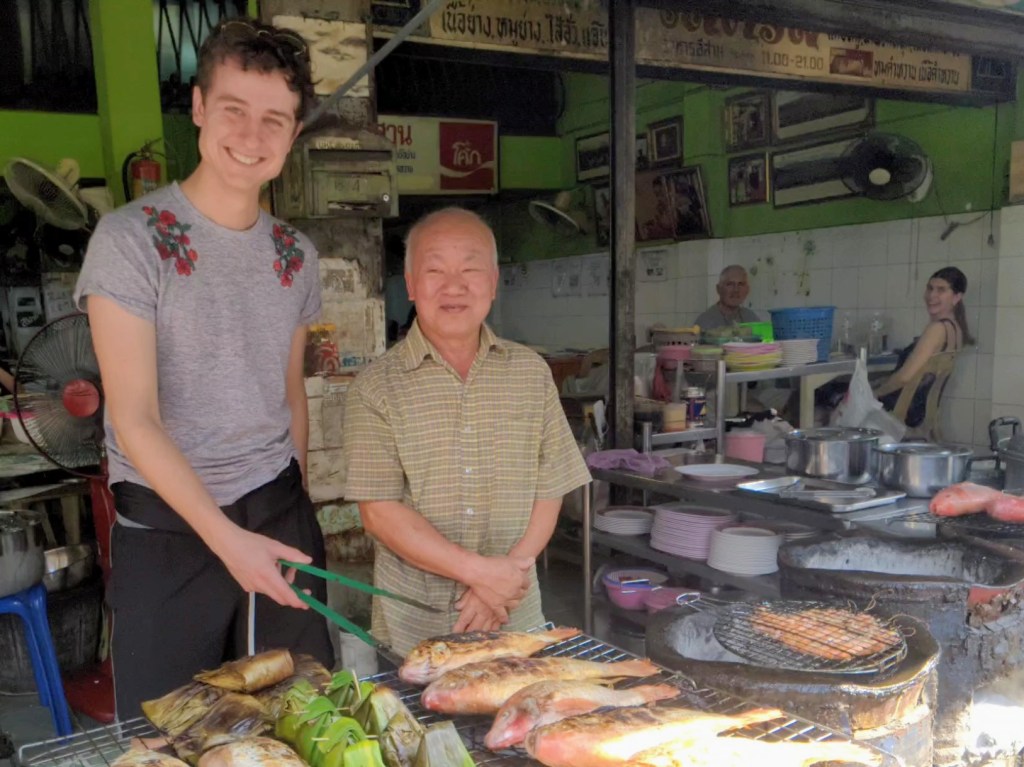
For lunch, we decided our stomachs were ready for some authentic Thai again. We ate at a place across from our guesthouse called Lert Ros. We had walked past it many times; it’s coal barbecues displayed red-scaled whole fish that smelled divine. Moi and Arm had recommended it, as had our guidebook. All of the above had mentioned the barbecued red tilapia, so we got that and some papaya salad. And then we got it again, just to be sure it was consistently as good as the first time. Aaron, who is still trying to force himself to like fish and who gets very icked out by fish bones and skin, wanted to order two of these whole fish. That alone should tell you how good it was. It wasn’t spiced or marinated, just stuffed with some alliums. But the meat was juicy and fresh-tasting and a little bit sweet. 

Tomorrow, we head to Laos, but to prepare for another day of travel, we would need another massage first. Right? Only makes sense. I’ll tell you about it tomorrow. 

Chiang Mai: Day 5

Our exotic lunch, unsurprisingly, did not sit well with my stomach. I was already carsick from the incessant veers in the mountain pass, but now it was taking the full force of my will to hold it together. I stuck with the views from the front and took deep, centering breaths all the way to Tham Lot. 

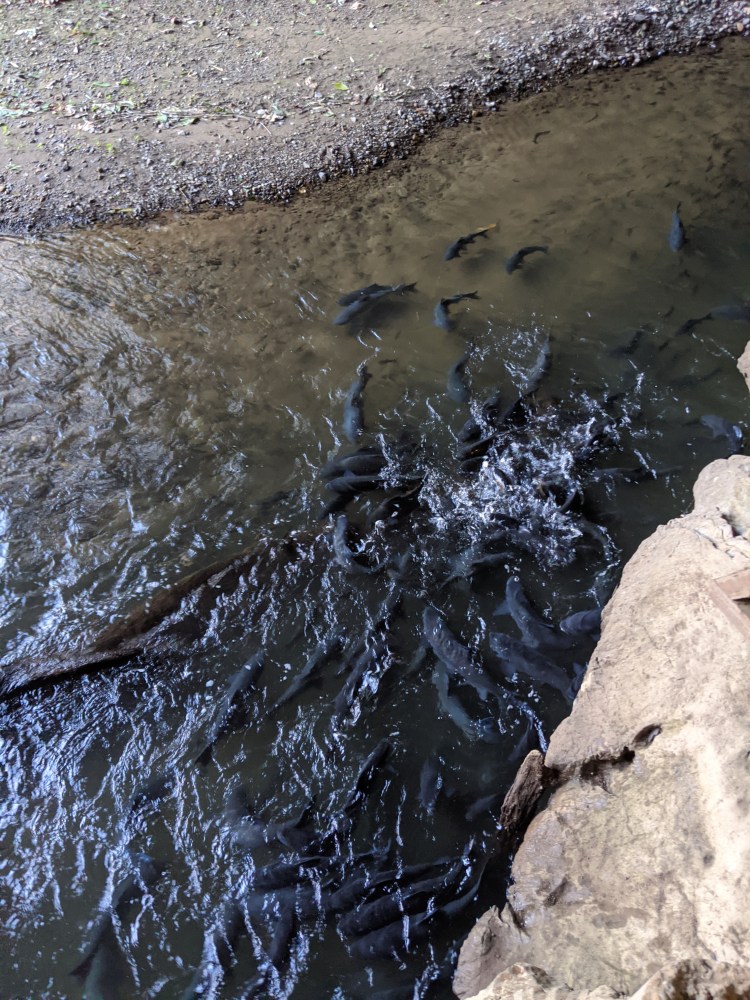
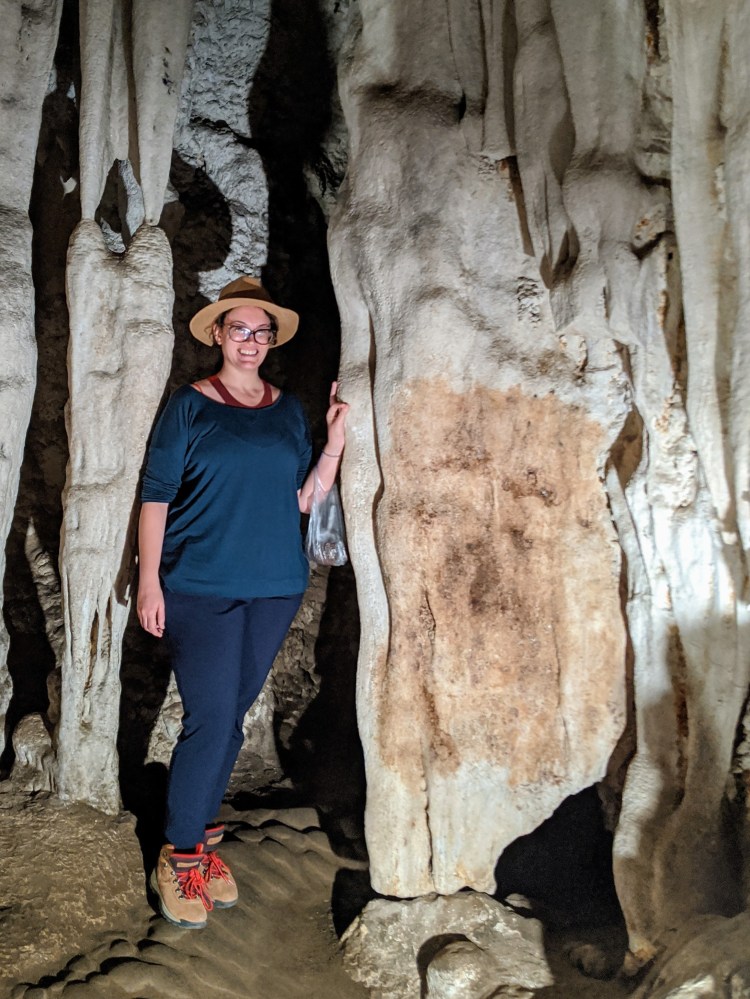
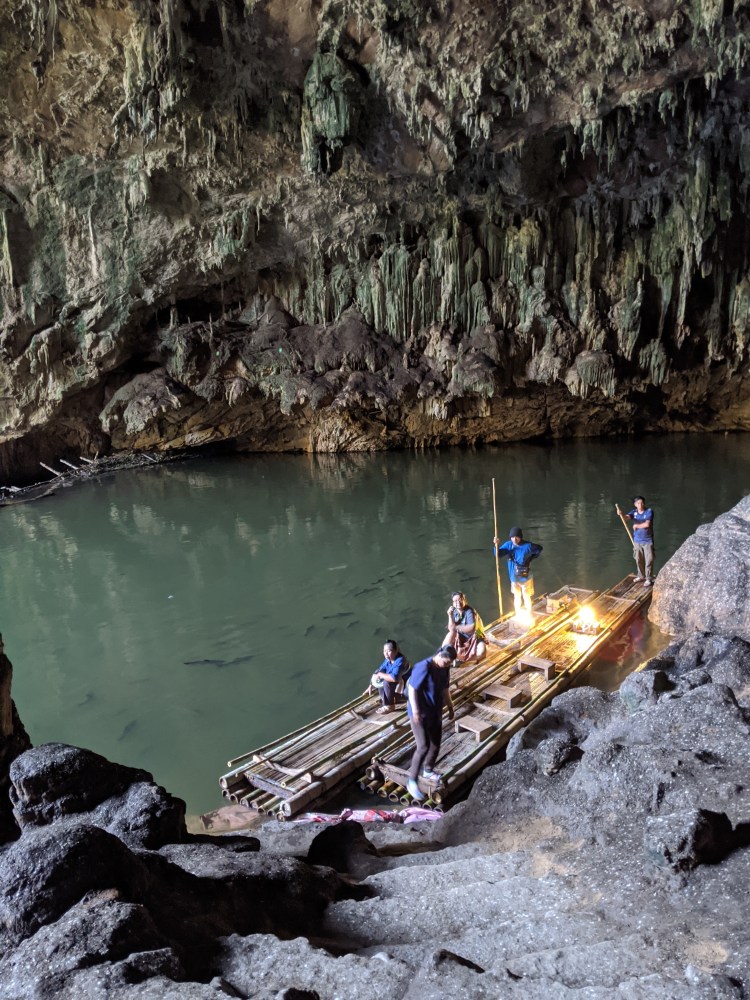
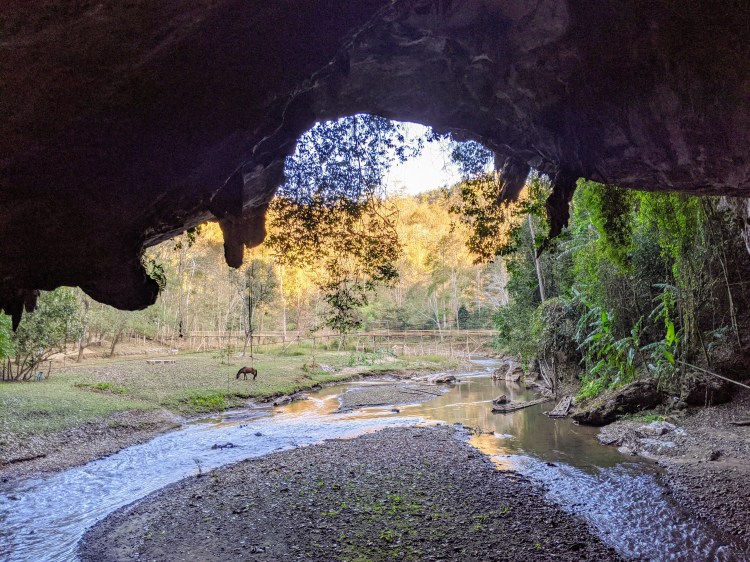
Once there, we hired a guide and lantern; visitors are not allowed to wander the three caverns of Tham Lot on their own. We also bought a small bag of fish food, because Poom and Moi told us to, and they had yet to steer us wrong. A very short trail led to the mouth of the cave, from which a large shallow river emerged. A roan pony was picturesquely grazing the grass just in front of the stream. We crossed the wooden bridge taking us over the water and into the caverns, and on the way we fed the fish. They were colossal and frankly, hostile, black koi. Every time we’d throw a small handful of the food, the surface of the water would instantly erupt where it landed, with fish being shoved around by dozens of their brethren. It was a full-on frenzy. I was terrified of them, so we moved on and entered the cave, stepping onto the cool, damp rocks of the cavern floor. Sand bags were stacked everywhere, holding back the small flood which wanted to cover the cavern in shallow pools of water. Our guide spoke almost no English. I don’t know what we would have done without Poom and Moi. I watched her footing carefully and tried to copy it; I learned my lesson early when I almost stepped in a hole on one rattan bridge. The cave itself was immense and deep; at over 1600 meters, it is one of the largest caves in Thailand. While there, we saw a prehistoric painting, some ancient teak log coffins, and roughly a gajillion rock formations that looked like other things, which is about as much information as our guide could share. She would stop somewhere, point her flashlight at a stalagmite formation, and say a word in Thai. Poom would then lean towards Aaron and me, and translate “alligator,” or “Buddha statue,” or, once, “tit.” They really did look like whatever she said they looked like, especially the tit. 

To reach the third cavern, we rode in a long bamboo raft, down the river with the violent koi. Aaron intentionally threw some fish food right next to me just to freak me out. Editor’s note: this was only in retaliation. Anna struck the first blow. Author’s note: unintentionally! I’m just bad at throwing. Above us were swarms of bats and starlings. In order to reach the cavern we had to climb some precipitous wooden stairs; the railings were covered in guano, but not holding them would have been much more dangerous than getting some dried bat doo on your hands. “We have hand sanitizer” was the mantra I mentally repeated to myself as we climbed them. 

After the cave, Poom and Moi took us back to Pai. They wanted to walk around the night market and get street food, but I told them I needed something simple. I needed– I hate to admit it– a cheeseburger. So we had dinner at Maya Burger Queen, the premiere burger joint in a town weirdly full of burger joints. The cheeseburger was almost too flavorful for what I needed, but the french fries with garlic mayo really hit the spot. We did end up walking the street market afterwards for a bit, and that’s when we noticed something strange– something that explained why Pai had so many places to get a burger. The population was mostly white people. Pai had the feel of an American beach town. Even the signs were mostly in English, without a Thai translation. Poom asked us how we thought she felt, to see this Thai mountain town taken over by American tourists. “You tell me. How do you feel?” Aaron asked. “I don’t know,” she replied, a bit sadly. The daytrip took a full 12 hours, all told, and we were bushed. Aaron and I took dreamless naps on the way back, now that the sky was too dark to enjoy the views. 

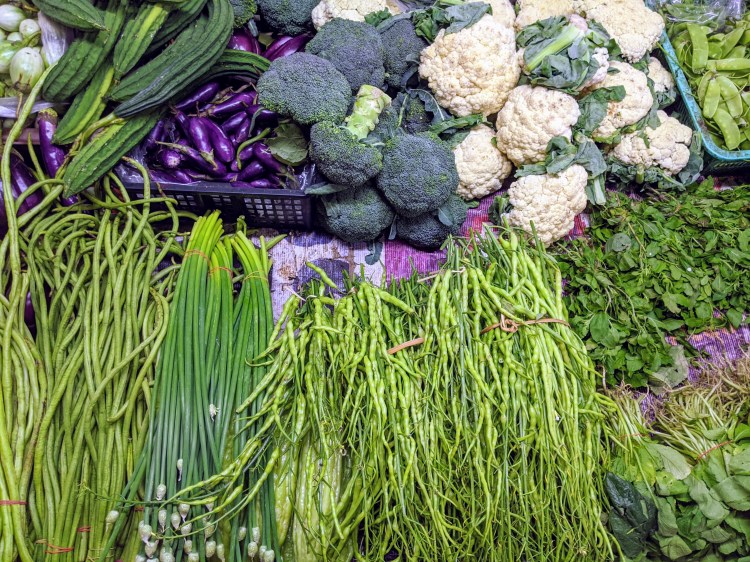
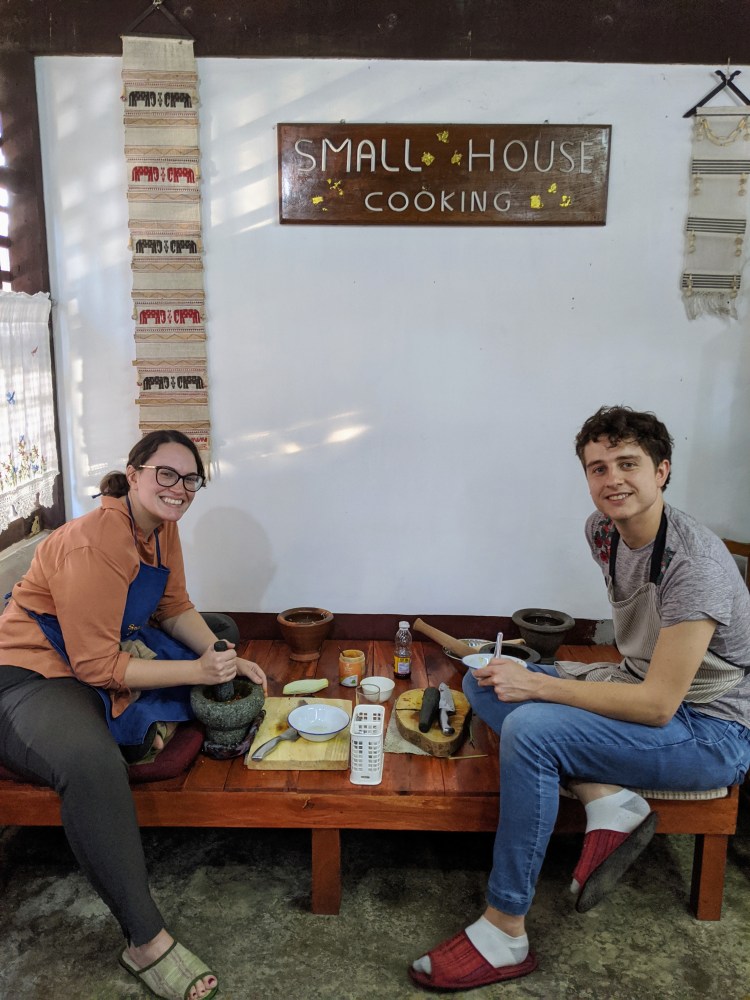
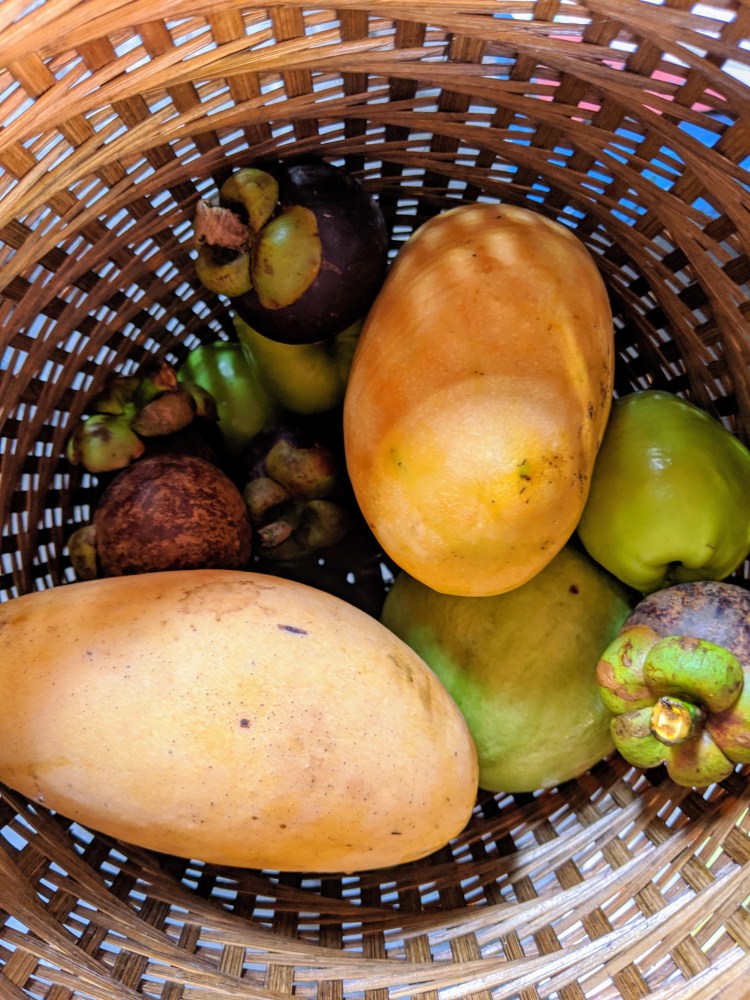
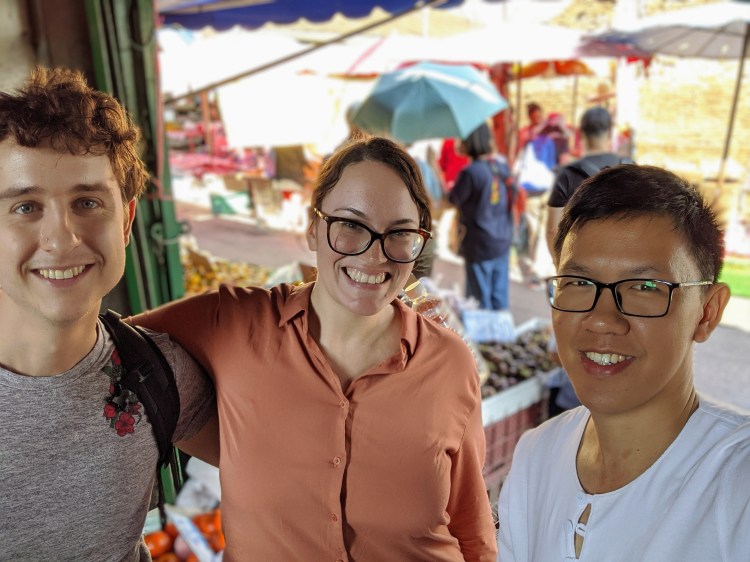
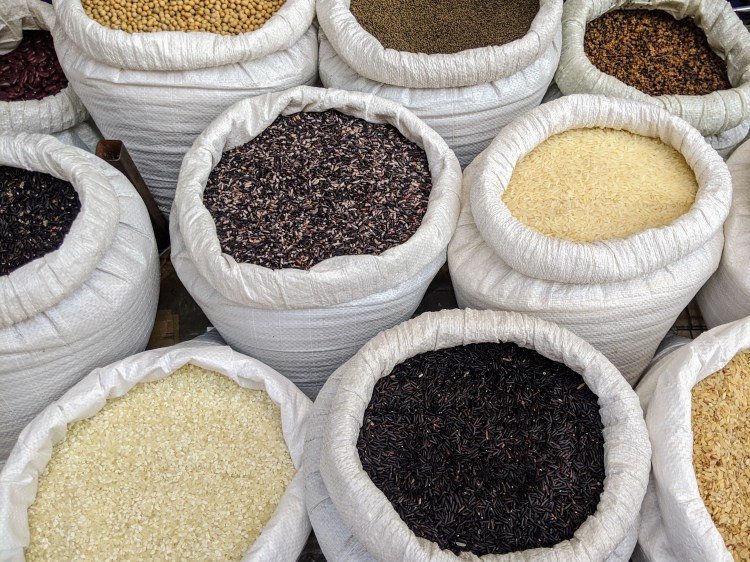
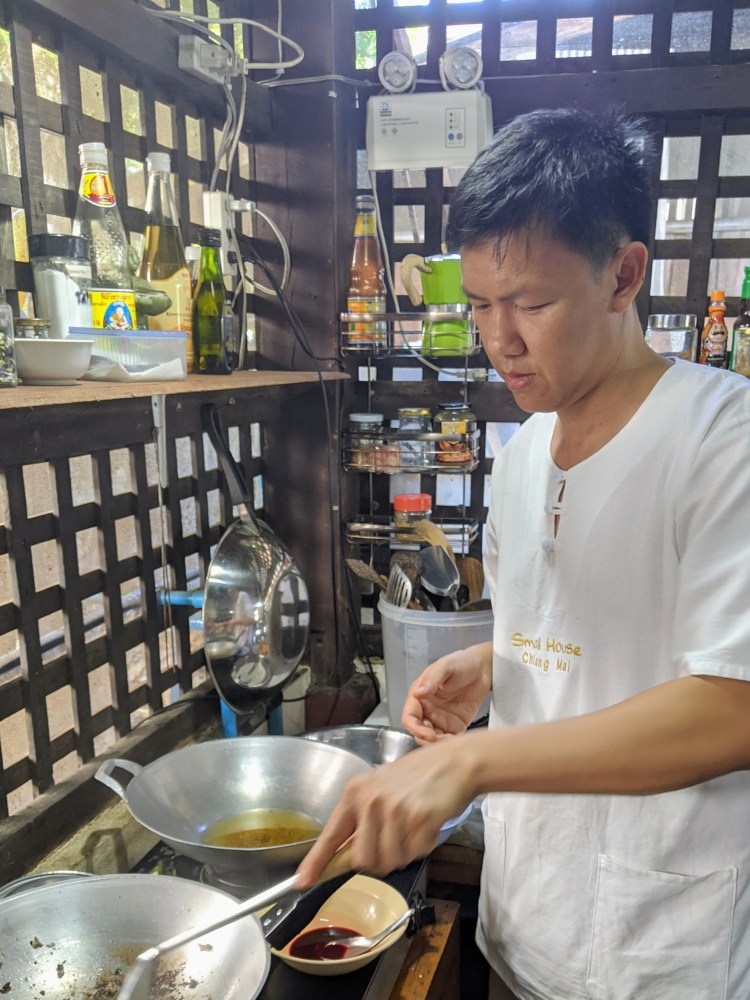
The next morning, a car came to pick us up for our Northern Thai cooking class at Small House Chiang Mai Thai Cooking School. Arm, the car’s driver, was also our instructor for the day. We picked up another couple from Washington, then made our way to the south gate market. Arm gave us a tour of the market as he picked out ingredients for the day’s recipes. He showed us a wide variety of Thai fruits and vegetables, some of which he either did not know the English name for, or there wasn’t one. “What’s this?” we’d ask, holding up some caper-like branches. “Thai vegetable,” he’d respond. “What’s it taste like?” I’d ask, seeing if I could figure out it’s western equivalent. “Taste like vegetable,” he’d say. Arm had a wonderfully deadpan sense of humor– so deadpan, in fact, that I was never really sure when he was kidding. We picked out a basket of Thai fruit, and Arm told us how to tell if each one was ripe.

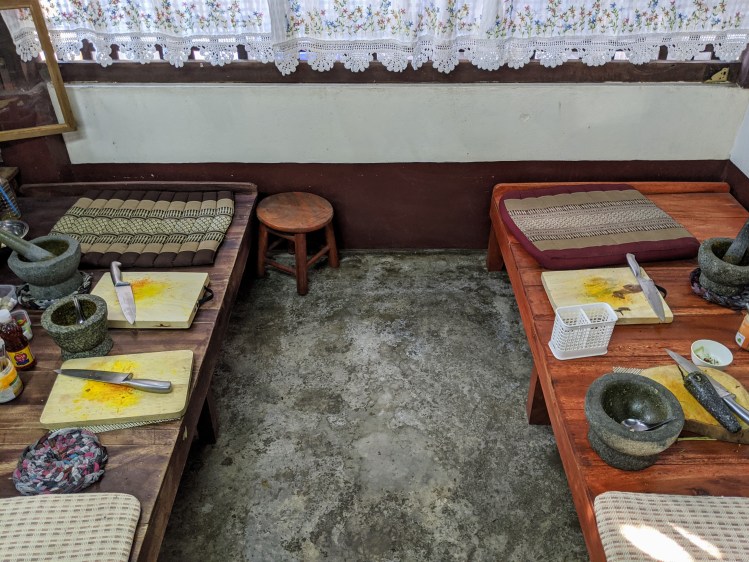
Back at his charming, very Thai home, we got to work. First, though, there was a snafu with a floor pillow that I wasn’t sure about. Did it go on the ground and we faced the bench? Did it stay on the bench and we sat sideways to face the cutting board? Arm came over to help. “Ok,” he said, straight-faced, “I teach you how to sit.” 

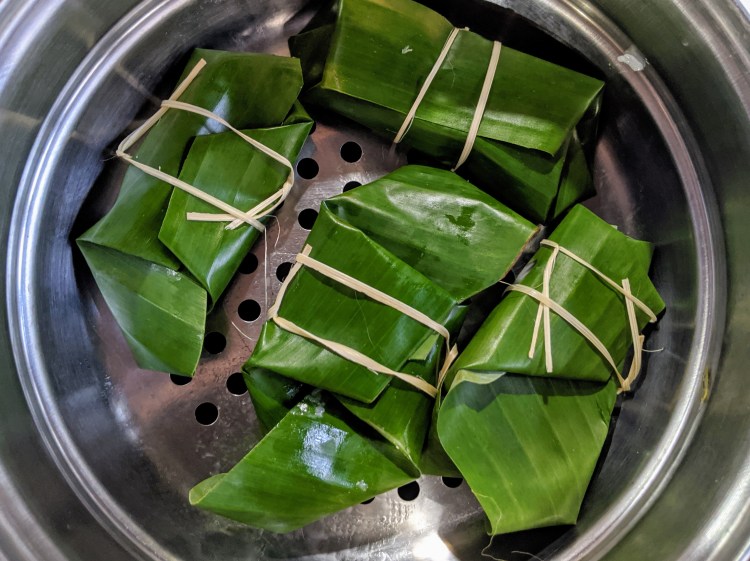
In addition to lessons on sitting, we were also taught how to make our own Thai curry paste, milk coconut meat, wrap banana leaves, and open a mangosteen. We made green mango salad (papaya salad relies on lime juice to make it sour, but green mango is sour all on it’s own), khao soi, hor nung moo (pork chili paste steamed in banana leaves with glass noodles), pork laap, straw mushroom soup, and sweet sticky rice steamed with banana. Arm was patient with us, and very knowledgeable, though he did keep insisting we weren’t adding enough chili. “More chili?” we teased him when he tasted our dessert. 

We returned to the hotel to rest after our all-day cooking class, happy to have made another Thai acquaintance.

Chiang Mai: Day 4

After our visit to the jungle temple of Wat Pha Lat, it was time to go to the top of Doi Suthep and visit its main attraction: Wat Phra That Doi Suthep. We shared a rot daang with a friendly, young couple from Mexico City who were also on honeymoon, and compared notes about our trips and recommendations.

Our driver dropped us off at the bottom of a very long stairway, which I can’t say I was excited to see. After hiking the Monk’s Trail all morning, my quads were killing me. But Wat Phra That was at the top, and taking these stairs was the only way to get there, so I put on my big girl pants and sucked it up– for 309 steps.

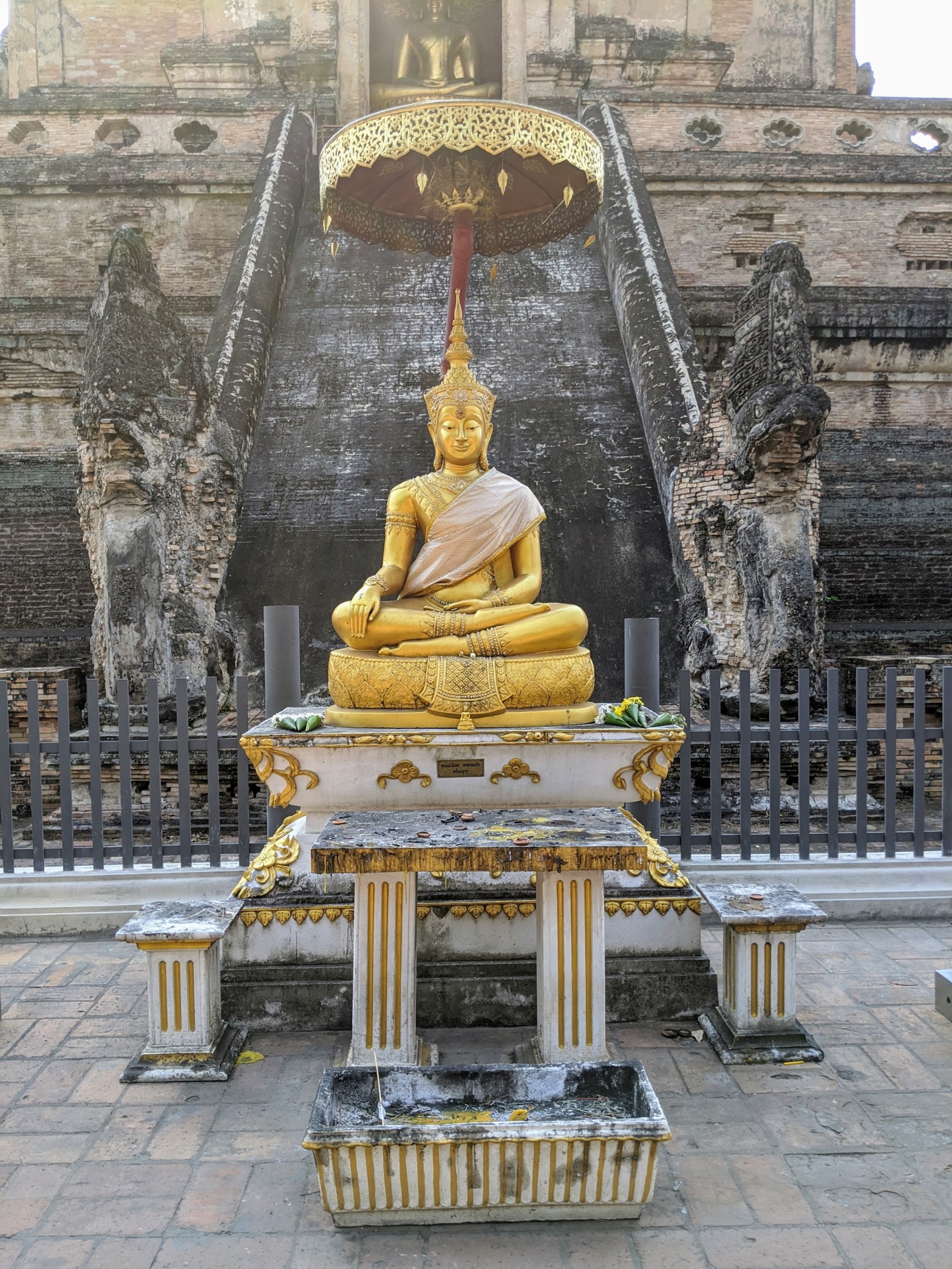
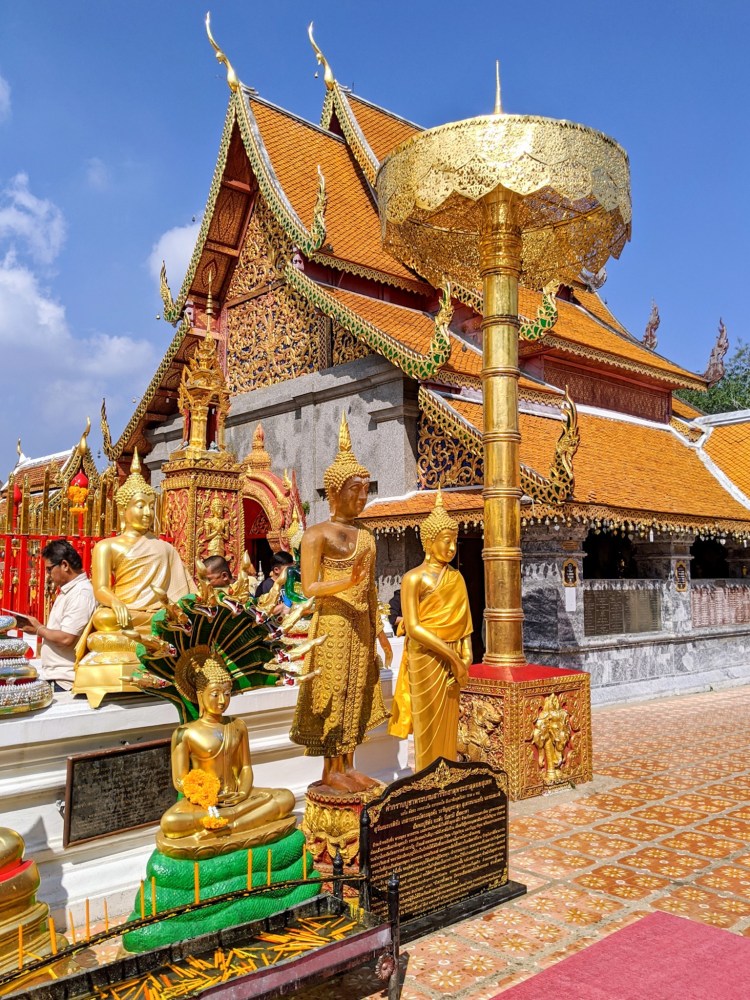
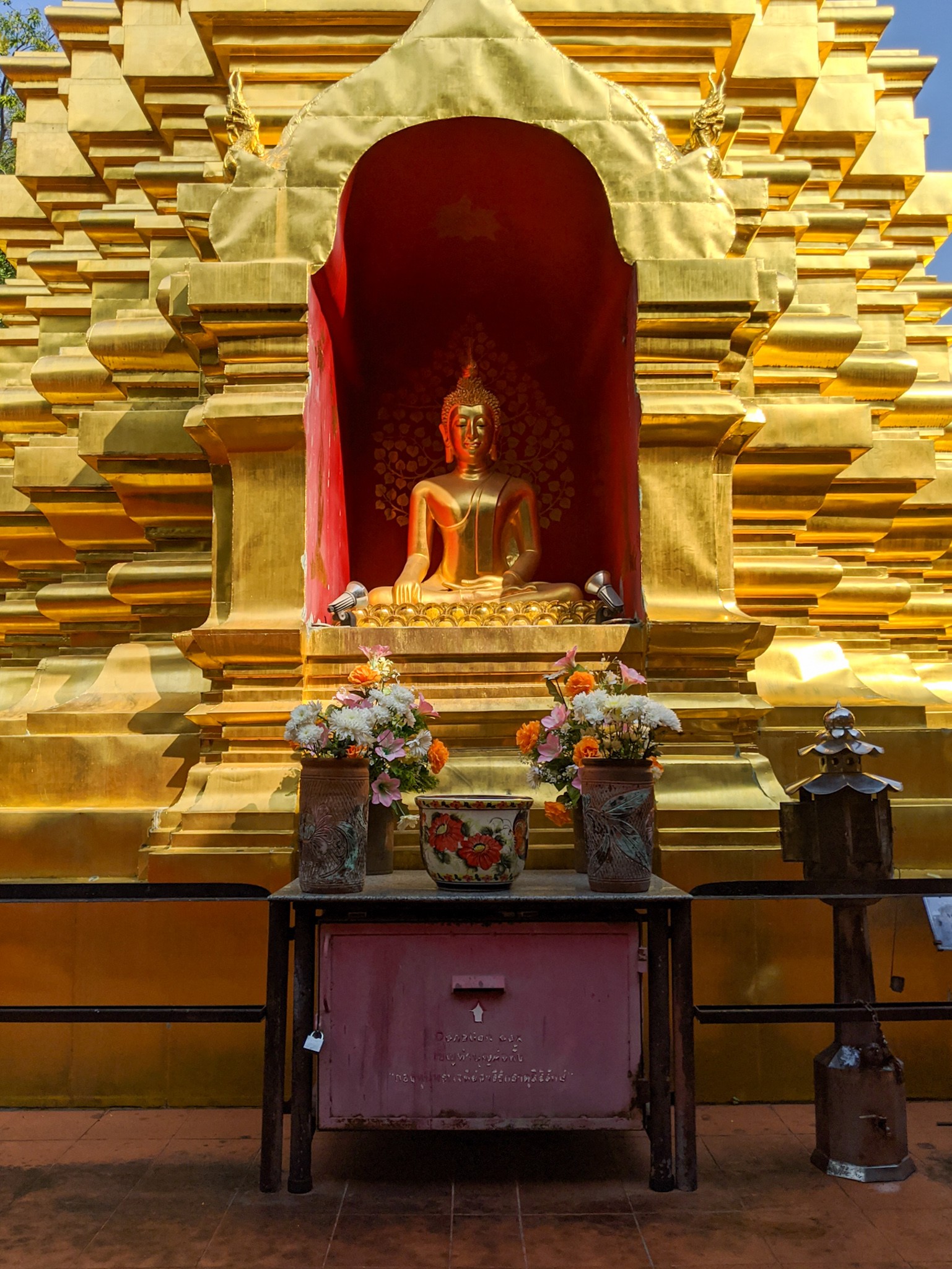
At the top, we placed our shoes with the dozens of others and entered the temple. In Wat Phra That, all that glitters actually is gold. A giant gold chedi, as always, but also gold facades, gold roofs, gold umbrellas, and an abundance of gold Buddhas. We circled the chedi, then went off to admire all the Buddha statues. Aaron and I agreed that we were now, after so many gold Buddhas at every temple we’ve been to, over gold Buddhas. Fortunately, there were also a handful of emerald Buddhas to marvel at.
We were inadvertently blessed by a monk when we wandered into one of the structures (note to self: start learning the names of all the different sites in temples so I can stop calling them all “structures”). A crowd had gathered around the monk and he began a chant in Thai. We were in back, checking out the centerpiece of the– erm– structure (which was, of course, three gold Buddhas) when the monk dipped his bouquet of tightly-bound reeds into a bowl of holy water and began shaking it over the crowd, sprinkling them with the water. He then deliberately aimed towards Aaron and I. This anecdote may not sound like much, but it meant the world to me. Although I consider myself a sort of western Buddhist, I often feel very much like an interloper in these temples. I wonder if I am intruding, both physically and culturally, especially when I am participating in whatever small ways I do (circling the chedi, meditating, wai-ing to the Buddha). The fact that this monk intentionally included us in the ceremony, even though we had not yet given the offering usually expected for a blessing (we did after, of course) and even though we were not a part of the crowd waiting to be blessed, meant that, for this one monk at least, we were welcome here.

Before we left, we walked along the walls surrounding the temple complex to study it’s intricate murals. Each panel depicted an important moment in the Guatama Buddha’s life. Aaron and I had fun trying to match the panels with our knowledge of the story. Here was his birth, here his marriage, here is where he left his palace and witnessed the four universal sufferings (birth, illness, aging, death), and here is where he flew a pony? That one we didn’t know. But it was good entertainment uncovering the gaps in our knowledge.

For an overdue lunch, we hired a car to take us to Huaen Jai Yong, a traditional Northern Thai restaurant on the outskirts of the city. The clientele was almost entirely Thai, which is always a good sign. My soup, tom som pla, was both incredibly delicious and a bit tough on my western sensibilities. It included giant chunks of ginger, lemongrass, galangal, mushroom, garlic, chilies, and an amazing freshwater fish that was sweet and perfectly cooked. But the fish was served head and all, and each bite had several tiny bones. I’m trying to be an adventurous eater. It’s paying big dividends, but I’m still a bit squeamish about bones and sinew, much less big ol’ fish eyes staring up at me from their severed heads. Nevertheless, I slurped up all the broth and picked at most of the other ingredients. A side of jackfruit laap and sticky rice completed the meal.

Aaron commented on how spicy the food was and I half-nodded and “mm”-ed back. It didn’t really seem that spicy to me, especially after the last few days. Noticing I was humoring him a bit, he decided to build his spice tolerance by biting off half a dried Thai chili. He then spent the next 15 minutes switching between stealing my ice and gulping down water. “Is this forever? Will my mouth ever not be on fire again?” he asked me, red-faced and eyes watering.

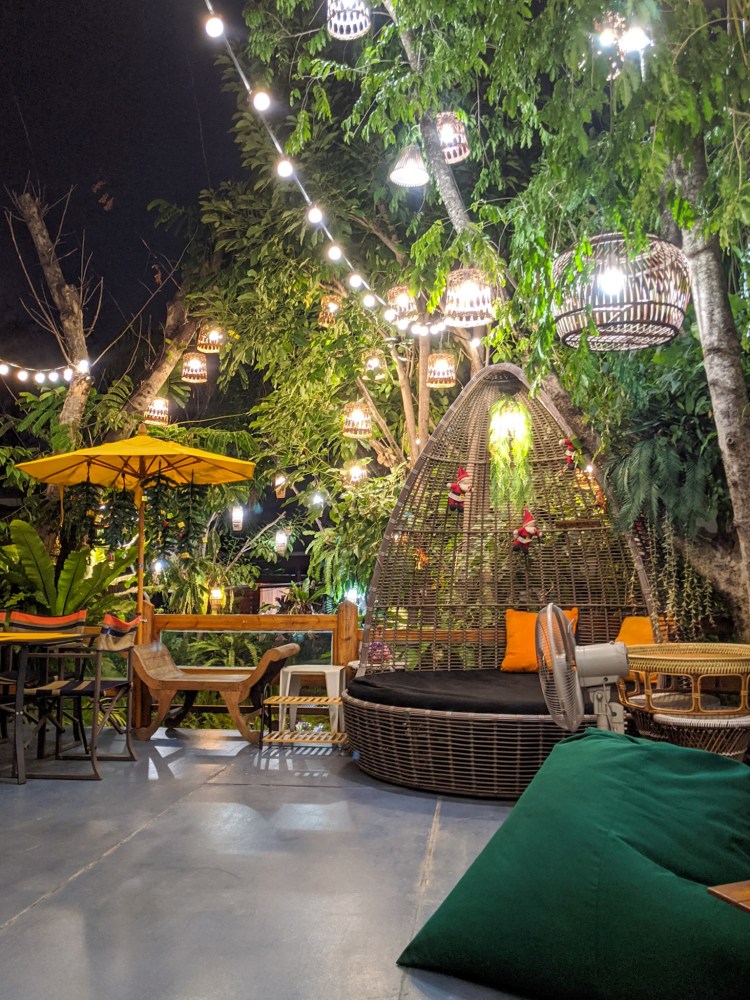
Back at the Awana House, we took a deserved rest. January 5th is the anniversary of the day we first met, so we decided to celebrate at a restaurant called Airniversary that we had seen on our walk home from the market the night before. The ambience was romantic and chic. We were led to a rooftop and seated in comfortable rattan lounge-chairs that would not have been out of place poolside at a nice resort. The scene was lit by hundreds of string lights, lanterns, and candles. It was a great spot for a date-night, made even more wonderful by the fact that our drinks and food were excellent. A bowl of veggie massaman curry, side of fried papaya salad, and an extremely fresh mojito (or two) later, we were satisfied and a bit tipsy.

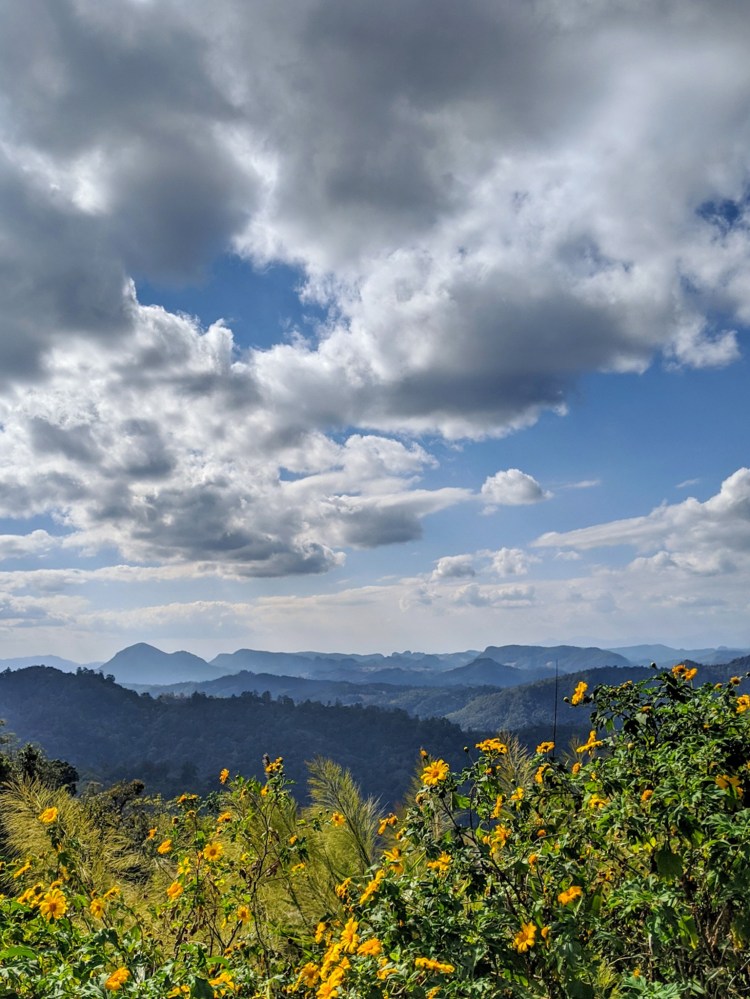
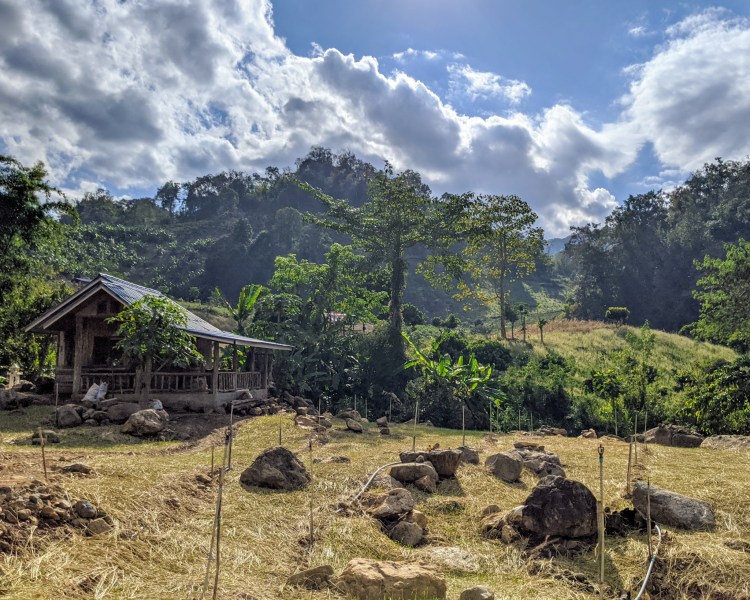
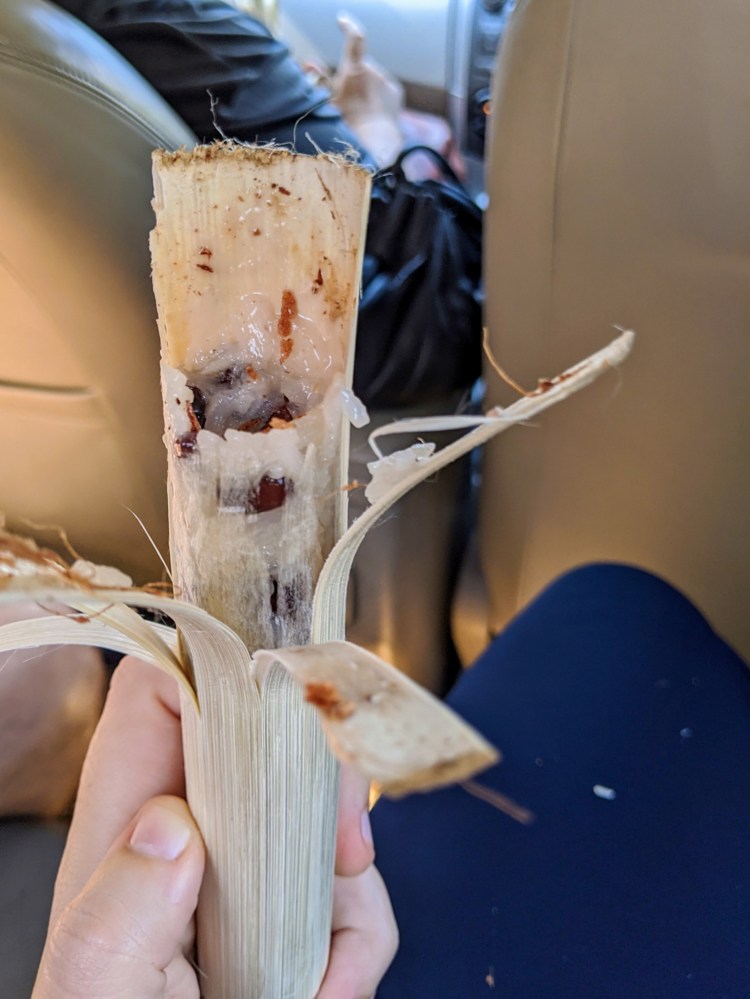
This morning, we ordered a car and driver to take us to Pai, a mountain village to the northwest of Chiang Mai. Poom, our navigator, and Moi, our driver, picked us up from Awana House. Moi, we later found out, was the owner of our beloved guesthouse. Both Poom and Moi spoke impeccable English and were endlessly patient with our questions about restaurants, sights, language, and culture. Once we were outside the city limits, they stopped at a roadside stand, telling us they needed snacks. After a brief Thai exchange with the vendor, we were handed two sticks of bamboo. Poom showed us how to peel back the outer hull to get to the coconut-milk-infused sticky rice treat in its center, speckled with bits of taro. The mountain pass we drove on was so winding and steep that I got a bit carsick, but the vistas were breath-taking. Majestic mountains donned mantles of mist as far out at the eye could see. Bamboo bungalows dotted the landscape, and silver streams crossed it. All was palms and rice paddies, garlic and orange farms, golden lotus and roadside fruit stands.

The lunch place we had in mind was just outside Pai, at a place called Larp Khom Huay Poo. Larp or laap (or larb or lahb or laab; there are no standardized rules for anglicizing Thai,  so almost everything has multiple spellings) is a Northern Thai specialty consisting of minced meat (or sometimes vegetables or fruit) fried with Lanna spices. It is sapid and delectable, but not for the faint of tongue. When I told Poom where we wanted to lunch, she turned around in the passenger seat to face us. “This is very spicy food. Lanna spices. Northern Thai food. Are you sure you want this?” Moi was smiling into the rearview mirror. “She likes spicy food,” Moi said. I knew what they were getting at. Most Western tourists think Thai food is spring rolls and pad thai, but authentic Thai food is a horse of a different, red-hot, color. I also knew how to put their fears to rest. “Yesterday, we had lunch at Huean Jai Yong. We loved it!” I informed them. They laughed and seemed relieved. “Ok,” Poom said. “If you like Huean Jai Yong, you will be ok.” But now they were excitedly speaking in Thai. They seemed happy to share this traditional food with us. “Will you try raw laap?” Poom asked us. “It’s very good,” she continued. “I like pork, and Moi likes buffalo.” Uh-oh, I had gotten us in over our heads.

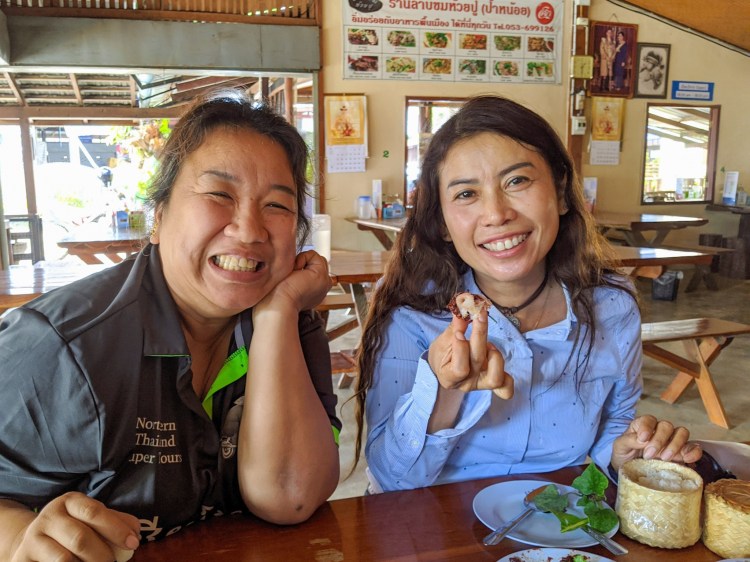
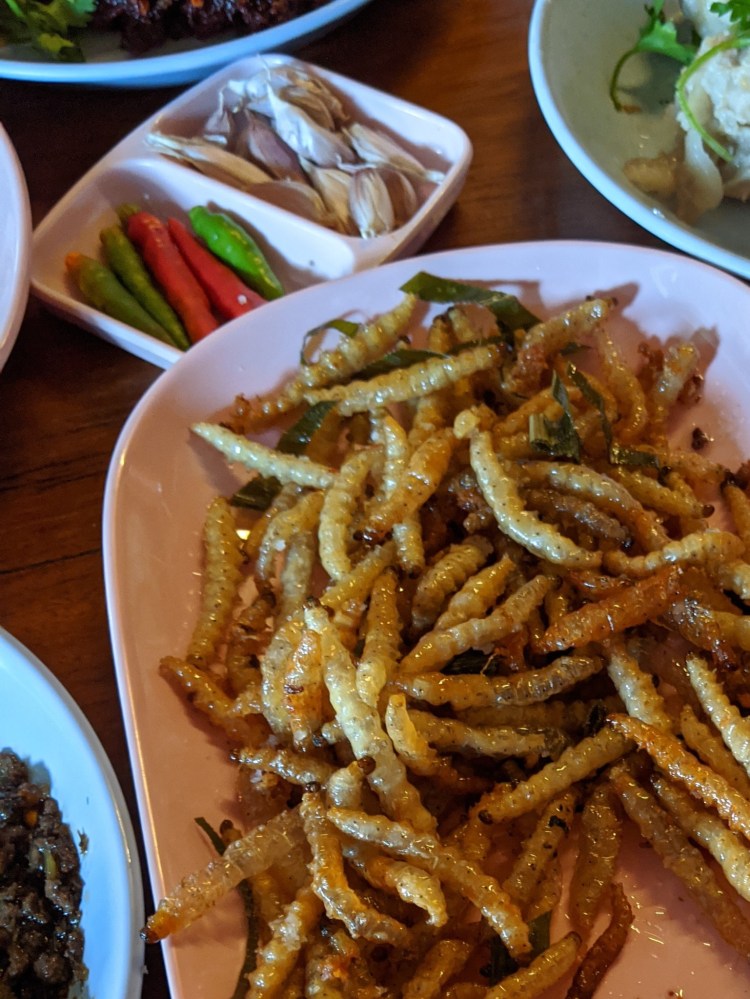
A half-hour later, our teak picnic table at Larp Khom Huay Poo was laden with adventurous Northern Thai specialties: the afore-mentioned raw laaps for our guides, fried pork laap for me and fried beef laap for Aaron, as well as fried silk and bamboo worms, a Northern Thai sausage, and sticky rice. Aaron and I both tried a little bit of everything, much to the amusement of our Thai companions. To my surprise, the bamboo worms were actually extremely edible. I don’t know that I’d seek them out, but they tasted like potato chips with a little more flavor. The raw laaps were also tasty, though I tried only one bite of each, because I wasn’t about to play Russian roulette with my digestive tract. Mostly, I stuck to my fried pork laap, but the experience was worthwhile, if only for the story.

Next on the agenda was a trip to Tham Lot, the largest cave in Thailand, but that’s it for day 4, which I am sub-titling Aaron and Anna’s Appetitive Asian Adventures. Thanks for reading!

Chiang Mai: Day 3

My second rot daang negotiation went much more smoothly, thanks to googling the fair price and remembering to counter below where we wanted to end up. For those of you who are wondering why I, a westerner with money to spare, am haggling with these drivers and vendors: everything I have read have said it is the ethical thing to do. When tourists don’t haggle, it drives up prices and makes services less available for locals. Honestly, the drivers seem to enjoy it. They always give me a sly smile when I counter. 

The drive to Nam Tok Bua Tong (Sticky Falls) was a very scenic 50 minutes, taking us beyond the city limits and past rice paddies and banana farms. Riding in the red truck was a lovely way to experience rural Thailand. Songthaews (another name for the type of vehicle; not all are red) don’t have air conditioning, but the wind is enough.

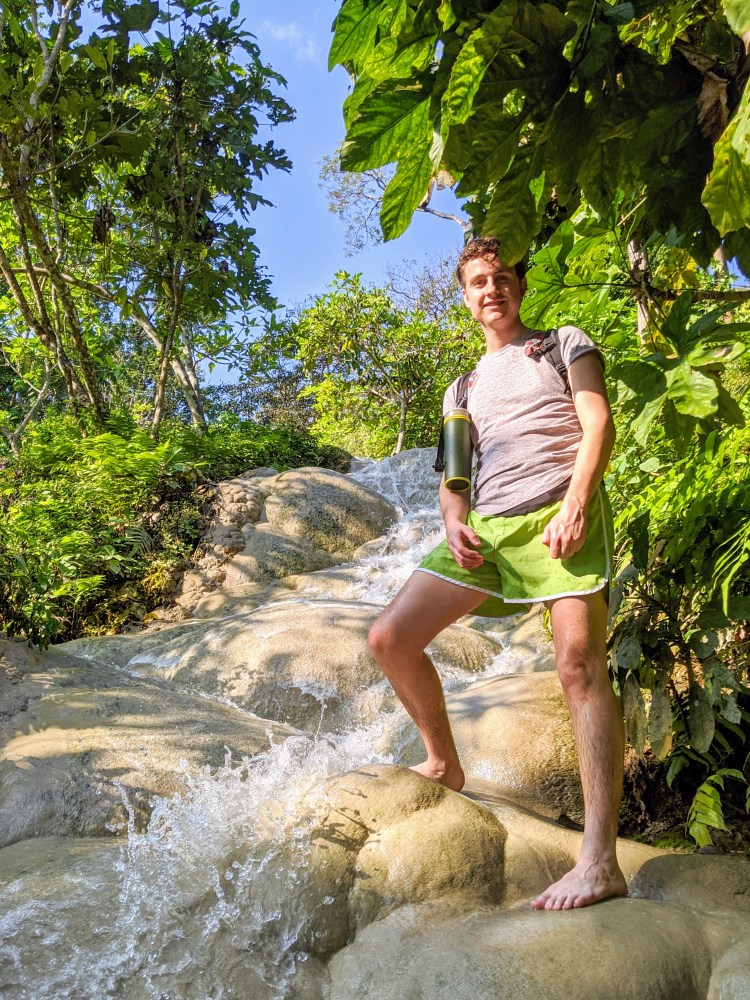
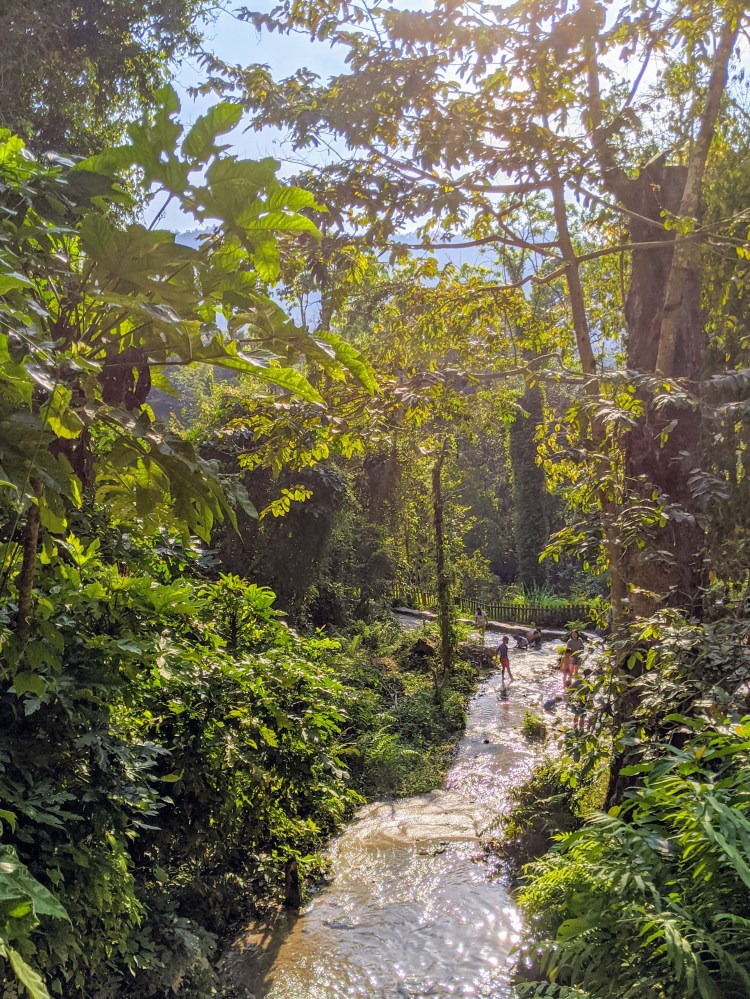
We arrived at the falls during the heat of the afternoon, so the cool water was a welcome respite. The parking lot is actually at the top of the falls, so we took the stair-trail to the first stop on the falls and began to climb. That’s right. We climbed up some waterfalls. The spring of the falls is rich with calcium, which deposits on the rocks below and prevents algae accumulation. Thus, the waterfall can be easily climbed. Well, sort of easily. As easily as some kind-of-steep rocks can be climbed. We had to kind of scramble-crawl up them, but it was both fun and a feast for the eyes. We were there for the golden hour, but I’m afraid my pictures do not do justice to the beauty of the sunlight dappling through the forest canopy and sparkling off the stream. We left, however, when a bee began chasing me around the falls, and my alarmed squeals started freaking all our fellow park-goers out. What can I say? Bees love me and don’t care if it’s unrequited. At first, Aaron didn’t believe me, but after several minutes and changes of location with an overly-friendly bee still harassing me, he admitted there was something weird going on with me and this bee. Neither of us wanted to see where it was leading. We got plenty of time at the falls, though, and spent an enjoyable hour on the ride back discussing the differences between Thai and American culture (see Aaron’s latest post on this blog).

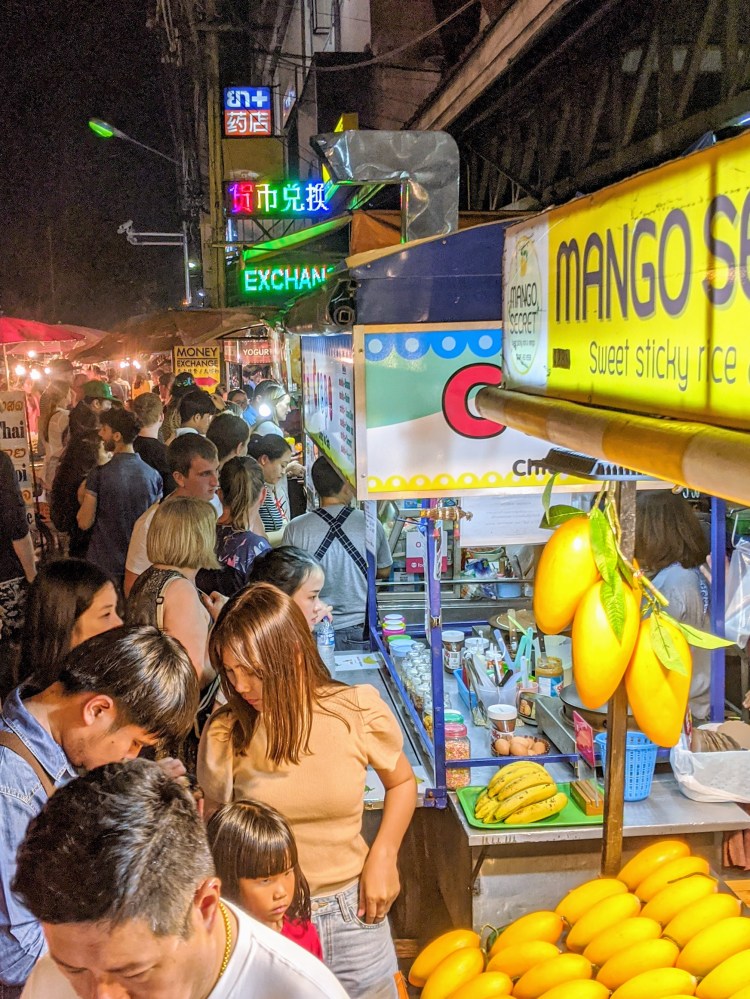
Last night, we checked out the street markets. The south gate of the city has a food market every night, and, on Saturdays, a souvenir and handicrafts market sets up across the river. Much like Talat Warorot, the sensory experience and crowds were a bit overwhelming, especially after such a long day, but we both loved the food. And you can’t beat the prices at a street market! Pork gyoza, mango sticky rice, coconut smoothie, another bowl of khao soi, and fresh passionfruit juice, all for under $7. The mango sticky rice was a highlight for me. You have not had mango until you’ve had it here. It’s as juicy as watermelon and as sweet as a peach. Paired with the slightly salty, slightly sweet sticky rice and topped with a drizzle of condensed milk, it’s perfection. After dinner, we took a short stroll through the handicrafts market, but we simultaneously decided to call it a night after a couple of blocks. Our feet hurt and we were sleepy and there were too many people and ugh.

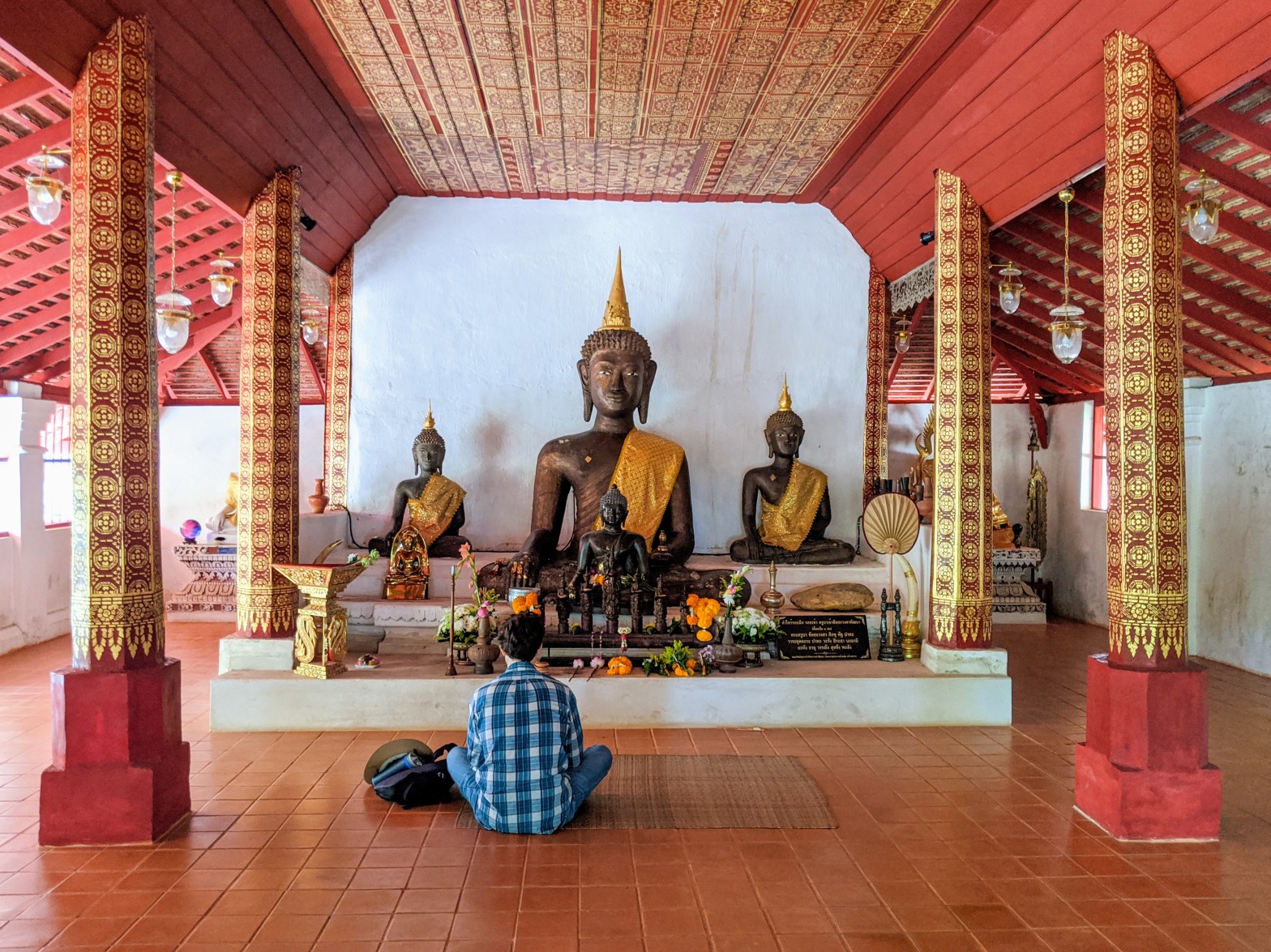
This morning, we caught another rot daang to the trailhead for the Monk’s Trail. The hike cuts a steep path up Doi Suthep (Chiang Mai’s neighboring peak) that serves as a way for Buddhists to “make merit” before reaching Wat Pha Lat at the top of the trail. And boy, did we make some merit. Aaron did fine, but I kept having to stop to catch my breath every few minutes. Editor’s note: Some might say this indicates that Anna is not better at tolerating pain than Aaron. Author’s note: Aaron is my editor. It was all worth it, though, in the end, because Wat Pha Lat was enchanting. It’s a bit of a local secret (though the secret is getting out), so it wasn’t nearly as crowded as it should have been. I stopped in the first structure for some metta meditation, which a sign informed me was what this particular space was for. Metta meditation, also called loving-kindness meditation, aims to cultivate benevolence and empathy for all beings. You may do it as follows: first, take several deep breaths and center yourself. Then, imagine a person (or animal– I often think of Bob) that you have very loving, positive, entirely uncomplicated feelings for. This last part is key; if it’s someone you would get jealous about, they’re probably not who you should start with. Picture this person happy, receiving all the love you have for them, and be mindful of how this love feels. Dig into it. Grow it. And continue to send it to them. Then imagine others you are close to, maybe even a group of them, like your family or close friends. Send them the love, too, and notice that, as you send out more and more love, it doesn’t deplenish– it grows! The more you picture these people you love, joyful and at peace and experiencing all the love you have for them, the fuller your love cup will be. So give it to more beings. How about your neighbors? Or co-workers? Then maybe your city. Don’t forget the non-human beings. They get that love, too. Multiply that love exponentially, sending it to more and more beings, until you are sending it to the entire universe. Note the feeling you have right now. This is metta: equanimity, benevolence, peace, empathy. It feels amazing. Now– and this is the hard part for a lot of people– send it to yourself. You, too, are a being deserving of love and peace. Finally, blur the lines. Realize that the love you send yourself is the same love you are sending everyone else, and that you, too, are part of this universe of love. Open your eyes and enjoy continued bliss as you go about your day. It’s all very hippie-dippy, but it really does feel great, and it puts you in touch with the best parts of yourself. This is what I did in that small shrine on Doi Suthep. The endorphins were hitting me from the arduous trek up to it, the mountain air was on my skin and in my lungs, the sound of a rushing waterfall was filling my ears, and another masterwork statue of a golden Buddha was watching magnanimously over me. It felt better than any drug (not that I have done or would ever do drugs, parents).

Aaron and I explored Wat Pha Lat for a couple of hours, ducking into its many structures and temples to admire its ruinous beauty and highland setting. As we were leaving, we stopped at a bamboo coffee stand and ordered two fresh coconuts. The vendor whacked the tops from all angles with a huge knife until the lid she was carving came off, then she stuck a straw in each and handed them over. I feel like I’ve had fresh coconut before, but I don’t remember there being this much liquid in them. It was filled to the brim with the desperately-needed, electrolyte-infused water. If I hadn’t watched someone whack them open right before our eyes, I would have assumed they had been supplemented with extra coconut water. The meat was sweet and helped to stave off hunger pangs, which we needed because we were about to go to the top of Doi Suthep to explore another temple. But that’s a story for another day. Tomorrow, specifically. See y’all then.
Morals and Culture

Anna and others want me to contribute to this blog, but writing about travel is hard when you rarely even trek down to the real world. As such, I invite you to come get tangled in the neurons of Aaron’s Brain, Chiang Mai, Thailand, Earth.

Disclaimer for family, this post contains very personal and possibly upsetting themes (TW: atheism, sexuality, and leftist politics).

In Thailand, making an earnest effort to embrace the customs and codes of Thai culture, I’m finding myself reflecting about my own morals a lot. For those who know me well, this should be unsurprising. Like Chidi Anagonye sans PhD, I always seem to end up here.

I’ve always been a very moral person. I’m not saying I’m a good person–I very rarely live up to my own ethical standards–but I am deeply concerned with morals and values. My moral system is the foundation upon which my worldview is constructed. Some of you may take this for granted and wonder why it deserves mention. But you’ll be surprised to learn that there are people out there like my wife, for whom a worldview is constructed on the shifty beaches of truth, constantly washed over by the cruel waves of discovery, facts. Following Busdriver’s recommendation, I bought real estate and built my home in an imaginary place.

My morality has developed gradually over time, and it can be hard to determine exactly which beliefs came from where. Still, there have been a few major disruptions which have punctuated my otherwise gradual moral development, and forced me to dismantle and reconstruct my moral system. This trip may just turn out to be another one.

The first big shift I can recall was in ninth grade, when I gave up my religion. Raised Catholic, I don’t think it had ever occurred to me that there may not be a god until I started having fantasies about another boy (I hesitate, on principle, to explain myself further. But for fear of confusing family on my honeymoon blog, I’d say I landed at about a 1.5 on the Kinsey Scale). I’d always found eternal damnation very troubling, but I was pretty sure that at least it wouldn’t happen to me. Now, I was the one going to hell. After months of late nights and self-flagellation, I concluded, as so many have before me, that no righteous god would create sentient beings, fill them with temptations, and punish them eternally for choosing to indulge them now and then. His own self-indulgence in demanding gratitude for giving babies malaria and banishing them, unbaptized, to an eternity in hell was also pretty decisive. Anyways, I shed a few tears and decided that I was just fine without him.

In my freshman year of college, though, I had an existential crisis of epic proportion when I read Nietzsche’s (retrospectively, fairly problematic) On the Genealogy of Morals. Despite my earlier renunciation of Christianity for moral reasons, I’d somehow never questioned the existence of good and evil as universal truths–I’d merely shifted the bounds of good, letting homosexuality in and pushing that vengeful punisher out. But moral relativity really changed things for me. In short, moral relativity is the idea that morals are a social construct and have no basis in the material world, besides the many words written and neurons trained to them. I drank it up like antifreeze, my moral system unraveled, and I went through a couple of dark years as a pretty miserable and insufferable nihilist.

Slowly, over the next few years, I began to rebuild a moral system. I joined a Buddhist temple and began learning to practice compassion. I became involved with environmental activism on campus. I joined the International Socialist Organization, and lived and breathed class politics for several years. I worked through some pretty regressive ideas about women (I’ll probably be working at that forever), began to take racism seriously, participated in struggles and activism, and read, read, and read (one of my least favorite activities). Anna, too, deserves credit for greatly deepening my empathy, and helping me try to extend it to all living beings, not only those who share my political beliefs or are victimized by capitalism. I’m proud of the belief system that I’ve built for myself. Unlike the dissonant morals that I passively absorbed through my Catholic education and liberal upbringing, I’ve come to my present beliefs through consideration, research, and self-work.

As an American-21st-Century-communist-Buddhist-absurdist-humanist-atheist, I’ve got a few hills that I’d die on. First, no one should reap the benefits of others’ labor, except where disability or other conditions require it. Wealth and power should be distributed evenly among people, or at least as close as we can come to that while still incentivizing ingenuity and work. Second, individuals should be granted as much liberty as they can possibly have without directly infringing on the liberties of others. Most people would probably agree with this, but what counts as an infringement on others for me is pretty leftist. Expression of identity, okay. Discrimination, not okay (including discrimination against people with different political views, who, no matter how regressive, deserve compassionate persuasion, not disdainful othering). Consensual whatever-you-want-to-do, okay. Causing harm to others, not okay (except causing harm to others consensually, okay).

While in Thailand, realizing that the “Land of Smiles” is aptly named, deeply unequal, and governed by rules that many westerners would find oppressive, I find myself questioning the universality and independence of my moral system once again. Somehow I’ve lost the only worthwhile insight that Nietzsche gave me in 2011: morals are culturally defined and by no means universal.

Before I go on, a few more disclaimers are in order:

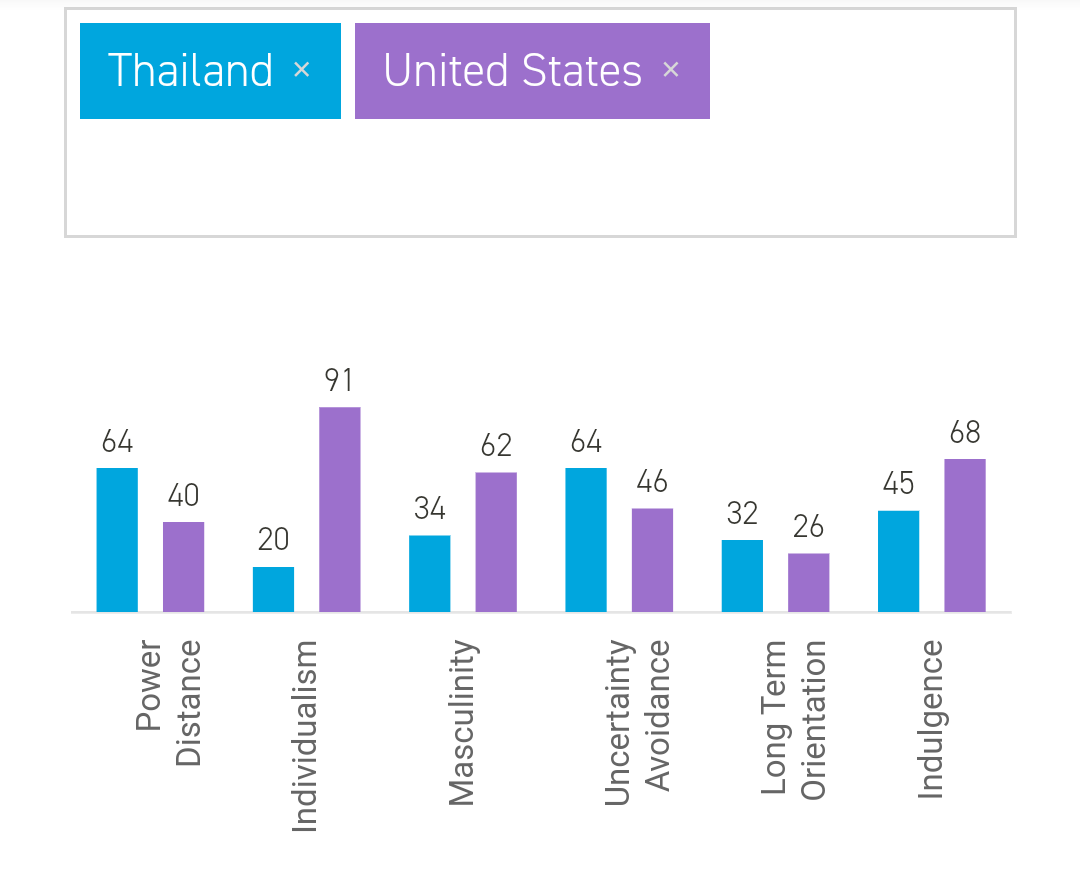
  1. The following generalizations are exactly that. Individuals vary widely, and many people, both Thai and US American would likely differ from these trends. Still, it seems to me that there are interesting differences on average worth examining in the social and moral systems of US American and Thai people.
  2. These generalizations are based on third-party studies. Though in many ways these trends present themselves obviously here, I’m not going around and questioning Thai people about their political and social beliefs. I’m a foreigner and a tourist, and it just isn’t really appropriate table talk, especially given the government. I’m using the Hofstede Cultural Index (HCI), as compiled by hofstede-insights.com. Geert Hofstede has received criticism for over-attributing differences to nationality and ethnicity, and those criticisms may not be entirely unfounded. I’m honestly less concerned with the validity of the specific trends than I am with the concepts of cultural imperialism and moral relativity.
  3. I’m not alleging any racial differences in belief systems. Southeast Asian cultures developed distinctly from European cultures, and different conditions led to the development of different belief systems. Thailand, in particular, has never been a direct subject of any Western nation (though it, like the rest of the world, listens to Western music, wears Western clothes, and genuflects in the Burger King’s court).

With all of that said, there are a couple of key differences between US American and Thai attitudes worth examining:

  1. Thai people are more willing to accept inequality of power and resources, given that they feel they are being appropriately cared for. Thailand, for all of its smiles, boasts the greatest wealth disparity of any country in the world, according to a report by Credit-Suisse. Other reports put it closer to the center; I’m not sure who to believe. But regardless of material conditions, HCI suggests that these cultural attitudes trend.
  2. Thai people accept a more rigorous social order, with seemingly more rules and regulations concerning individual behavior. I’ve certainly found myself dedicating a lot of energy to avoiding offensive behaviors: no shoes inside, no public displays of affection, modest dress (no short shorts for this boi), and never point your feet at the Buddha. But it’s difficult to compare the burden of rules, especially with your native culture. There are new customs and taboos anywhere you go, and they always feel oppressive. A Thai person visiting the US may find themselves retraining their middle finger to avoid offense. Still, HCI suggests that, in general, Thai people accept more restrictive laws and customs. Did you know that porn is illegal here? Did you know posting about pornography is illegal here? I hope this post doesn’t cross a line, and I’m sure glad we can all agree that porn should be illegal.
  3. “Masculinity,” questionably defined as “a preference in society for achievement, heroism, assertiveness, and material rewards for success” is less important here, with a preference for compassion, cooperation, and modesty. While I reject the notion that masculinity and femininity are antonymous and defined as such, this trend is very much in accord with my own beliefs. Men here are just lovely. More about this in a later post.

I’ve always been in favor of self-determination, the preservation of cultural autonomy worldwide. But, as a leftist, anti-imperialism is easy when your country consistently forces right-wing values on other people. I think a part of me assumes that, left to their own devices, people worldwide would eventually arrive at the same values as I have. But that just might not be true. If people feel that their political needs are being protected by a benevolent dictatorship, is that so bad? If women are okay with being told to cover up before entering a temple, if admitted at all, is that restriction unacceptable? Widespread female support for female circumcision (not a Thai issue) offers a particularly troubling example, one for which the research was a bit too unsettling for this already queasy traveler’s stomach.

For me, above all else, the alleviation of human suffering (or rather, of all sentient beings) is the most fundamental good. I’d decided my own moral system offers the best hope of doing so. But the reality is that I don’t know if that’s true. I’m not presenting counter-evidence here. But it’s certainly conceivable that people would be willing to surrender certain personal freedoms to achieve stability, happiness, or whatever their moral predilections required. Inequality may be tolerable if accompanied by an adequate and sustainable social safety net. Not to mention, the alleviation of suffering might not be a universal measure of good. If the US military invented time travel and forced ancient Rome to renounce their gladiatorial traditions and routine slavery, would that be cultural imperialism? Perhaps eventually, science, philosophy, or something else will unveil some even greater moral good.

For now, I think the closest a moral good can come to universal is the alleviation of suffering (the most fundamental objective of Buddhism). What constitutes suffering is complex and personal, but what defines it is perhaps the simplest moral definition: it just feels bad.

I think the Platinum Rule is the best maxim we have: Treat others as they would like to be treated. Believe them when they tell you what that means. When faced with conflicting desires, I hope to choose utilitarianism, the satisfaction of the most beings.

On a societal level, this is even harder than it sounds. Some women in Saudi Arabia may have no issue with being forbidden to drive, while others may yearn for the open road. Some Native Americans understandably take offense at the name of the Washington Redskins, but the majority seem to be indifferent, if not supportive. In resolving our own conflicts of interest, Anna and I frequently rely on a scale of 1-10. Last night, I was a 7 on going to get a drink at another bar. Anna was a 9 on staying put. So we settled in and ordered another drink. This practice suits us well, even with higher stakes. We’re always adjusting our methodology and adding new tools for decision-making and conflict-resolution.

I’m hopeful that the people worldwide grow to concern themselves more with the alleviation of suffering and maximization of happiness, and that we find better ways of quantifying these metrics. Until then, you do you, Thailand. Screenshot_20200106-174520~2

Chiang Mai: Day 2

Well, the jet lag is starting to get to me. By the time I was resting and finishing up my last post yesterday, I was not in a good place. I’m sleep-deprived, hungry at all the wrong hours, and just generally a grouch. I’m very lucky that I ended up with such a kind man, because otherwise we would probably be in a fight right now. But Aaron is patient with my moods, and was actually very sweet to me while I grumped at him about everything. I took a few minutes to gather myself, then met him at a coffee shop.

Chiang Mai’s coffee game is on point. There are at least 3 coffee shops per block and all of them serve locally-grown, single-origin, artisan coffee and espresso drinks. It’s definitely been helpful for dealing with the jet lag, but it’s always a delicate balance with caffeine and grouchiness. I had reached my caffeine limit, so we set off for Wat Phra Singh.

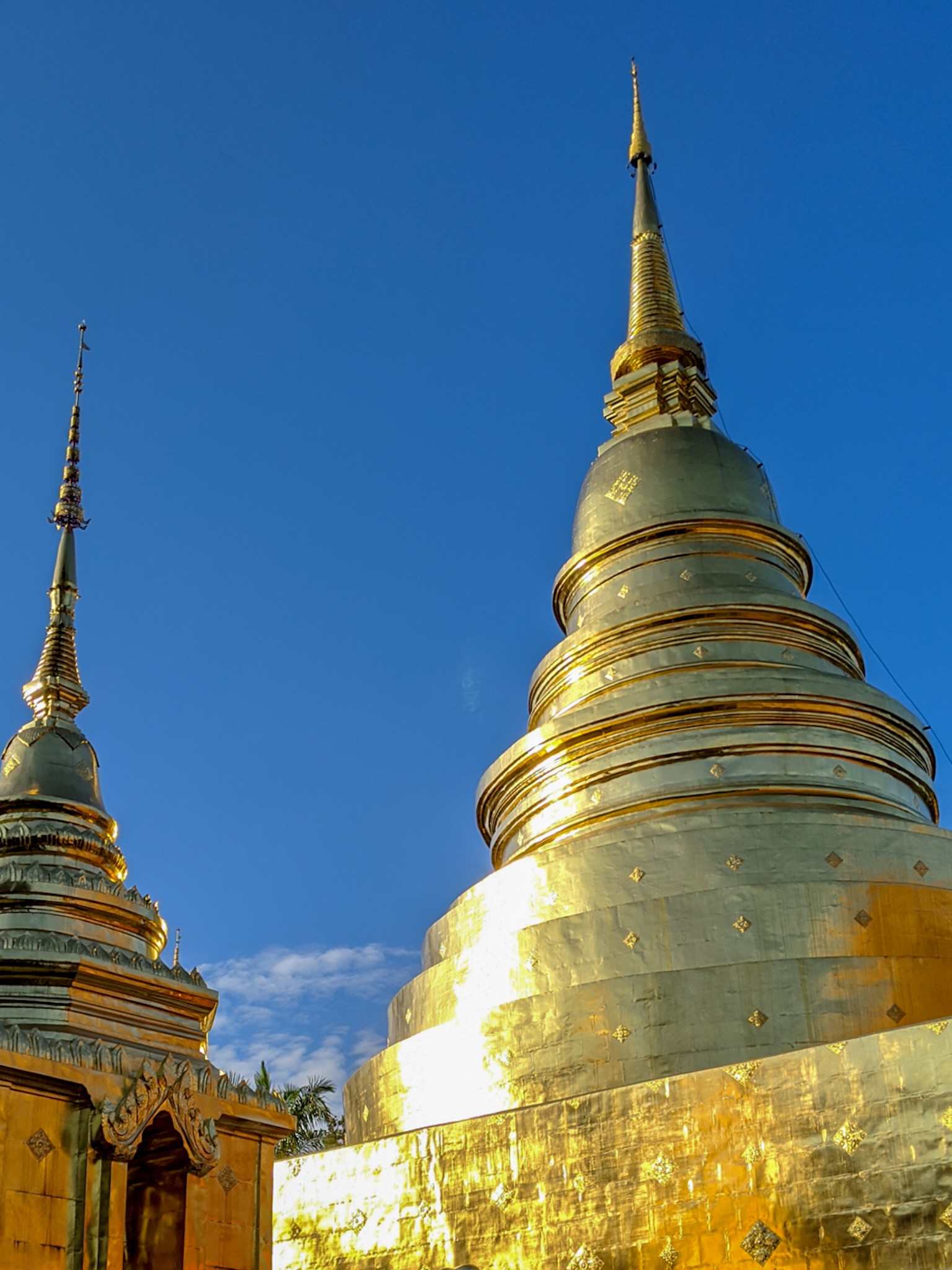
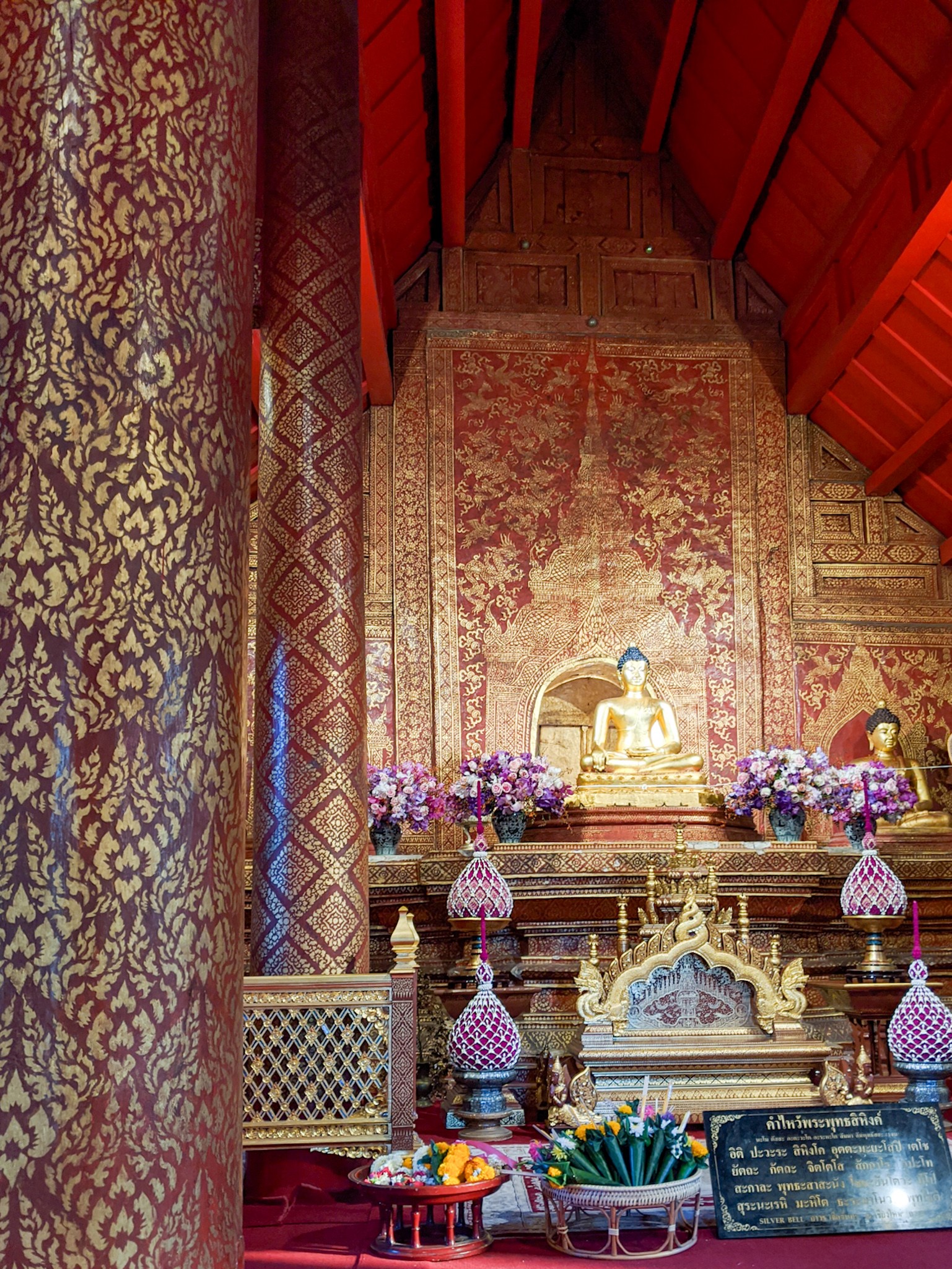
Wat is the Thai word for temple, and Wat Phra Singh is probably the most famous temple in Chiang Mai proper. It was been granted “royal temple of the first grade” status by a former king, which is basically like the 3-Michelin stars of Thai temple designations. It’s actually more of a temple complex with one large building and several smaller structures surrounding. However, the main attraction, arguably, is the gigantic, entirely gold-leafed chedi and it’s three smaller siblings. Either that or the Phra Singh Buddha, which is enshrined in a structure with gorgeous, centuries-old, hand-painted murals lining all of its walls. 

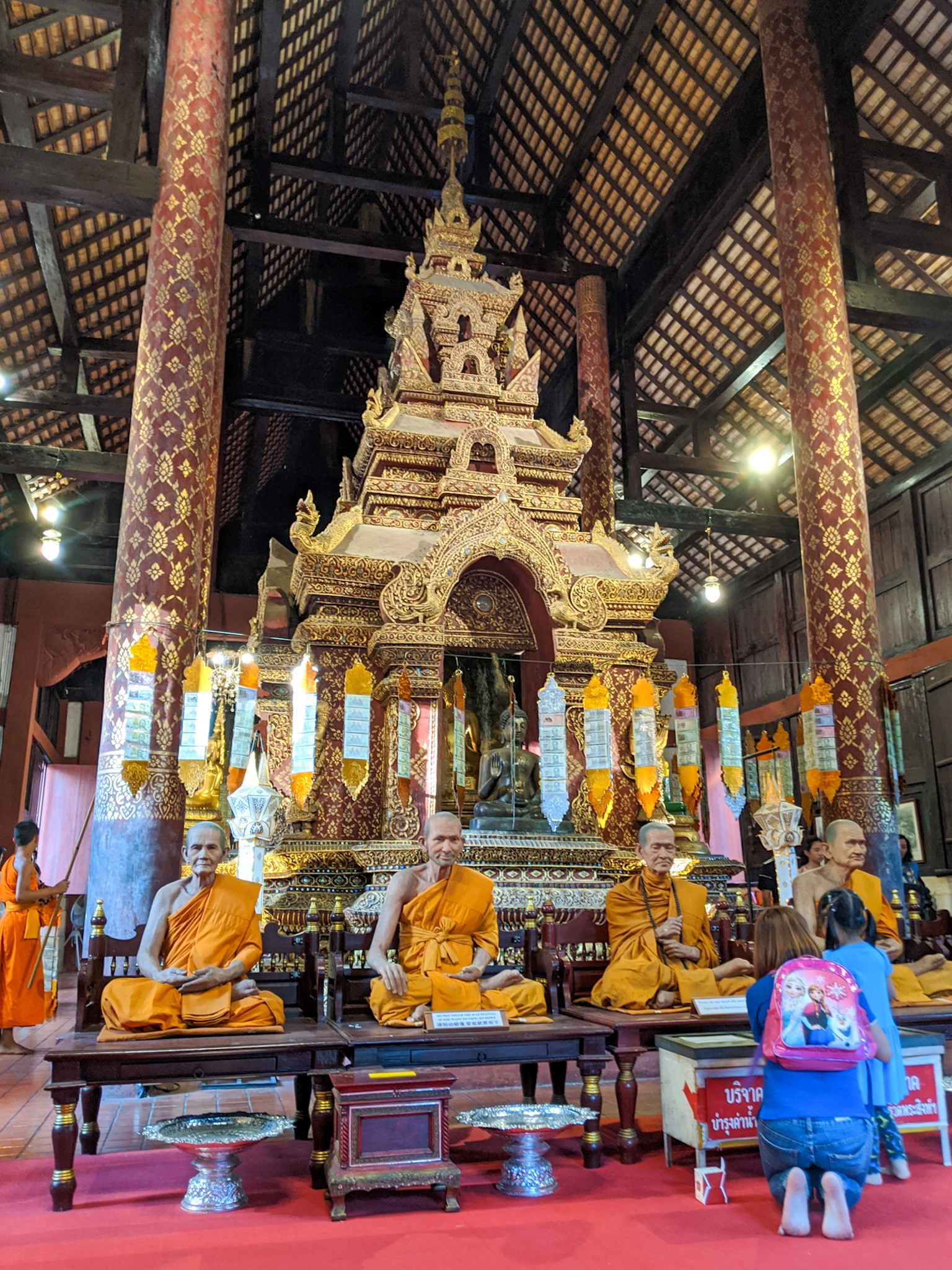
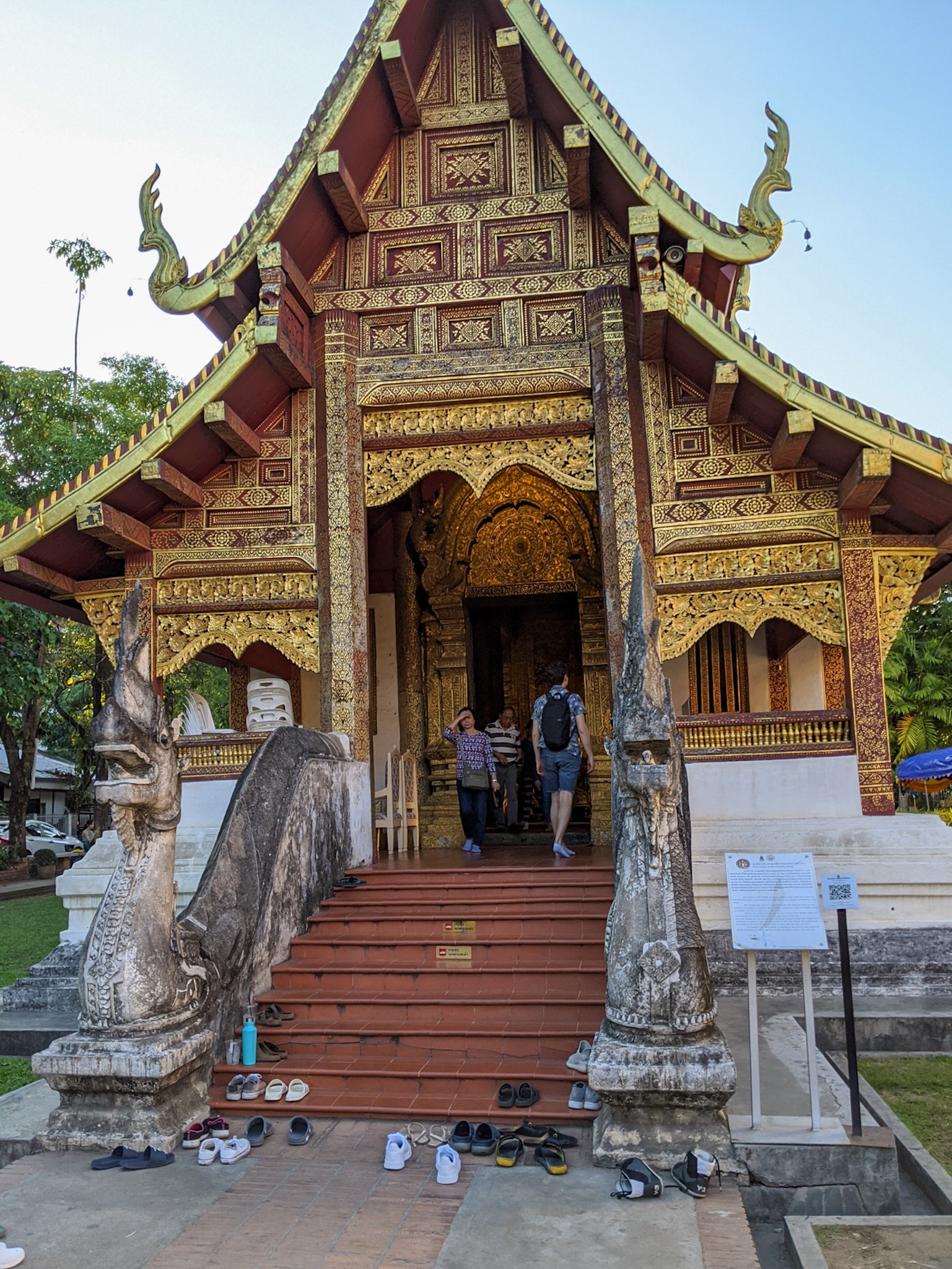
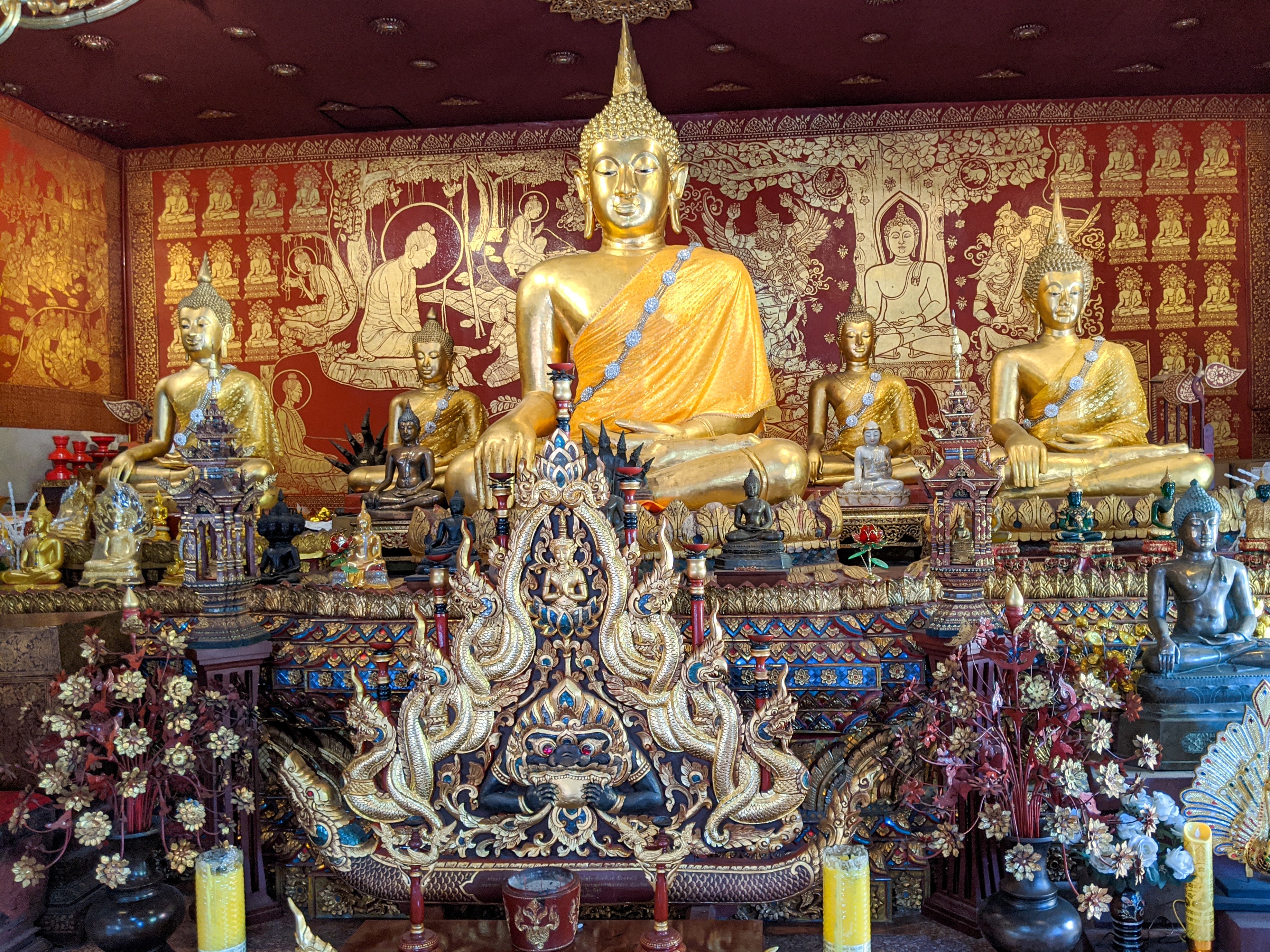
When Aaron and I came, we started by paying our respects to him. He is truly beautiful, even if shrouded in mystery (people are not really sure where the Phra Singh Buddha is from, what his significance is, or whether this statue is even really him; there are at least two other statues that claim to be the Phra Singh Buddha, and rumor has it this particular one’s head was stolen, but the temple hasn’t ‘fessed to it). We happened to arrive right as a service was starting, so even though we tried to do a quick meditation, I was a bit distracted by the loud-speaker. It became much more pleasant, though, when the monks began chanting. We visited an extremely large reclining Buddha in another structure and circled the enormous chedi while enjoying the monotonous Thai hum. Finally, we popped into the largest structure, where we were surprised to find four aged monks sitting side-by-side in a row, staring forward, placid and entirely still. Too still. “Are they going to blink or what?” I thought, as I approached. A sign told me not to touch them and that if I wanted to look at them, I would need to sit. And that’s when I realized they were wax, but not before pondering if they found it rude for people to stare while standing.

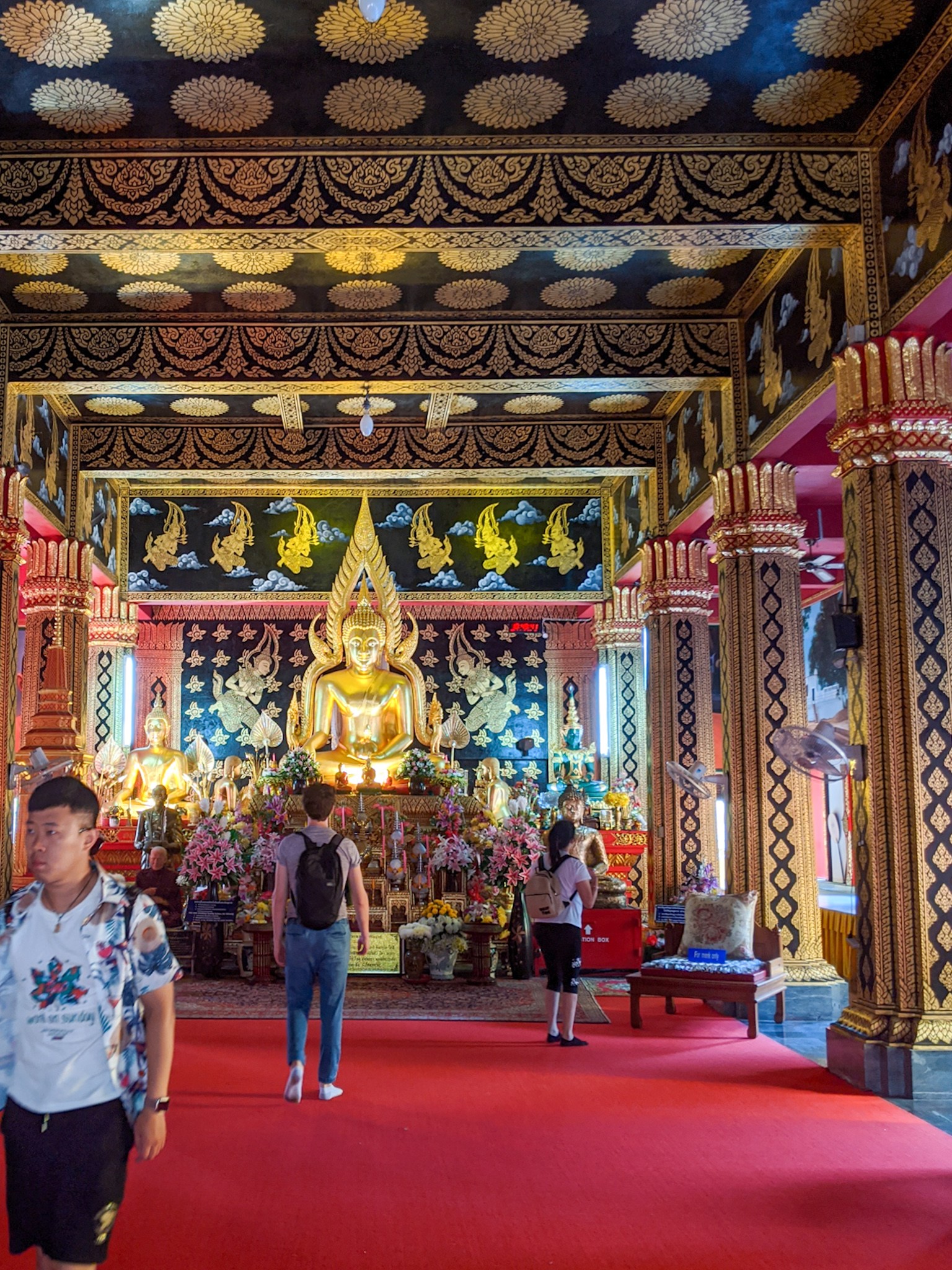
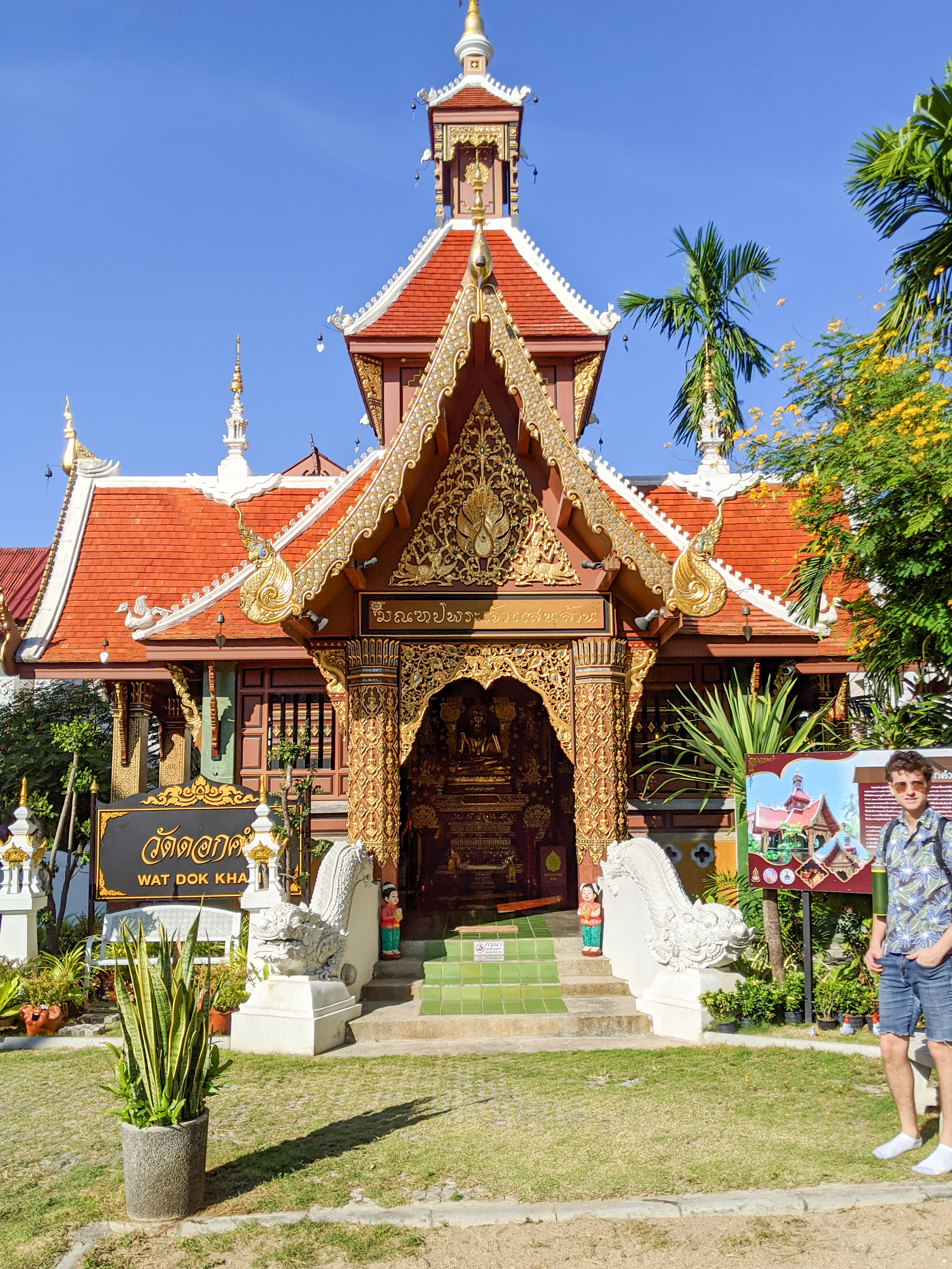
On the walk back to Awana House, we stumbled upon yet another temple. They are everywhere here. The only buildings more abundant than temples in Chiang Mai are coffee houses, and it’s pretty neck-and-neck. This one was empty, which was a relief after vying for space at the very crowded Phra Singh. We took a few minutes to meditate and enjoy the feel of the balmy late-afternoon air, then returned to our room to prepare for the evening’s events.
We had tickets to the Old Chiang Mai Cultural Center’s Traditional Khantoke Dinner Show, so we put on our nicer clothes and went to find a rot daang. Rot daang, or red trucks, are usually the cheapest way to get around in Chiang Mai. They are exactly what they sound like– red pick-up trucks– but the back has been converted to a covered seating area with a bench running along the length of the truck-bed on both sides. The front desk clerk told us to expect to pay about 50 baht, but haggling is common here, so I didn’t bat an eye when the first driver we approached quoted 100 baht. For a second, I forgot how haggling works and countered with 50 baht. The driver laughed and shook his head in a way that seemed to indicate he was pleasantly surprised that a white tourist was haggling with him, like I was a chicken that could do sums or something. “80 baht,” he said. “Erm, 50 baht?” I sputtered out, knowing I’d already messed up. This wiped the smile off his face. I had offended him. Whoops. Oh well. Move on to a different driver. But he was not to be deterred. He brought over another driver and asked him how much he would charge, which was, of course, 80 baht. I walked away embarrassed I’d failed at my first Thai haggle. Aaron was pleading with me to just pay the stupid 80 baht. But it was the principle of the thing! Our front desk clerk had said 50 baht! “You’re arguing over 99 cents, Anna,” Aaron reminded me, as another driver approached. Our last guy had been wrangling other drivers to tell them how crazy I was, and one tuk-tuk driver was prepared to go down to 70 baht. When I told him what our front desk clerk had said, he got upset. I was really botching this. Aaron looked at me, pleading, so I caved. On the way to the show, I googled what was a reasonable price: 100 baht. Sigh. My wounded pride. Not to mention these poor drivers who were just trying to make a reasonable wage. Lesson learned: google it first.
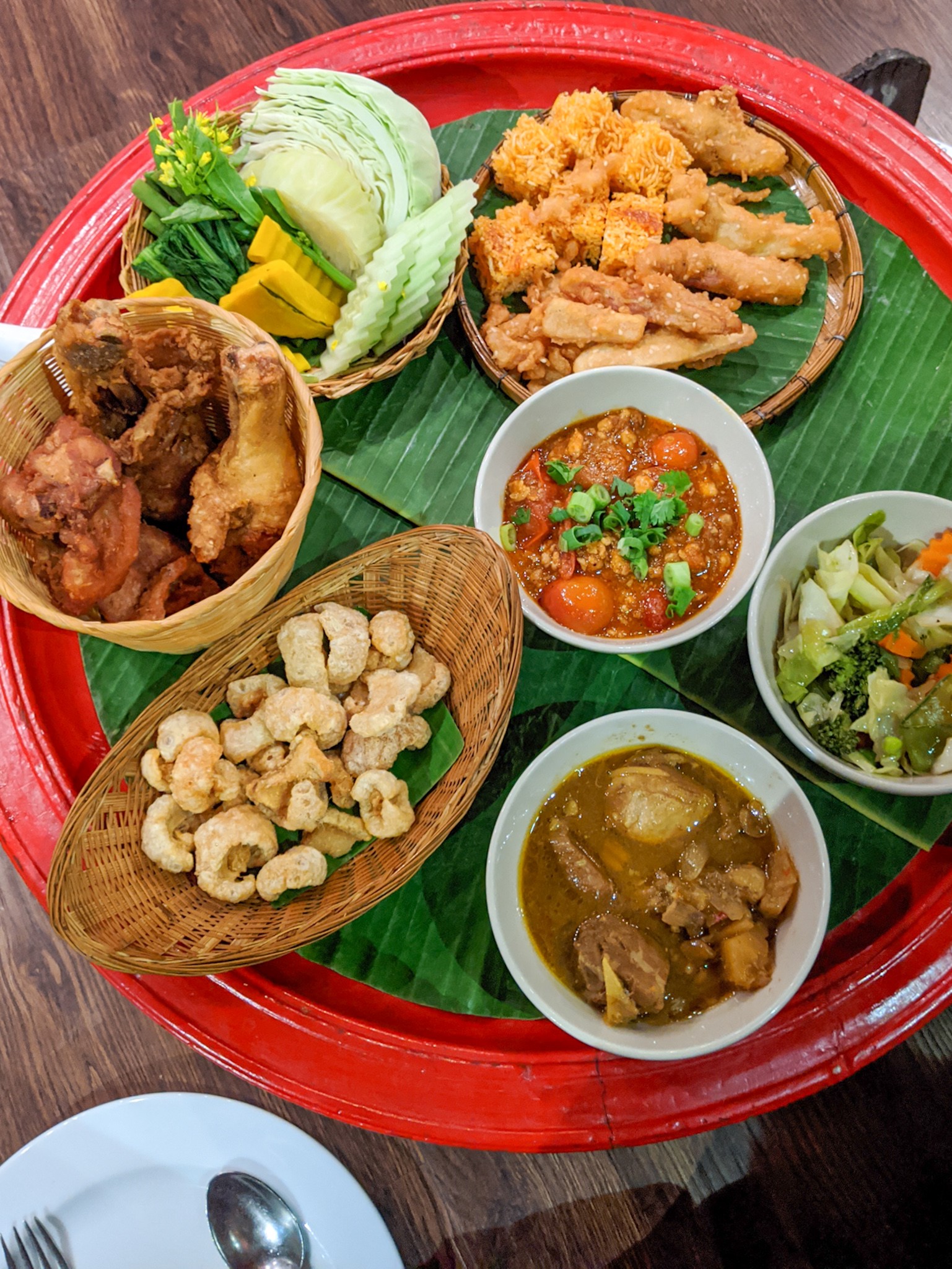
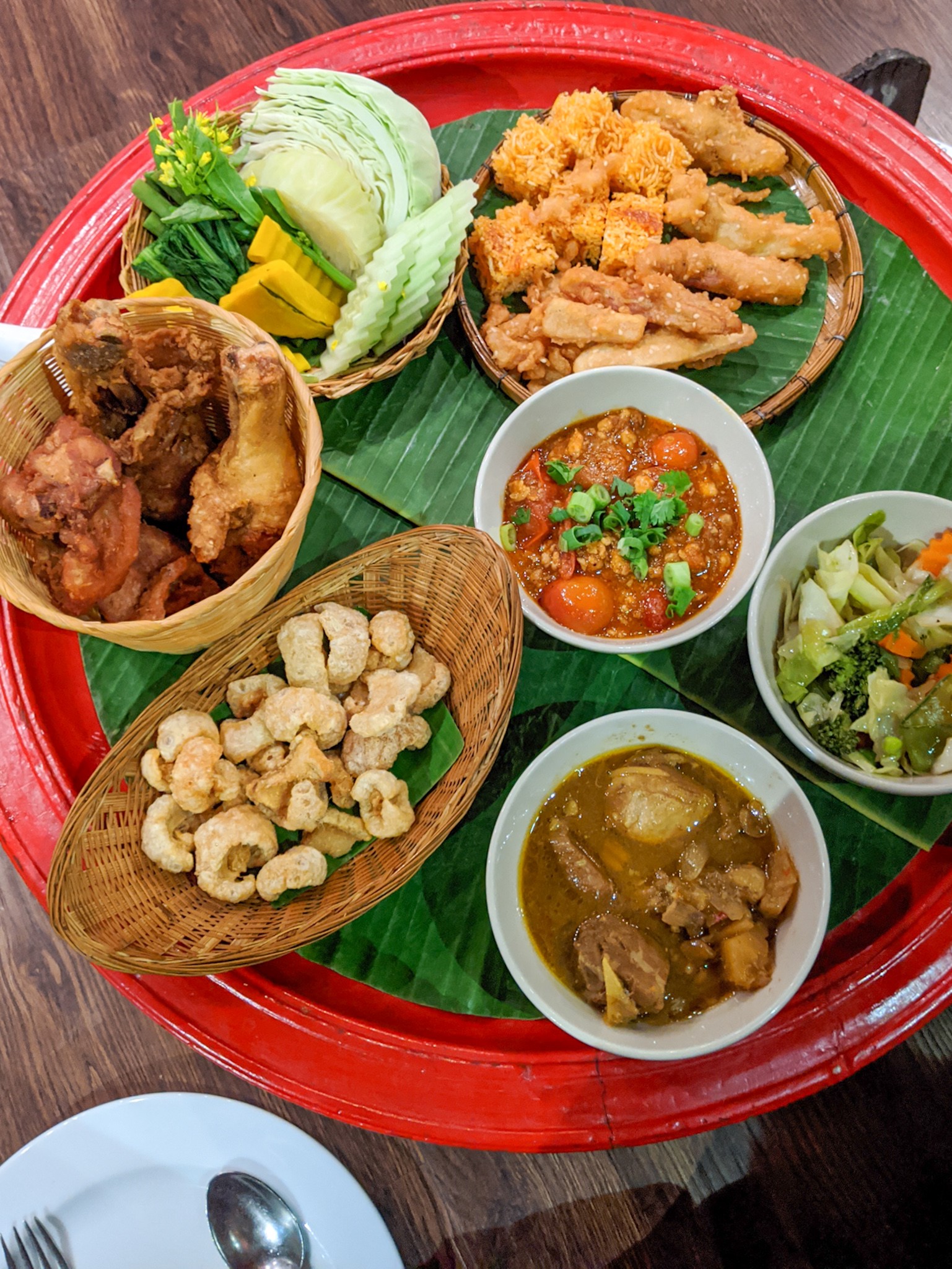
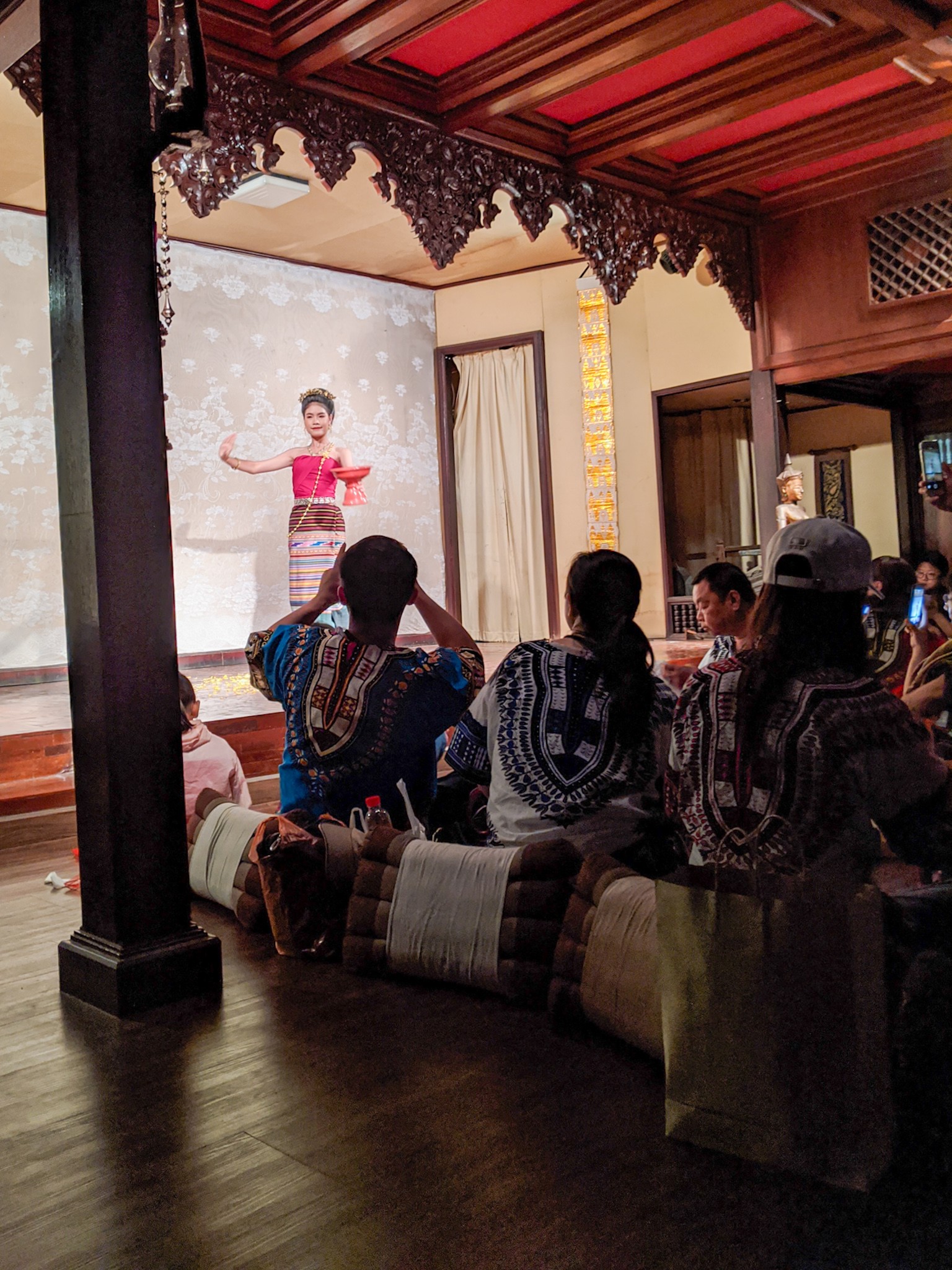
A somewhat tense tuk-tuk ride later, we reached the Cultural Center. We were greeted with a circle of dancers dressed in traditional Lanna garb, walking rhythmically to the sound of a banging drum. Lanna, by the way, is the name of the 13th-through-18th-century kingdom that spanned what is now northern Thailand, uniting several peoples under its banner. To call something Lanna, then, could refer to a lot of different time periods and peoples, but my understanding here isn’t very nuanced, so I won’t try to get too particular. We were led into a teak Lanna-styled room and given floor pillows to sit on. They then brought us a tray of Northern Thai specialties that I won’t even pretend to know the names for. Veggies boiled in a buttery broth, minced pork (I think– I don’t know: it was minced), beef curry, fried bananas, pork skin chips, and some sort of chewy, sweet, rice noodle cubes. Well, I could name one of the dishes, actually, because I’m pretty sure fried chicken is called fried chicken everywhere. After dinner, the show began. A so-beautiful-I-thought-about-shielding-Aaron’s-eyes young lady performed intricate hand movements to the music of traditional strings and cymbals. She would dance several times throughout the night. Her dancing was much like ballet–controlled, feminine, graceful–but if the emphasis were on the hands and arms, rather than the feet and legs. Even her blinking was deliberate and slow. The male performer made a striking contrast. He performed several militaristic dances, sweeping his swords in broad twirls and leaping wildly. They shared skill and grace, though, and both were extremely entertaining. At the end of the show, the performers came into the audience and chose onlookers to perform in the final dance. The female dancer walked straight to me and wai-ed (a common Thai gesture of greeting and respect where you press your hands together and bow your head). I wai-ed back, both terrified and flattered to be chosen. After I’d embarrassed myself thoroughly (Aaron has a video if you insist on mocking me), we paid what I now knew was a fair fare of 100 baht to return to our guesthouse and slept.

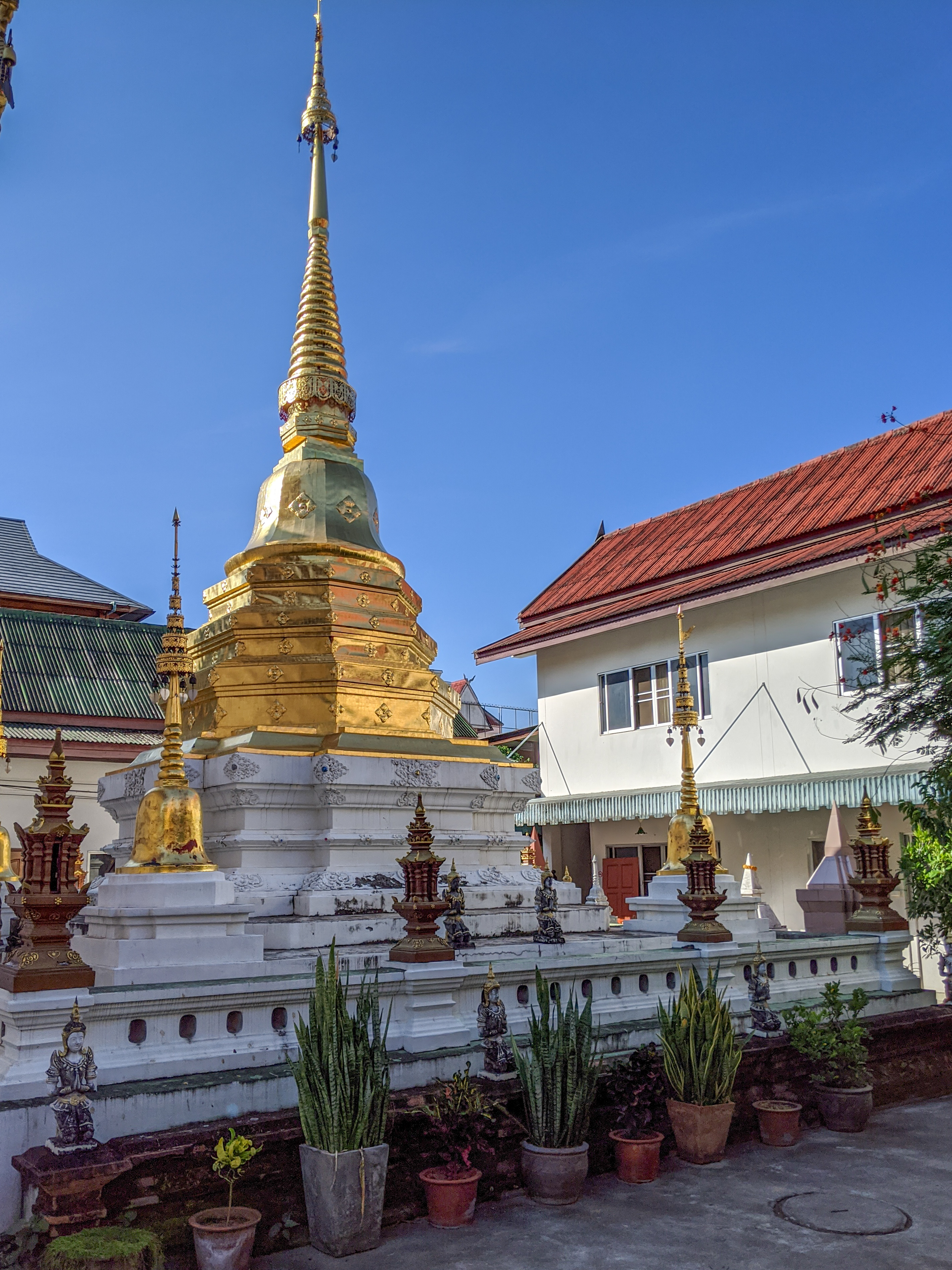
This morning, after another latte at Coffee Plus during which Billy the soi dog graced us with his presence, we stopped in Wat Phan Tao and another temple I didn’t get the name of, and ooh-ed and aah-ed over yet another couple of giant golden chedis. I think I might be getting a bit of chedi fatigue at this point. But Phan Tao also had a lovely wicker number that was a refreshing change.

After, we decided to make the journey to Sticky Falls, or Nam Tok Bua Tong if you’re a local. First, though, we would have to get some lunch in us, and we knew exactly where we wanted to do so. Khao soi is the local dish to try in Chiang Mai, and Khao Soi Lam Duan Fah Ham is the place to try it. The sesquipedalian-ly-named shop is in the northeast corner of Chiang Mai, an area known as the khao soi ghetto because of the abundance of khao soi hawkers. Lam Duan Fah Ham is, according to all the guidebooks, the best of them. Getting there was an adventure in itself, since (parents, please skip the rest of this sentence) Chiang Mai has very few stop lights, crosswalks, or even sidewalks, and everyone drives a bit crazy. But we managed to make it there in one piece. Or at least, we think we did. It didn’t have any signs in English, but Google Translate assured me the Thai on its sign read “Lam Duan Fah Ham.” This khao soi was my favorite dish I’ve had so far on this trip. Coconut milk, yellow curry spices, pickled mustard greens, lime, shallot, and rice noodles stewed together to form a salty, savory, sweet, sour, and very, very, VERY spicy soup. Did I mention it’s spicy? It’s very spicy. Aaron and I were both sweating and taking frequent breaks for water, but I couldn’t stay away long because it was so yummy. I finished Aaron’s for him because it was too spicy for his palate (more evidence that women have a higher pain tolerance), and we walked back to the main road to flag down a rot daang.

And that was day 2. Tomorrow, I’ll tell you all about the Sticky Falls we visited and may even explain what the Sticky Falls are. 

Chiang Mai: Day 1

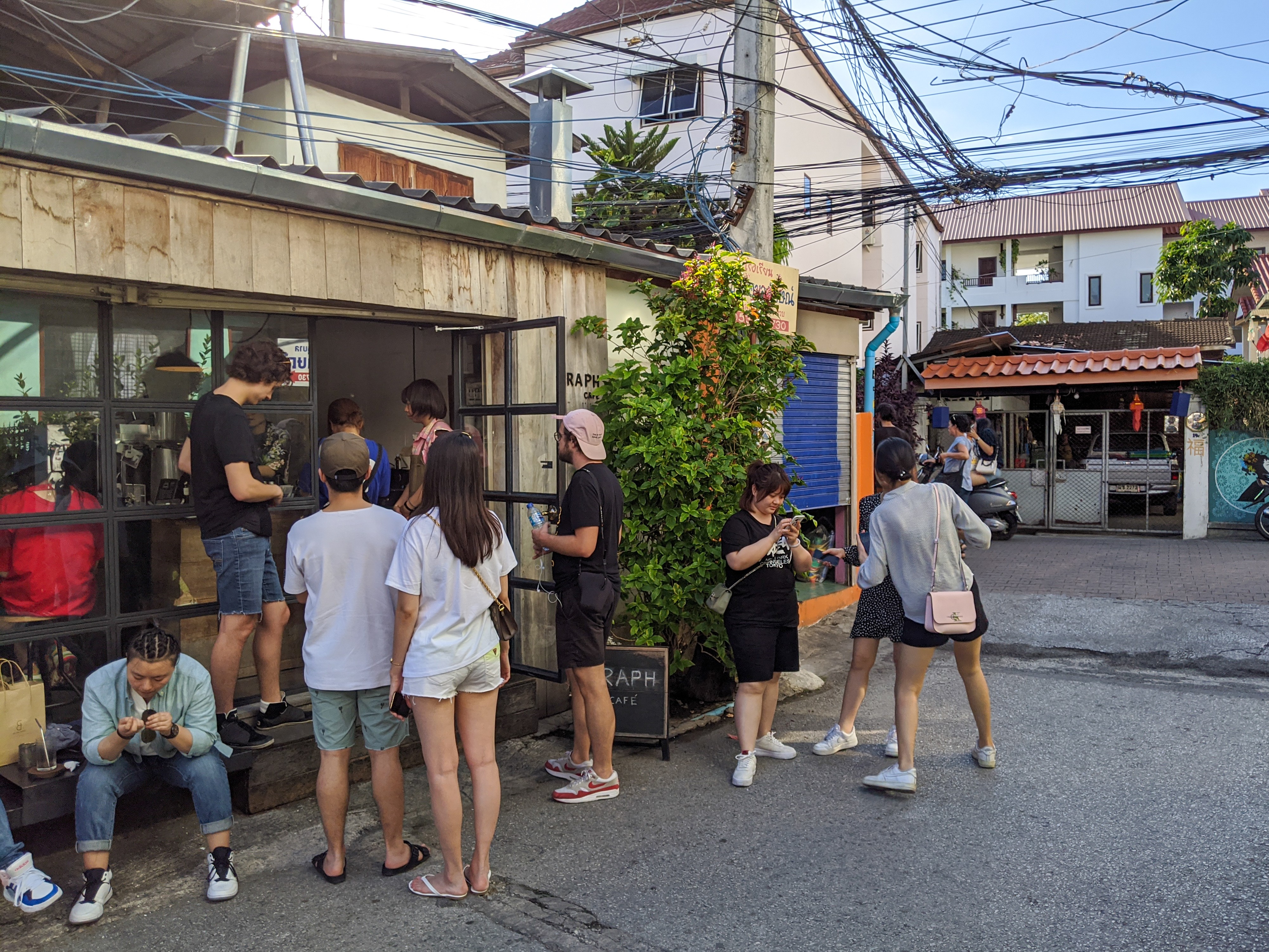
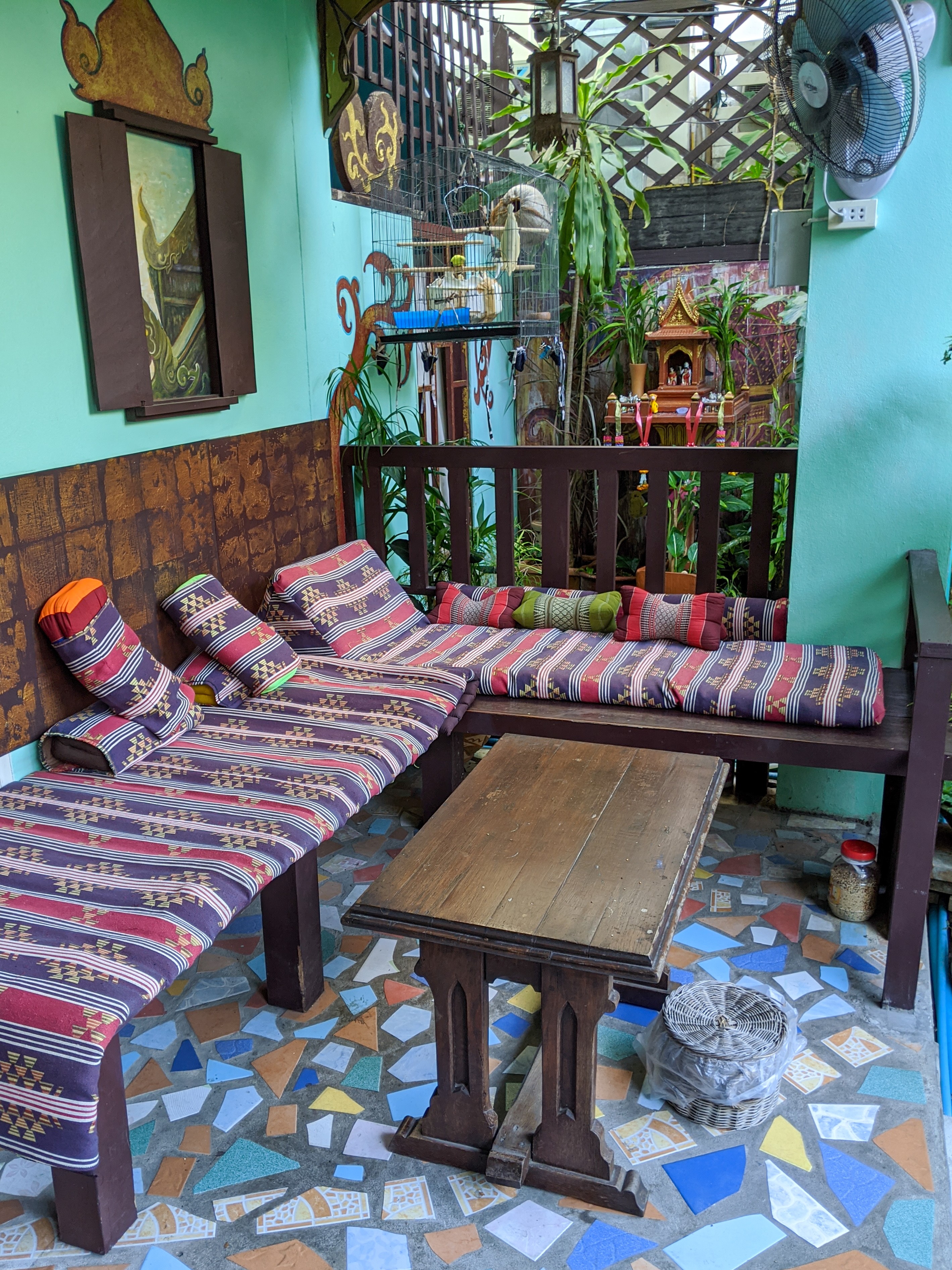
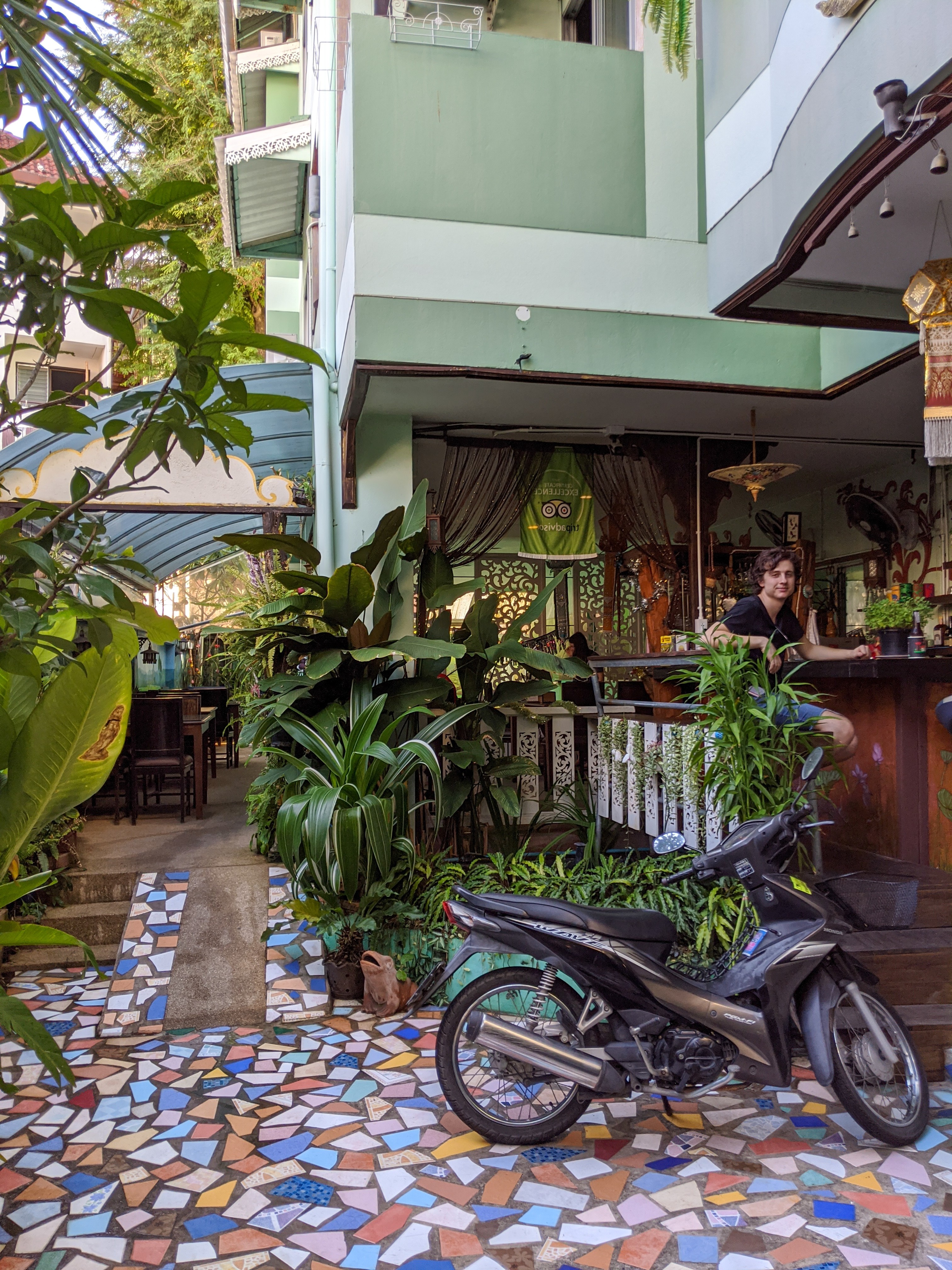
We landed in Chiang Mai exhausted and fussy. After a brief spat about whether our taxi driver was trying to rip us off (he wasn’t and I’m an idiot who can’t convert currency), we were taken to our guesthouse. A gated wall surrounds the Awana House, so we got a bit of a reveal moment when we walked into its courtyard. A white wire cage with two bright budgies was hanging over some corner benches adorned with piebald throw pillows. To our left, a wooden bar, with a small concrete pond behind its stools. To the back, a swimming pool with a tropical mural painted around it. It wasn’t fancy, but it was perfect. We smiled at each other and instantly forgot that we were exhausted and fussy. But I was hungry and we were both eager to take in more of the city, so after checking in we set off for Graph Cafe in the hopes of getting a snack and some much-needed caffeine.

There was a study I read about a few years ago examining the aromatic profiles of cuisines from around the world. The researchers found that there were two kinds of flavor palettes: analogous, which drew from aromas that have many chemical components in common, and contrasting, which drew from aromas that have few in common. French food, for example, uses an analogous palette. With its butter and chicken and cream, it draws mostly from the savory arc of the flavor wheel. Thai food, on the other hand, is contrasting. Basil and mint are mixed with ginger and chiles, fish sauce with lime juice, coconut with kaffir. Thai food relies on this melange to provide balance and interest to its dishes.

This is Chiang Mai. Not just its food, but its architecture, its smells, its people, its colors. It is lush, it is vibrant, and most of all, it is contrasting, in the same sense that a color or flavor palette may be. Interest and balance comes from the fact that it draws from opposite arcs of the life wheel. Restaurants are decorated in a jewel-toned rainbow, with splashes of bright pink or pastel yellow. Tin-roofed ramshackle guesthouses sit next to glossy modern spas and across from centuries-old temples. As we walked down one of it’s many winding lanes on the way to Graph, every few steps brought a new smell: the smoke from the barbecue of an open-air food stall, the spices of a curry, the intoxicating scent of jasmine, and a thousand other smells we couldn’t identify. Occasionally we’d catch a whiff of the city garbage smell that’s common in tourist areas around the world (if you’ve ever been to Bourbon Street or Times Square, you are well-acquainted with it), but it was always quickly replaced by herbs or grilled meat. Even the birds were contrasting. Tropical bird twitters harmonized with cooing pigeons and a very insistent rooster. And everything was verdant. In fact, going forward, imagine the gaps of every description I give in this post filled with palms and ferns and bromeliads.

Graph was an industrial, minimalist hole-in-the-wall (and yes, this, too, was a bit of a contrast). A floor-to-ceiling window with thick black grilles served as the shopfront for the garage-sized cafe. Inside, the couple of tables that could fit were overfilled with people, and outside was a large group of loiterers waiting for their coffee. The menu was ambitious. Specialty drinks read like something out of a craft cocktail bar: nitro cold brew with orange blossom, latte with dried banana and cocoa, activated charcoal and vanilla with espresso. But it exceeded my expectations.Aaron and I agreed that our drinks were, as they say here, arawy (delicious). No food to be found except a small brownie, though, so we made our way back to Awana House and its restaurant.

After a yummy (and amazingly cheap) meal of stir-fried chicken with holy basil and chilies with a side of peanut-y spring rolls, Aaron went off to find a barber and I settled in to unpack and nest a bit. Our room is small, but romantic, with white sheer curtains framing the bed’s canopy net and dark wooden furniture. After several days of travel, it was both nice and necessary to set up a bit of a more permanent space for ourselves.

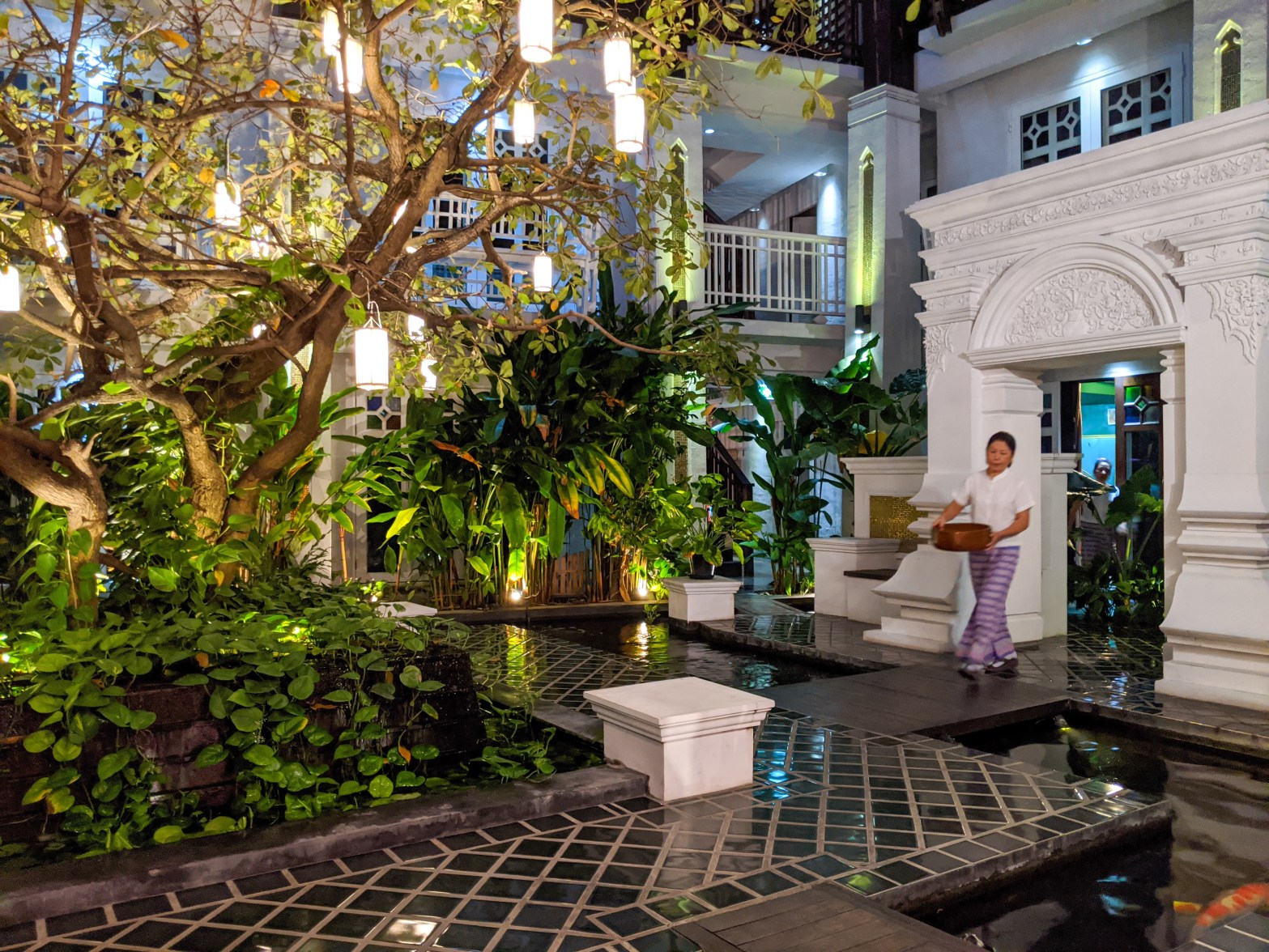
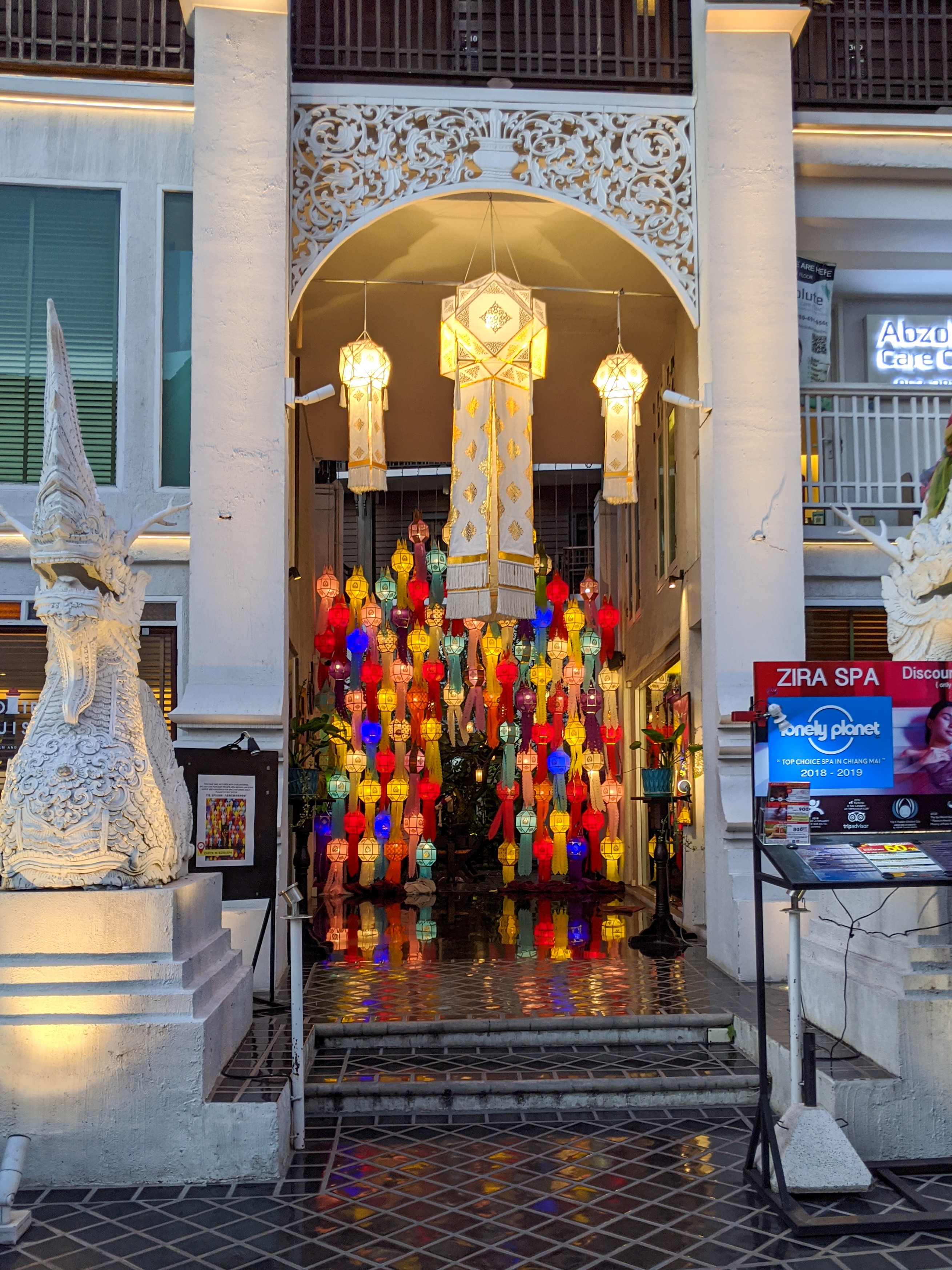
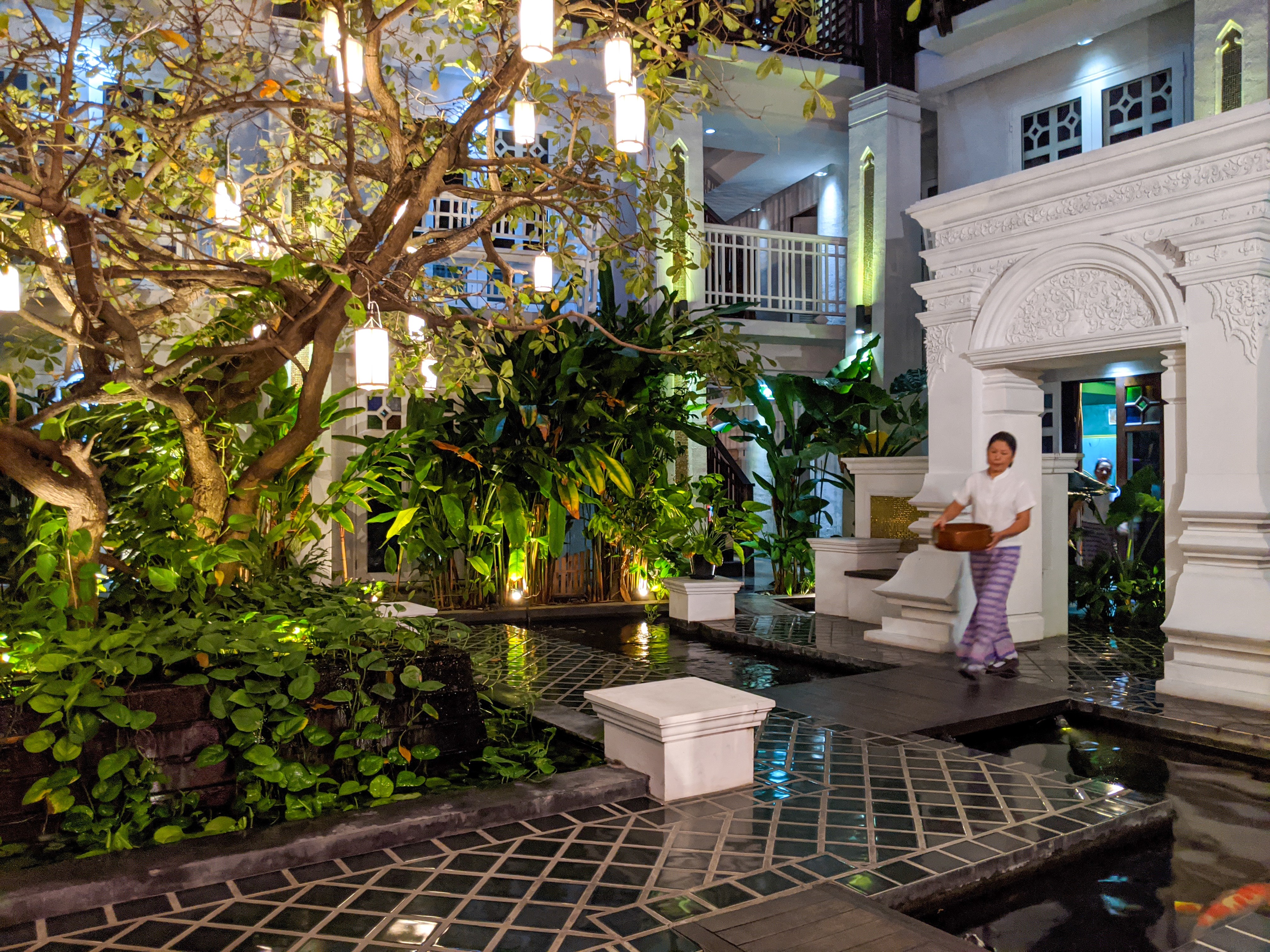
A haircut later, we walked to our appointment at the spa. I had booked us massages before the trip, knowing we would be cramped and tense from riding in airplanes for three days. I was more right than I could have predicted, so we were both extremely ready to be a bit pampered. Zira Spa was a grand, all-white complex with twin dragon statues guarding either side of its entrance. We were led through an archway of lanterns into an edenic, open-air courtyard. A tree hung with tens of white lanterns was surrounded on all sides by a giant koi pond (giant here refers to both the pond and the koi) crossed with wooden bridge pathways. We were told to sit on a bench facing this idyllic scene, and large bowls of hot water infused with rose, lime, and I-don’t-know-what-else-but-it-smelled-heavenly were brought to soak our feet in. Two expert masseuses washed and massaged our feet with a salt scrub before we were led to a room in the back of the spa. When we arrived, the lights were off (side note: everywhere here requires a key card to be powered, which is actually a really efficient way of making sure the lights get turned off when you leave). The attendant who showed us to the room literally sprinted to go get the key card when he realized the mistake. We changed into some cult-like uniforms complete with weird knitted underwear and were greeted by the same masseuses who washed our feet. 

What I have not yet said was that the massages we booked were “traditional Thai” massages. I have had one once before, but Aaron had no idea what to expect. Thai massages differ from Swedish massages in a number of ways, my descriptions of which will surely give away my preferences. In my opinion, Swedish massages sort of push your skin around over your muscles. If you beg enough, occasionally the masseuse will work out a knot for you. Mostly, they are an excuse to put perfumed oils on you in fancy ways and charge you $200 for it. Thai massages, however, are intense. They are, at times, uncomfortable, and even, occasionally, extremely painful, but you can’t argue with results. The masseuses asked us to lay on our backs and went to work on our feet and legs. They were stretched, contorted, pressed, kneaded, and stretched some more. It’s like a combination of forced yoga and massage. They found pressure points I previously had no idea existed and worked out knots in muscles I didn’t know were cramping until they got to them. At times, the pressure was so much and the tension it was working against so great, that I squirmed my toes and exhaled sharply through my teeth just to get through the pain. But always, always, when they were done working with an area, it felt brand new. They moved from legs, to arms, to back, to neck. They pulled our bodies into pretzel-like contortions. They pounded, pushed and pulled us. I’m pretty sure my arms will be bruised from how hard she squeezed them. And I would do it all again in a heartbeat. I can say with confidence that I will never pay for a Swedish massage again. I’m embarrassed to admit it, but after such an eventful and prolonged journey to get here, the treatment brought tears to my eyes, and not from the pain. Aaron did not enjoy it as much as me (which he says is because his masseuse was harder on him, but I say it’s because women tolerate pain better), but he did love the afterglow. We checked out after partaking in some complimentary ginger tea and coconut custard pie: the entire one-hour treatment was only $20 each! 

Last on the agenda for the evening was a reservation at Ginger & Kafe, which we were extremely late for. Our massage ran a bit longer than it should have, but there are certainly worse problems to have. In fact, we were so late that they cancelled our reservation, but were fortunately able to seat us. To be honest, dinner was delicious, but unremarkable. We had wine and laap and soft-shell crab and it was all great, but we were oh so tired (we’re still jet-lagged), and we faded fast. We collapsed upon our return to the room. 

This morning, I woke up at 5:30am. My clock is slowly adjusting, but when I’m up, I’m up, so I spent some time writing this post and, once it was a more reasonable hour, meandered to a local coffee shop. Something notable about Chiang Mai is that it’s full of hidden courtyards. Every building has some sort of open-air, plant-filled space. You’ll walk into a store or cafe that seems somewhat unremarkable, only to be led by an extremely friendly (and they are all extremely friendly) attendant into a secret walled garden. Coffee Plus was no exception to this rule. In line for a latte, I made small-talk with a kind, Canadian man who enumerated the names and ages of the many soi (street) dogs that wander Old Chiang Mai. Billy, a white dog that is roughly Bob-sized-and-shaped (ugh, my heart) I’ve seen walking around with a little sweater on. Apparently, many of these dogs are sort of adopted by the street they live on, and on cold nights (or at least cold for Chiang Mai) someone will dress them. I headed into the florid courtyard. Aaron met me here when he woke, but unfortunately missed the moment when a monk came by collecting alms in the form of rice from the devout Buddhist owners (who were, by the way, extremely friendly). Once Aaron arrived, we had coffee together and agreed that Chiang Mai was paradise and we were going to have to figure out a way to live here someday (sorry, parents), then set off to saunter aimlessly. 

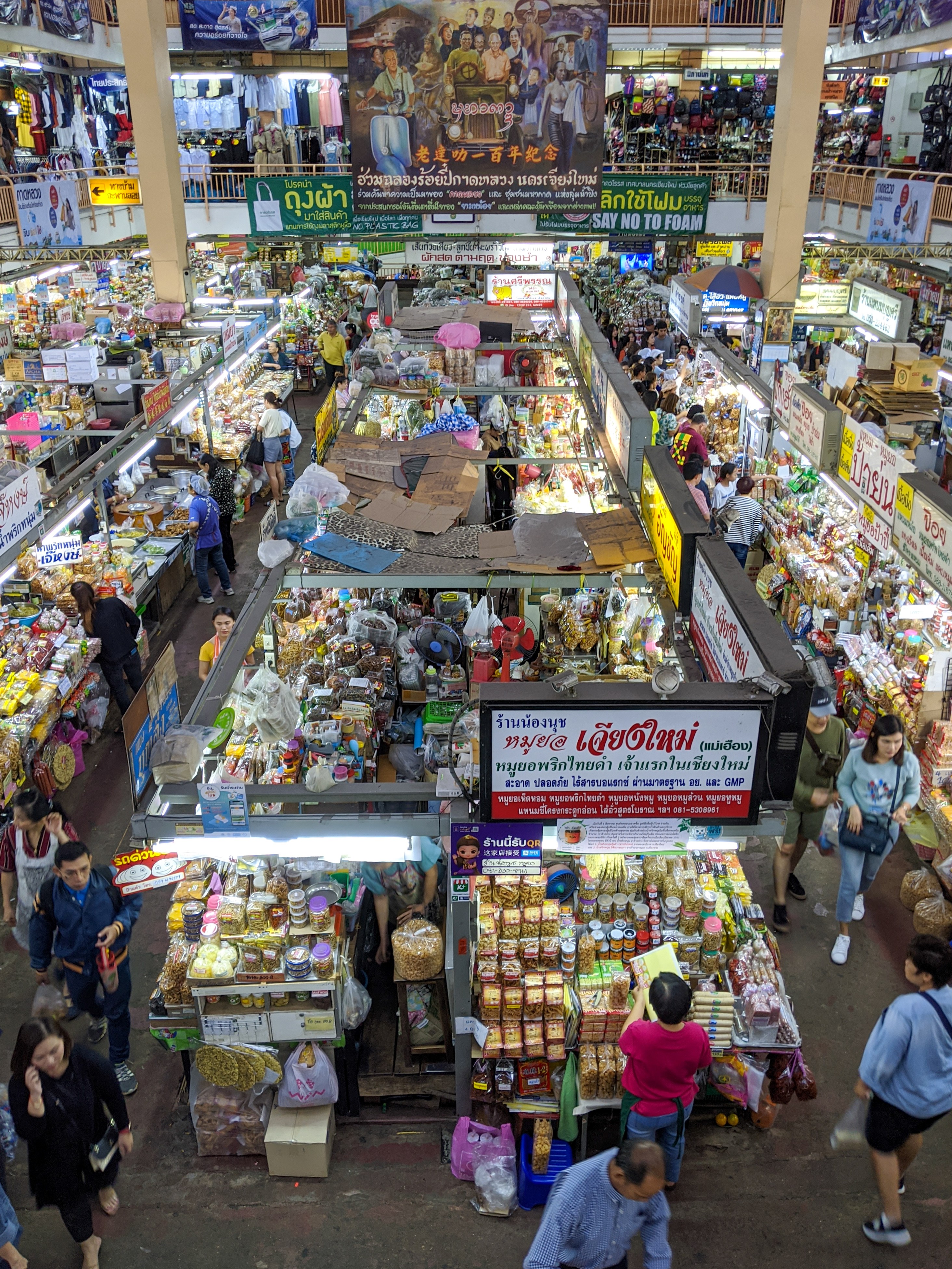
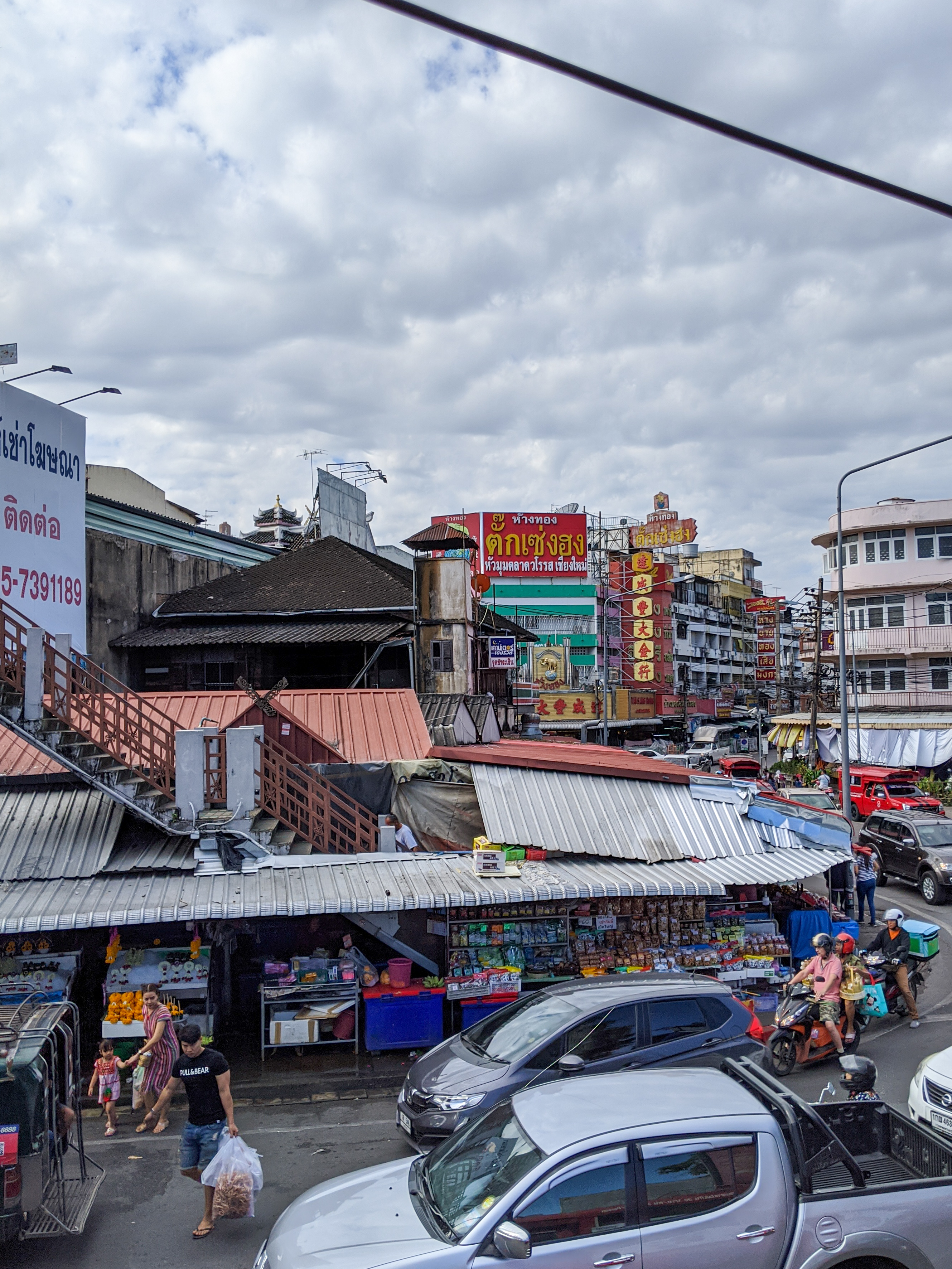
Well, not entirely aimlessly. We knew where we wanted to have lunch, but lunch was still hours away, so we decided to leisurely stroll our way to the restaurant and stop at whatever seemed interesting. Only three or four blocks into our stroll we happened upon a temple, replete with golden chedi and sitting Buddha statue. We took ten minutes for silent meditation, but cut it short when we heard a band marching down the street and decided to follow. We never figured out what it was, but no matter. A few more blocks down we winded through Talat Warorot, the central market. Hundreds of street vendors set up here daily, selling dried and fresh fruits, hand-sewn clothing and accessories, sausages, shoes, spices, and trinkets. Tourists and locals alike flock here for deals. It was sensory overload, so we bought some promising-looking fruit that Aaron thought might be ground cherries and crossed the Ping River to get away from the market crowds. 

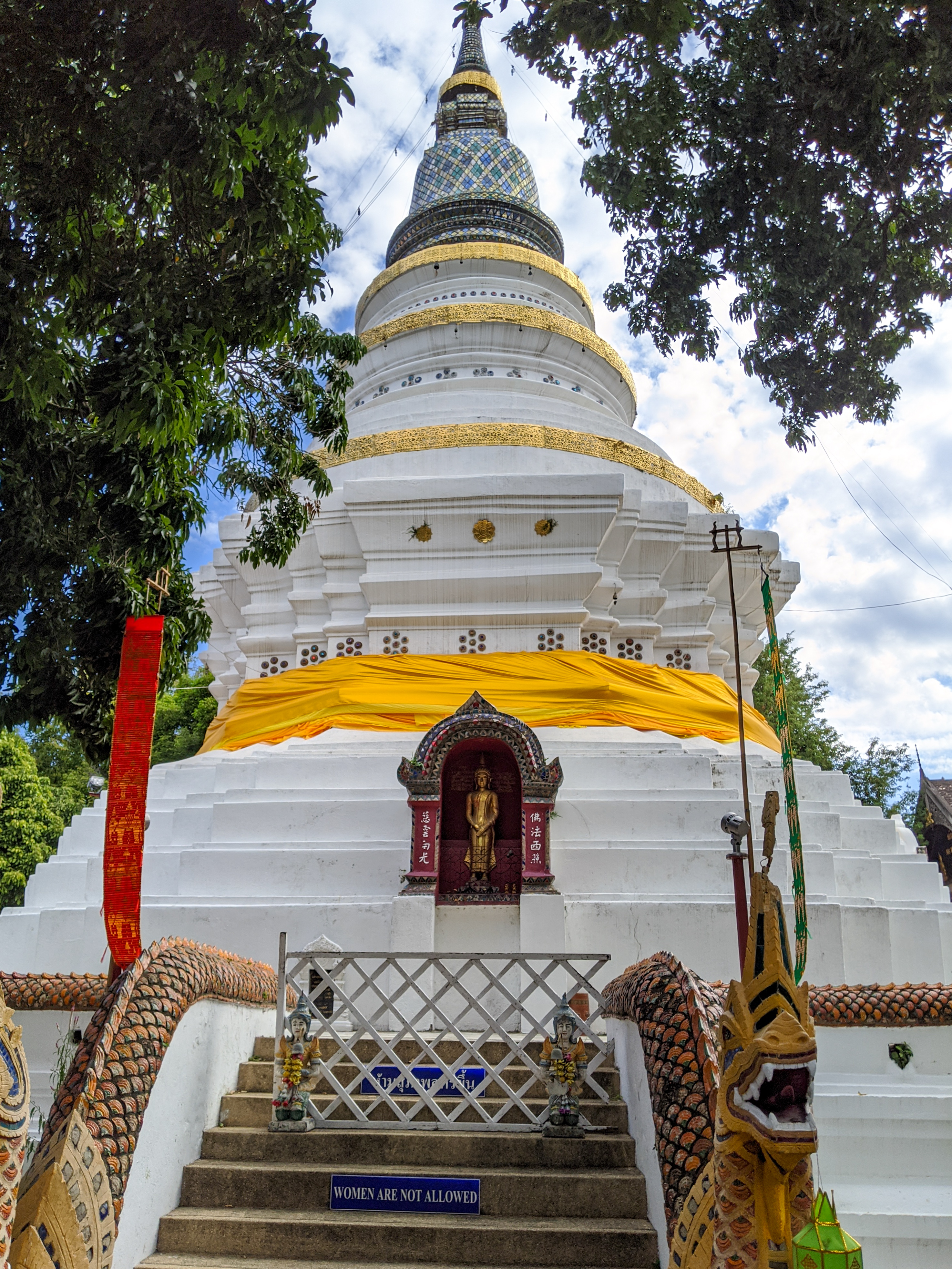
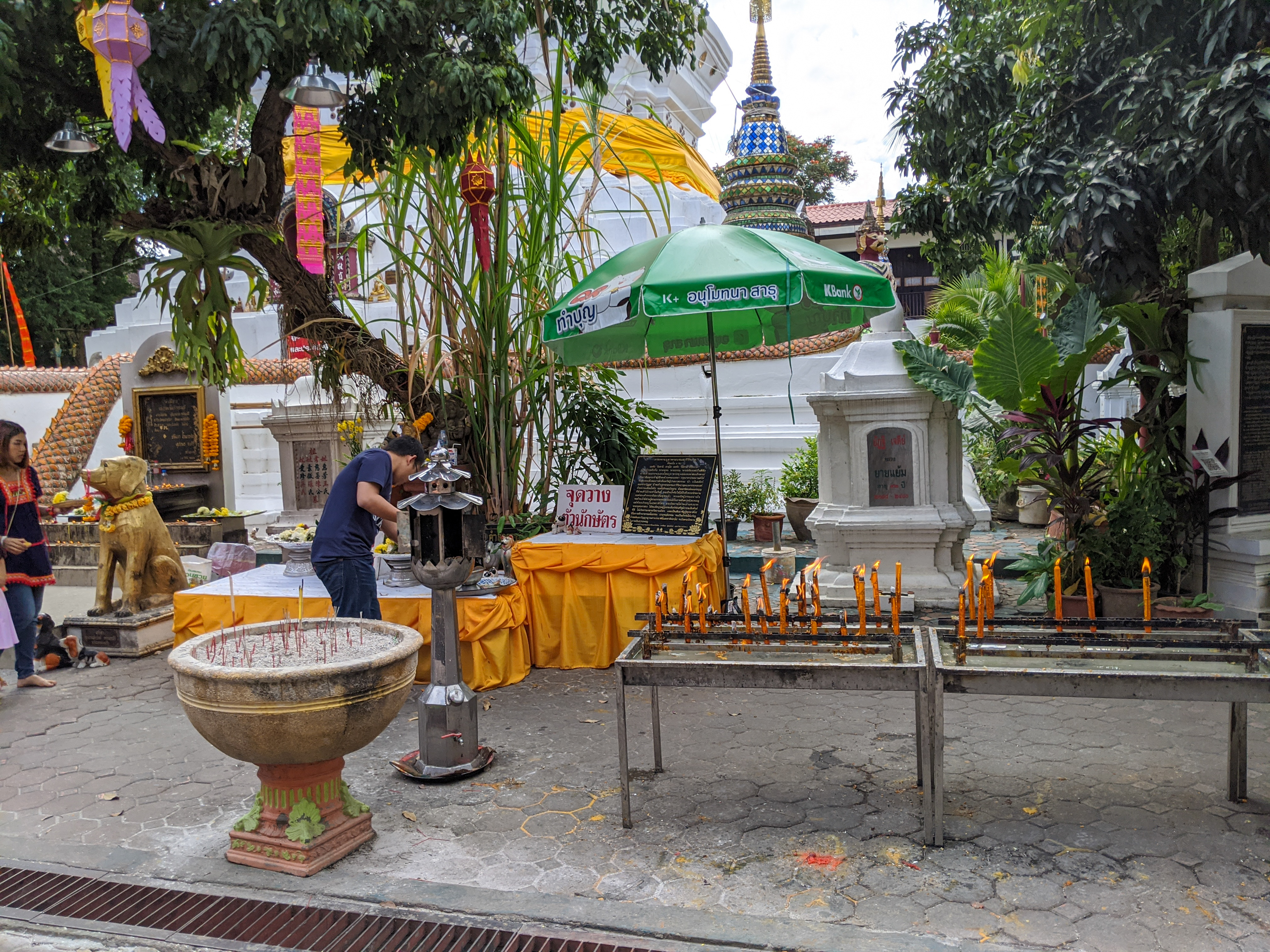
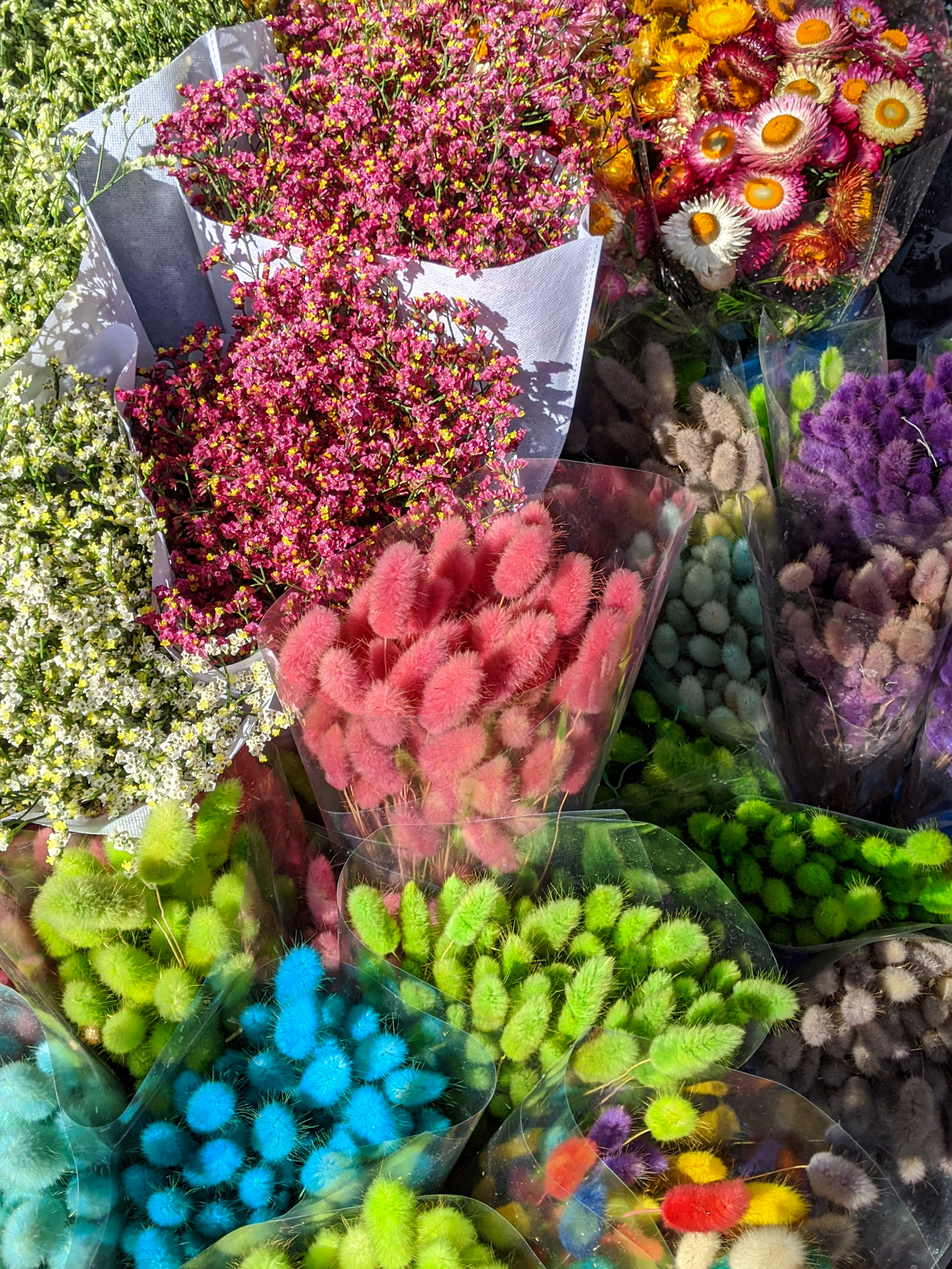
The bridge let out in front of yet another temple that wasn’t in any of the guidebooks. Sidenote: Chiang Mai is so full of temples that many of the giant chedis don’t even make it into the guidebooks. Incense burned in a cart in front of this particular chedi, and a sign told me that women weren’t allowed to approach it. In solidarity, Aaron refused to approach it, too. Whoever said chivalry was dead? We were thirsty, so we stopped in a little tea house that didn’t look like much. Of course, we were then led to the gorgeous secret courtyard in the back. After some refreshingly complex fruit tea, we decided to backtrack to the market, where we spent a lovely hour taking in the perfumes and kaleidoscope of its flower section. Finally, it was lunchtime, so we made our way back across the bridge once more to Woo Cafe, Market, and Gallery. 

Woo was a maximalist dream, with pattern and color everywhere. Our Chiang Mai sausages and chicken rice were to die for, and we gobbled them up greedily. Our waiter, who was still learning English, asked us how to pronounce “dessert”, and we, in turn, asked him to teach us to say “excuse me”, which I immediately forgot.  Finally, we returned to the hotel, where I finished this post. 

And that was day 1 of Chiang Mai. Forgive me if it was too much detail. I am writing this blog as much for me to remember as for you guys to keep tabs.

Design a site like this with WordPress.com
Get started